On this page
Keep enough cash at home to cover about three days of basic spending for your household, mostly in £5 and £10 notes and coins. Card machines, cash machines and banking apps all depend on power and data. The government's Be Ready kit list includes cash in notes and coins for this reason.
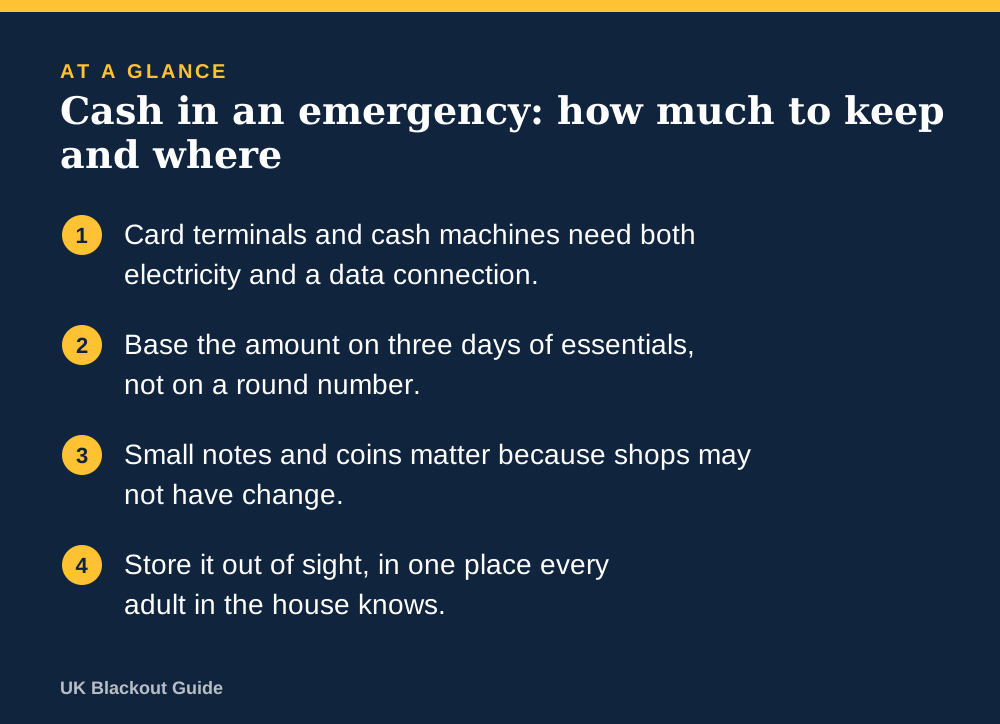
- Card terminals and cash machines need both electricity and a data connection.
- Base the amount on three days of essentials, not on a round number.
- Small notes and coins matter because shops may not have change.
- Store it out of sight, in one place every adult in the house knows.
Card payments stop when power and data stop
A card payment needs a powered terminal, a working data connection and the bank's systems at the other end. Lose any one and the payment fails. Cash machines have the same weakness, and why card machines go down in a power cut has the detail.
Two past events show how it has gone elsewhere, without saying anything about what will happen here. In Lancaster in December 2015, when a flooded substation cut power to about 61,000 properties, cash machines and card payments failed locally along with mobile and internet service. During the blackout across Spain and Portugal on 28 April 2025, card payments were widely disrupted and people with cash in their pockets found it useful.
That is why the government's Be Ready campaign lists "cash in notes and coins" in its household kit, next to the torch and the radio.
Work the amount out from three days of spending
There is no official figure. Be Ready asks households to be able to manage for three days, so three days of essential spending is the sensible yardstick.
Think about what you would really need to buy if cards were down: bread and milk, a few tins, nappies, a prescription charge, a bus or taxi fare, perhaps some fuel if a pump is working. If your three-day food store is already in the cupboard, the list gets short.
As a worked example, a household of four that allows £15 a head per day would hold £180. A single person allowing £20 a day would hold £60. Those are illustrations, not rules. Our answer on how much cash to keep at home walks through the sums for different households.
Hold small notes and a bag of coins
A £50 note is close to useless in a corner shop running without a till. The shopkeeper may be working from a notebook and a cash tin, with little change to give.
Ask for £5 and £10 notes when you withdraw, and keep a few pounds in £1 and £2 coins. Coins also cover things like launderettes and some car parks once power is back but card readers are still catching up.
Build the float gradually. Taking out an extra £10 or £20 with a normal shop over a couple of months is easier on the budget than one large withdrawal, and it matches the Be Ready advice to build a kit slowly.
Keep it in one hidden, known place
Emergency cash only works if you can find it by torchlight and nobody else can find it by chance. Pick one spot, away from the front door and not in the obvious bedroom drawer, and tell every adult in the house where it is.
A small lockable box, like those in our pick of home cash boxes, keeps notes and coins together and stops the money being borrowed for a takeaway.
Paper money burns and suffers in a flood. If you already keep passports and policies in a fire-resistant pouch (we list fire-resistant document bags worth a look), the notes can go in with them.
What cash cannot do
Cash solves the payment problem only. It does not open a shop that has shut because its lights, tills and fridges are off, and it does not work a petrol pump with no power, as we explain in whether petrol stations operate in a power cut.
So cash sits alongside your supplies, it does not replace them. A household with water, food and a torch needs very little money over three days. A household with nothing in the cupboard may find there is nothing open to spend it in.
Banking apps are a separate question. In a local cut they often keep working on mobile data for a while, and our answer on banking apps in a blackout sets out when.
Check the float twice a year
Count the money when you check the rest of your kit, which Be Ready suggests doing every six months. Top it back up if you have dipped into it.
Two quiet precautions are worth taking. First, read your home contents policy to see how much cash it covers at home, because many policies set a limit and the figure varies by insurer. Second, do not talk about the cash outside the household.
Keep a written note of your bank's phone number with the cash, alongside copies of the documents worth copying. If your card is lost or your phone is flat, you will still be able to ring them from any working line.
Checklist
Cash in an emergency: how much to keep and where
- Work out three days of essential spending for your household
- Withdraw it gradually in £5 and £10 notes
- Add a few pounds in £1 and £2 coins
- Store it in one hidden place every adult knows
- Check your contents policy for its cash limit
- Count and top up every six months
Common questions
Does the government tell people to keep cash at home?
The Be Ready campaign's household kit list includes cash in notes and coins. It does not give an amount.
Will cash machines work in a power cut?
A cash machine needs mains power and a data link, so machines in the affected area usually stop. Machines outside the affected area carry on, but may be busy.
Should I keep emergency cash in my grab bag?
A small amount in the bag is sensible if you might have to leave quickly. Keep the main float hidden at home so one loss does not take everything.
Is it better to keep a lot of cash in case of a long outage?
For most households, no. Large sums at home add theft and fire risk, and may exceed what your insurer covers. Supplies in the cupboard do more than extra notes.
Reviewed against these sources on 18 November 2026. If official advice has changed since, follow the official advice.
General information only. This page is not professional, safety, medical, legal or financial advice, and it is not official guidance. No national blackout has been forecast or announced, and nothing here suggests one is expected. We are independent and have no connection to the government or any energy company. Always check the official sources linked on this page. Full disclaimer
Keep reading
 Buying guide
Best cash boxes for emergency cash at home
Lockable cash boxes for keeping emergency notes and coins ready at home for when card payments fail in a power cut. Eight Amazon UK listings compared.
Read: Best cash boxes for emergency cash at home Buying guide
Best fireproof document bags for emergency paperwork
Fire-resistant document bags for emergency paperwork: keep passports, policies, contacts and cash ready to grab. Seven Amazon UK listings compared.
Read: Best fireproof document bags for emergency Question
How much cash should I keep at home for emergencies?
A practical way to work out how much emergency cash to keep at home in the UK, with example sums for different households and the notes and coins to hold.
Read: How much cash should I keep at home for Question
Will my banking app work in a blackout?
Whether mobile banking apps keep working in a UK power cut or wider blackout, what they depend on, and how to make sure you can still pay for essentials.
Read: Will my banking app work in a blackout?