On this page
Often not. A card terminal needs electricity and a live data connection to approve a payment, and a cash machine needs the same. Shops inside the affected area may close or go cash only. This is why the government's Be Ready kit list includes cash in notes and coins.
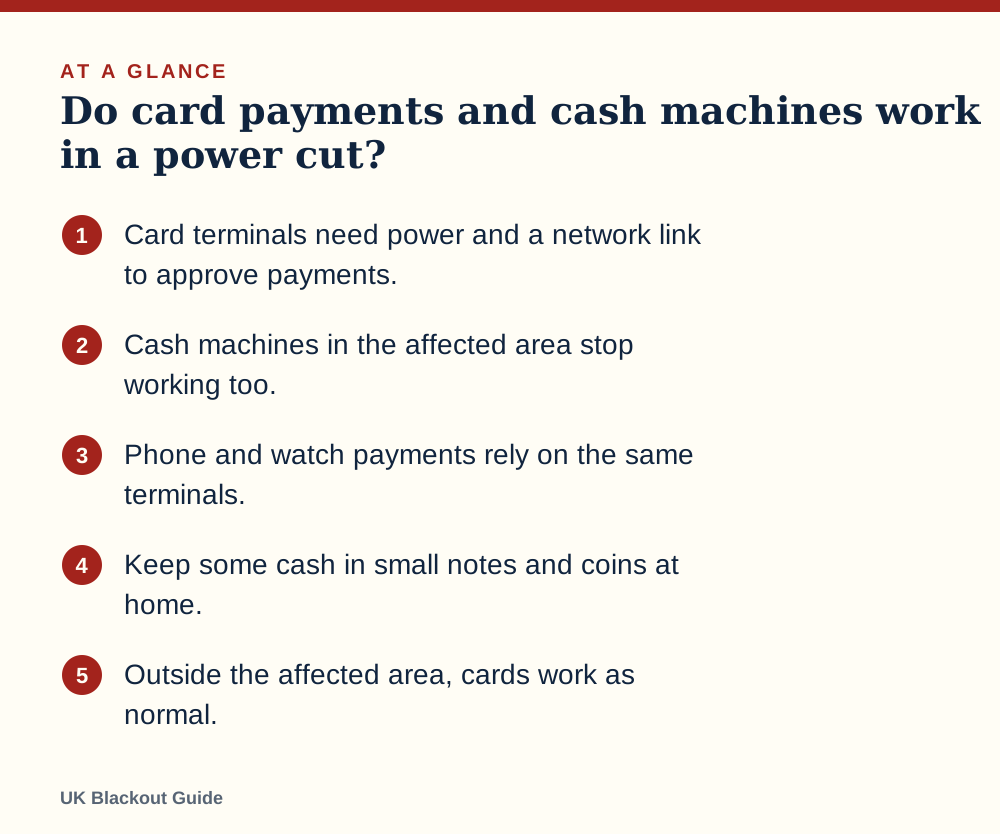
- Card terminals need power and a network link to approve payments.
- Cash machines in the affected area stop working too.
- Phone and watch payments rely on the same terminals.
- Keep some cash in small notes and coins at home.
- Outside the affected area, cards work as normal.
What a card payment depends on
Tapping a card looks instant, but several things have to be working at once. The terminal needs power. The till it talks to needs power. Then the terminal has to reach the bank over broadband or the mobile network to get the payment approved.
A handheld terminal with a charged battery might survive the first part. It still needs a signal, and in a power cut the shop's router is off and the mobile network may only be running temporarily on backup power. Paying with a phone or watch makes no difference, because it goes through the same terminal.
Cash machines have the same two needs. A machine with no mains is a locked box, and one with power but no data link cannot check your balance.
What happened in real outages
When a flooded substation cut power to about 61,000 properties in the Lancaster power cut of December 2015, cash machines and card payments failed locally along with mobile and internet services. Cash still worked in the shops that stayed open.
On 28 April 2025 the whole Iberian peninsula lost power. Card payments were widely disrupted and cash proved useful, as we describe in the lessons from the Spain and Portugal blackout.
How much difference the size of the cut makes
In an ordinary local fault, the problem is small. Walk or drive to the next area with power and your card works as usual. Your account, your balance and the banking system are all untouched.
A national outage is a different case. The National Risk Register rates one as low likelihood but very high impact, and describes knock-on effects on payments. These past events show how payment systems behave without power. They are not a sign of what will happen here. Your banking app may not load either, for reasons set out in whether your bank app works in a blackout.
Keeping a sensible amount of cash at home
You do not need a large sum. To settle how much cash to keep at home, think about what three days of basics would cost your household: bread, milk, fuel, a taxi or bus fare. Small notes and coins are best, because a shop with a dead till may not have change for a £50 note.
Store your emergency cash somewhere you can find in the dark, but not somewhere obvious.
We compare sizes and lock types in our list of the cash boxes for emergency money. Check your home insurance for the limit on cash kept in the house, and do not tell people it is there.
Common questions
Can shops take card payments offline during a power cut?
Some systems can store payments to process later, but that is the retailer's decision and the till still needs power. Do not rely on it.
Will my direct debits still go out in a power cut?
A local power cut does not affect your bank's systems, so scheduled payments carry on as normal.
Are coins worth keeping, or only notes?
Keep both. Coins and small notes let you pay the exact amount when a shop cannot open its till or give change.
Reviewed against these sources on 18 November 2026. If official advice has changed since, follow the official advice.
General information only. This page is not professional, safety, medical, legal or financial advice, and it is not official guidance. No national blackout has been forecast or announced, and nothing here suggests one is expected. We are independent and have no connection to the government or any energy company. Always check the official sources linked on this page. Full disclaimer
Keep reading
 Guide
Could a cyber attack cause a UK blackout?
The government has not said a cyber attack is expected to cause a UK blackout. How grid control systems work in general terms, and what households can do.
Read: Could a cyber attack cause a UK blackout? Explainer
Lancaster 2015: what a city learned from days without power
In December 2015 Storm Desmond flooded a Lancaster substation and cut power to about 61,000 properties. Phones, cards and internet failed with it.
Read: Lancaster 2015: what a city learned from days Explainer
The 2025 Spain and Portugal blackout: lessons for UK households
On 28 April 2025 Spain and Portugal lost all power for most of a day. Phones, cards and trains failed. What happened and the practical lessons for UK homes.
Read: The 2025 Spain and Portugal blackout: lessons Explainer
The 9 August 2019 power cut: what happened
On 9 August 2019 a lightning strike and the loss of two generators cut power to about 1 million customers, most for under an hour. What happened and why.
Read: The 9 August 2019 power cut: what happened