On this page
Black Sky is a term used by emergency planners for a prolonged power outage over a very wide area that also disrupts other essential services, such as water, phones, fuel, payments and transport. It describes a scenario to plan for, not a prediction. It reached the UK headlines after a BBC report on 7 November 2026 about emergency broadcasting.
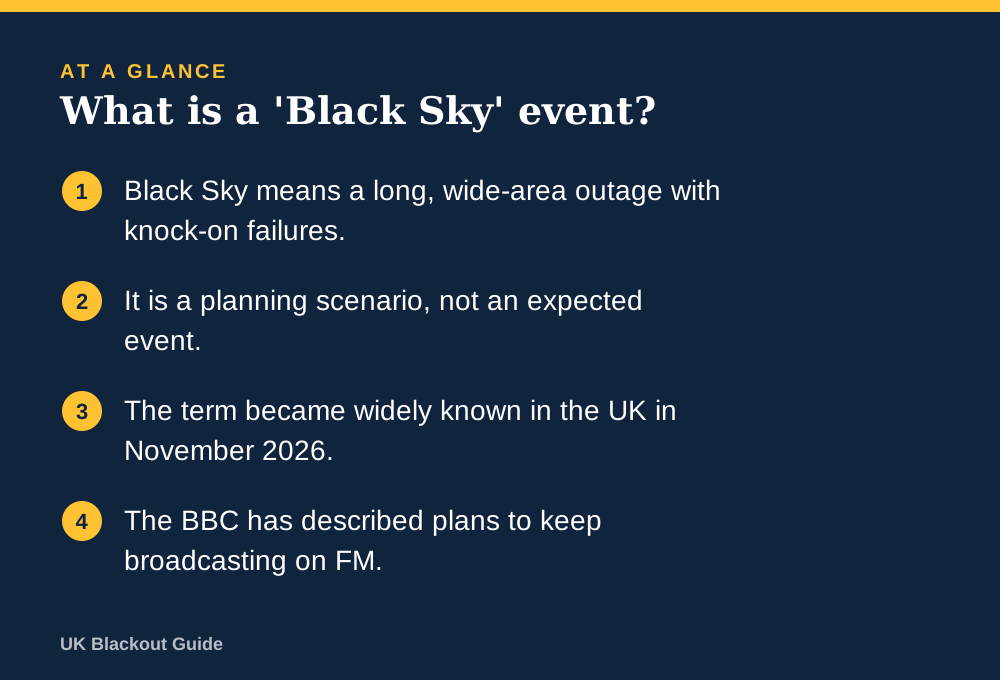
- Black Sky means a long, wide-area outage with knock-on failures.
- It is a planning scenario, not an expected event.
- The term became widely known in the UK in November 2026.
- The BBC has described plans to keep broadcasting on FM.
What sets a Black Sky event apart
Scale and duration. In an ordinary power cut, even a large one, the area around you still works, and help, supplies and engineers come in from outside. In a Black Sky scenario the outage is so wide and lasts so long that the services which depend on electricity begin to fail as well, and there is no unaffected area next door to lean on.
Planners sometimes contrast it with blue sky days, when everything works normally, and grey sky days, meaning familiar emergencies such as storms and floods that services handle routinely.
The UK's National Risk Register describes a national power outage in these terms: low likelihood but very high impact, with knock-on effects on water, mobile, internet, fuel, payments and transport, the chain described in what stops working in a blackout.
Why the phrase is in the news
Two things brought it to public attention. The government launched its Be Ready preparedness campaign on 22 October 2026. Then, on 7 November 2026, a BBC report described the BBC's emergency broadcasting plan, under which the corporation would keep broadcasting through such an event: on FM radio, from an emergency studio, with generator-backed transmitters and supplies for at least three days.
The report was about contingency planning, which broadcasters and utilities do as a matter of course, and it is one part of how the UK plans for a Black Sky event. It did not say an outage was expected.
What the official restoration figures say
The grid operator, NESO, must have the capability by 31 December 2026 to restore 60% of demand in each region within 24 hours and all of Great Britain's demand within five days. The risk register notes that restoring the transmission system could take up to about seven days.
Those are the official figures. Household guidance from the Be Ready campaign is three days, and the government has not suggested that an outage of any particular length is expected. In the Iberian blackout of 28 April 2025, most supply was restored by the early hours of the next day. That is what happened there, not a prediction for here.
What it means for a household
The preparation is the same three-day kit the Be Ready campaign recommends for any emergency, the one you would use to get through three days without power: water, food that needs no cooking, light, warmth, medication and cash. The item that matters most in this particular scenario is a radio.
If phones and broadband are down, FM broadcasts are the fallback the BBC has described. A battery or wind-up radio is on the official list for that reason. Write down your local frequencies in advance.
Common questions
Is Black Sky an official UK government term?
It is planning jargon used in the resilience and energy sectors. The government's public documents generally refer to a national power outage.
Has a Black Sky event ever happened in the UK?
No. The UK has had large regional power cuts, but not a prolonged outage across the whole country.
Is a Black Sky event the same as a blackout?
It is the most severe kind: a blackout that covers a very wide area and lasts long enough to disrupt other essential services.
- National Risk Register, Cabinet Office
- Be Ready campaign, UK government
- National Energy System Operator (NESO)
Reviewed against these sources on 18 November 2026. If official advice has changed since, follow the official advice.
General information only. This page is not professional, safety, medical, legal or financial advice, and it is not official guidance. No national blackout has been forecast or announced, and nothing here suggests one is expected. We are independent and have no connection to the government or any energy company. Always check the official sources linked on this page. Full disclaimer
Keep reading
 Explainer
How the BBC plans to keep broadcasting in a blackout
A BBC report on 7 November 2026 set out how it would keep broadcasting on FM radio through a long blackout. What it said and what radio you need to hear it.
Read: How the BBC plans to keep broadcasting in a Explainer
The government's Be Ready campaign: what it asks households to do
The government's Be Ready campaign, launched 22 October 2026, asks every household to be able to manage for three days. The full kit list and what it means.
Read: The government's Be Ready campaign: what it Explainer
'Black Sky' planning: what the reports actually say
What the autumn 2026 'Black Sky' reports are based on: the Be Ready launch, a BBC report on emergency broadcasting, and long-standing national risk planning.
Read: 'Black Sky' planning: what the reports Guide
Could a cyber attack cause a UK blackout?
The government has not said a cyber attack is expected to cause a UK blackout. How grid control systems work in general terms, and what households can do.
Read: Could a cyber attack cause a UK blackout?