On this page
The government's Be Ready campaign asks every household to be able to manage for three days without outside help. In practice that means 9 litres of drinking water per person, three days of food that needs no cooking or fridge, a torch, a battery or wind-up radio, a charged power bank, warm bedding, medication and some cash.
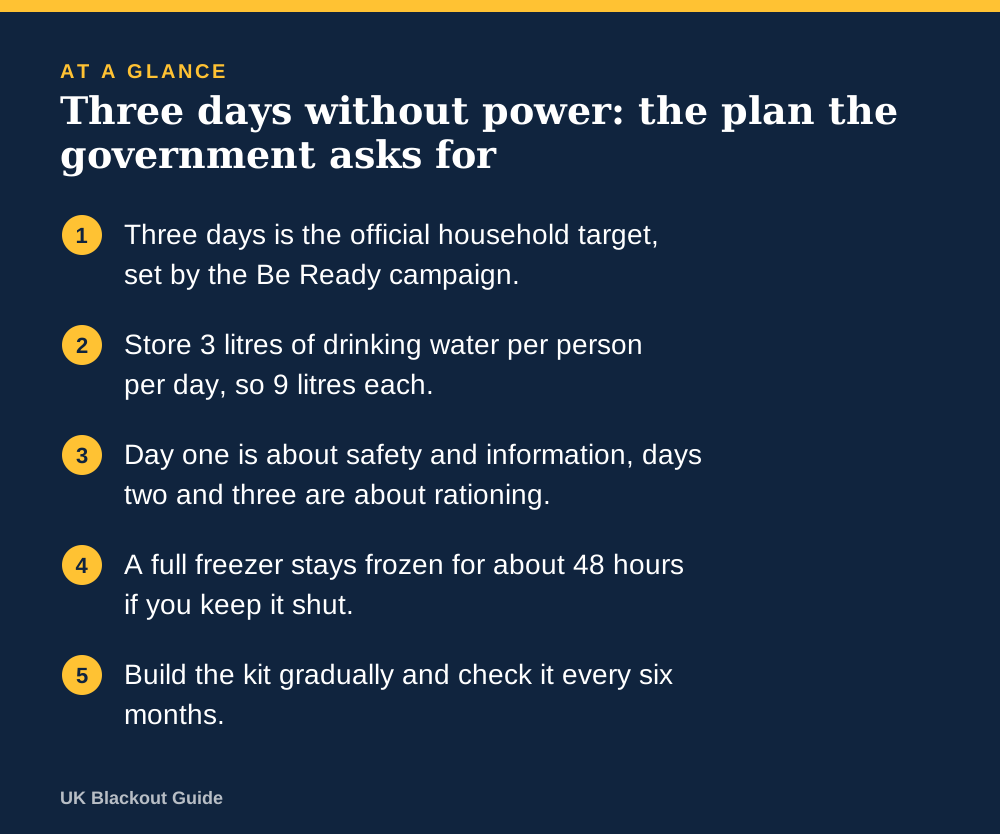
- Three days is the official household target, set by the Be Ready campaign.
- Store 3 litres of drinking water per person per day, so 9 litres each.
- Day one is about safety and information, days two and three are about rationing.
- A full freezer stays frozen for about 48 hours if you keep it shut.
- Build the kit gradually and check it every six months.
Why three days is the number
Three days is the figure the UK government chose when it launched the Be Ready campaign on 22 October 2026. The campaign asks households to be able to look after themselves for that long, and it presents this as general preparedness for any emergency. It is not a forecast, and no national blackout is planned or predicted, despite the 'three-day blackout' claim that appeared in some headlines.
Three days is also the longest period that official household guidance asks you to cover. The day-by-day plan below shows what the Be Ready advice looks like in practice. It says nothing about how long any particular power cut would last.
Day one: safety first, then information
The first day rarely feels like an emergency. The first 24 hours without power come down to a few simple jobs. Report the cut on 105 (03457 643643 in Northern Ireland), switch off ovens, irons, electric fires and fryers, and unplug the TV and computer so a surge on return cannot damage them.
Then get your information source working. A battery or wind-up radio is the official recommendation because it does not depend on your broadband or the mobile network, and mobile masts may only work for a while on backup power. Try both FM and digital.
Leave the fridge and freezer shut. The Food Standards Agency says an unopened fridge should stay cold for around 4 hours, so plan to eat the fridge food first.
Day two: start rationing what you cannot replace
By the second morning the fridge is no longer cold and the phone battery is the thing everyone is watching. Put phones on low power mode, agree set times to check for messages, and charge from the power bank rather than leaving phones to run flat. A 20,000 mAh power bank gives about 3 to 4 charges of a typical phone, which is enough for one phone for three days if you are careful.
Water needs the same discipline. When you are working out your household's water store, the official figure is 3 litres per person per day for drinking, with more for cooking and washing. Mains water can be disrupted during and after power cuts, so treat your stored water as the supply and the tap as a bonus.
A full freezer typically stays frozen for about 48 hours, and a half-full one for about 24. Day two is when you check the facts on how long a freezer holds without power and decide what to cook first if you have a safe way to cook.
Day three: routine does more than kit
By day three, tiredness and cold are the main risks. Keep everyone in one room during the day, wear layers, close doors and curtains, and eat at regular times even if the meals are cold. The NHS advises heating rooms you use to at least 18°C. If you cannot manage that, bedding and clothing have to do the work.
Never bring a barbecue, camping stove, patio heater or generator indoors for warmth. They produce carbon monoxide, which has no smell and can kill. Use torches for light, as they are safer than candles.
Check on neighbours, particularly anyone older or living alone. If someone in your home relies on powered medical equipment, they should already be on the Priority Services Register, which is free.
What a three-day kit contains
The official list, which our full emergency kit list goes through item by item, is short: water, non-perishable food that needs no cooking, a tin opener, a torch with spare batteries, a radio, a charged power bank, a first aid kit, essential medication, hand sanitiser and wet wipes, blankets and warm clothing, cash in notes and coins, printed copies of documents and a written list of contacts. Add formula and nappies for a baby, and pet food.
You can assemble all of this from supermarket shelves. A ready-made emergency kit saves time if you would otherwise never get round to it.
Once three days is covered
Most households can stop here. Three days is what the government asks for, and it is achievable for almost any budget if you build the kit a few items at a time.
Going further is optional. The government has not asked households to prepare for more than three days and has not suggested a longer outage is expected. Some rural homes were without power for more than a week after Storm Arwen in 2021, and if you would like a margin of your own, the next step is understanding what changes after day three. The cheapest place to start is extra water, kept in water containers made for home storage.
Checklist
Three days without power: the plan the government asks for
- 9 litres of drinking water per person
- Three days of food that needs no cooking
- Manual tin opener
- Torch and spare batteries
- Battery or wind-up FM radio
- Charged power bank and cable
- First aid kit and essential medication
- Blankets or sleeping bags
- Cash in notes and coins
- Written list of contacts, including 105
Common questions
Is three days a prediction of how long a blackout would last?
No. It is a general preparedness target from the Be Ready campaign. Most power cuts are far shorter, and no national blackout is planned or predicted.
Do I need a generator for three days?
No. Three days is manageable with a torch, a radio, a power bank, stored water and food that needs no cooking. A generator adds cost, fuel storage and carbon monoxide risk.
How often should I check the kit?
Every six months. Replace food and water that is near its date, recharge the power bank and test the torch and radio.
Does the three-day target apply in Northern Ireland?
The preparedness advice is the same. The number to report a power cut is different: 03457 643643 instead of 105.
Reviewed against these sources on 18 November 2026. If official advice has changed since, follow the official advice.
General information only. This page is not professional, safety, medical, legal or financial advice, and it is not official guidance. No national blackout has been forecast or announced, and nothing here suggests one is expected. We are independent and have no connection to the government or any energy company. Always check the official sources linked on this page. Full disclaimer
Keep reading
 Question
How long could a national blackout last?
How long a national blackout in Great Britain could last, based on NESO's restoration standard, the National Risk Register and what happened in past events.
Read: How long could a national blackout last? Question
How much emergency water does a family of four need?
How much water a family of four should store for a power cut: 12 litres a day for drinking, 36 litres for three days, plus extra for cooking and washing.
Read: How much emergency water does a family of Question
Is preparing for a blackout sensible or paranoid?
Whether preparing for power cuts is sensible or over the top: what the UK government asks for, where reasonable preparation ends and how to tell.
Read: Is preparing for a blackout sensible or Guide
A week without power: what changes after day three
Optional planning beyond the official three days: what changes by day seven of a power cut for water, cooking, freezer food, phone charging and cash.
Read: A week without power: what changes after day