On this page
NESO must be able to restore 60% of demand in every region within 24 hours and all of Great Britain's demand within five days, a capability due by 31 December 2026. The National Risk Register says restoring the transmission system could take up to about 7 days. The Register rates a national outage as low likelihood but very high impact, and no national blackout has been forecast.
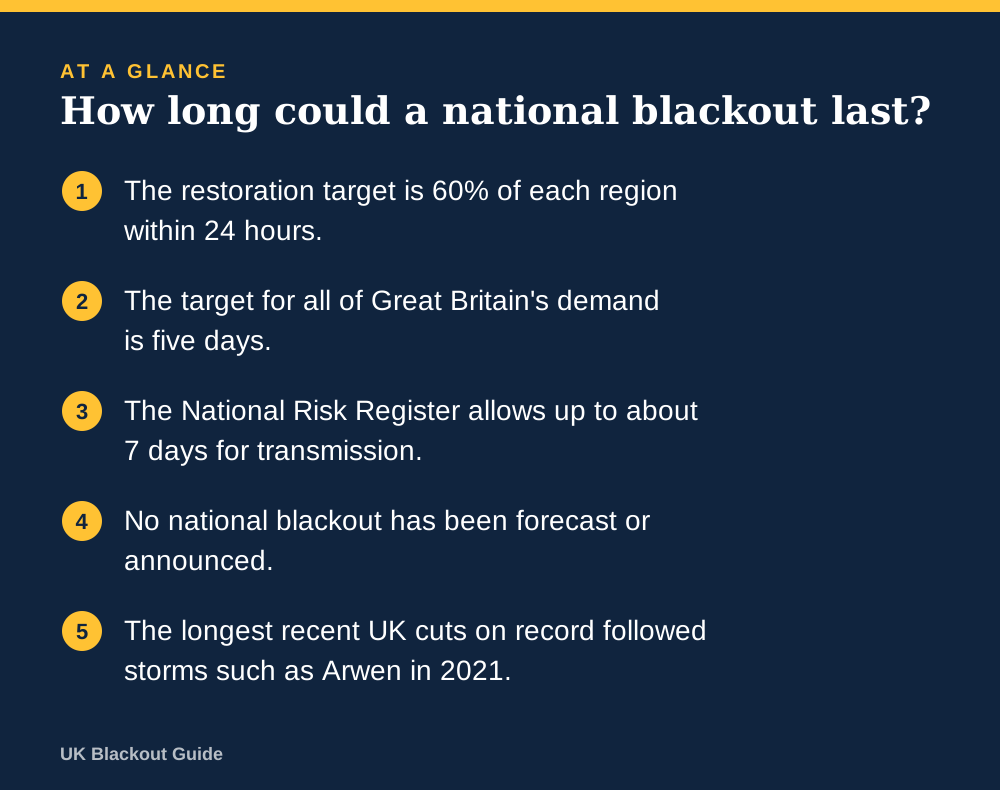
- The restoration target is 60% of each region within 24 hours.
- The target for all of Great Britain's demand is five days.
- The National Risk Register allows up to about 7 days for transmission.
- No national blackout has been forecast or announced.
- The longest recent UK cuts on record followed storms such as Arwen in 2021.
The official figures: one day for most, five days for all
Great Britain has never had a complete national blackout, so the best guide is the standard the system is required to meet. Under the Electricity System Restoration Standard, set by government in 2021, NESO must have the capability by 31 December 2026 to restore 60% of electricity demand in each region within 24 hours, and 100% of Great Britain's demand within five days. We look at that deadline in what the 2026 grid restoration deadline means.
The National Risk Register says restoration of the transmission system could take up to about 7 days. It rates a national outage as low likelihood but very high impact. The process of restarting a dead grid, power station by power station, is described in what a black start is.
What happened in past events
Past events show what happened on those occasions. They are not a forecast of what would happen here. On 28 April 2025 a total blackout hit Spain and Portugal. The whole Iberian peninsula lost power, and most supply was restored by the early hours of the next day.
Britain's own large incident, on 9 August 2019, disconnected about 1 million customers after a lightning strike and the loss of two generators. Most were back within an hour, although there was major rail disruption.
The longest cuts in recent UK history were regional. After Storm Arwen in November 2021, some rural homes in northern England and Scotland were off for more than a week. You can read more in how long power cuts usually last.
Why your street may differ from the national figure
The official figures are targets for the system as a whole. The standard is 60% of regional demand within 24 hours, so it allows for some homes in each region waiting longer than a day.
Other services lag behind the electricity. Water, mobile networks, internet, fuel and payments all depend on power, and the National Risk Register describes knock-on effects on each. Our guide to what stops working in a blackout shows the order in which they are affected.
What that means for how much to prepare
The government's Be Ready campaign asks households to manage for three days. It presents that as general preparedness and not as a forecast, and three days is the only period official guidance asks households to cover. The government has not asked anyone to prepare for longer. If you want a margin of your own up to the Risk Register's figure of about 7 days, you can plan for a week as an optional extra.
We compare what is on sale in the best emergency kits. Scenarios of a month or more are far outside official planning and best treated as optional stretch thinking.
Common questions
Has Great Britain ever had a full national blackout?
No. There have been large regional incidents, such as 9 August 2019 and Storm Arwen in 2021, but never a complete loss of the national grid.
Could a national blackout last for weeks?
Nothing in official planning suggests that. The stated capability is full restoration within five days, and the National Risk Register refers to about 7 days for the transmission system.
Does the restoration standard cover Northern Ireland?
The standard applies to Great Britain. Northern Ireland's electricity system is run separately as part of the all-island system.
- NESO, National Energy System Operator
- National Risk Register, Cabinet Office
- Be Ready campaign, UK government
Reviewed against these sources on 18 November 2026. If official advice has changed since, follow the official advice.
General information only. This page is not professional, safety, medical, legal or financial advice, and it is not official guidance. No national blackout has been forecast or announced, and nothing here suggests one is expected. We are independent and have no connection to the government or any energy company. Always check the official sources linked on this page. Full disclaimer
Keep reading
 Guide
Preparing without panic buying
How to build household supplies for a power cut gradually, without bulk buying: a six-week shopping plan based on the UK government's Be Ready advice.
Read: Preparing without panic buying Guide
Three days without power: the plan the government asks for
A day-by-day plan for three days without mains power, built on the UK government's Be Ready advice: water, food, light, radio, warmth and phone charge.
Read: Three days without power: the plan the Question
Is preparing for a blackout sensible or paranoid?
Whether preparing for power cuts is sensible or over the top: what the UK government asks for, where reasonable preparation ends and how to tell.
Read: Is preparing for a blackout sensible or Guide
How to manage 30 days without mains power
Optional planning for 30 days without mains power, far beyond the three days UK guidance asks for: what water, food, energy and health would need.
Read: How to manage 30 days without mains power