On this page
One adult needs roughly 60,000 to 75,000 kcal for 30 days, based on about 2,000 to 2,500 kcal a day: around 9 kg of dry staples, about 70 tins, plus oil, sugar and long-life milk. The government asks for three days only. It has not asked households to store a month of food or suggested an outage that long is expected.
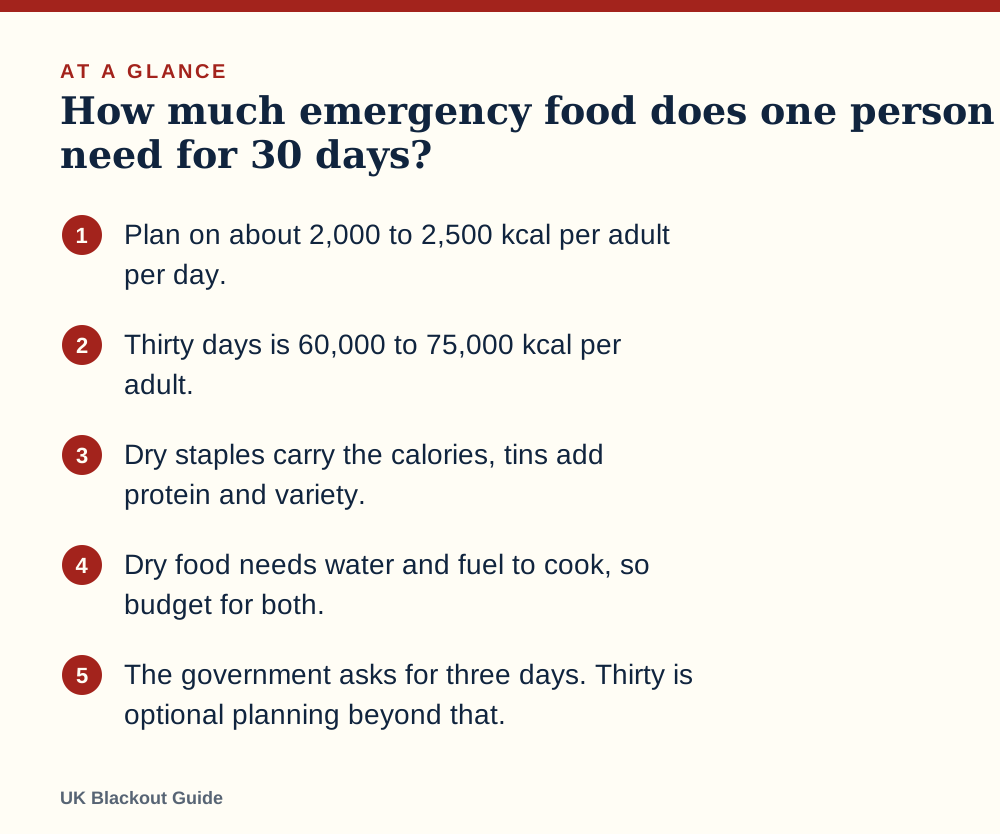
- Plan on about 2,000 to 2,500 kcal per adult per day.
- Thirty days is 60,000 to 75,000 kcal per adult.
- Dry staples carry the calories, tins add protein and variety.
- Dry food needs water and fuel to cook, so budget for both.
- The government asks for three days. Thirty is optional planning beyond that.
Start from calories, not from tins
The government's Be Ready campaign asks for three days of food. It has not asked households to store 30 days and has not suggested an outage of that length is expected, so treat this page, like our wider plan for managing 30 days without mains power, as optional planning beyond official guidance.
The reliable way to size a food store is by energy. General NHS guidance is around 2,000 kcal a day for an average woman and 2,500 kcal for an average man. Children need less and people doing heavy physical work need more. Multiply by 30 and one adult needs 60,000 to 75,000 kcal.
Every packet lists kcal per 100 g, so you can add up any combination. As a rough guide, dry rice, pasta and oats hold about 350 to 380 kcal per 100 g. Tinned food is mostly water and holds far less per tin, which is why a month built only from tins is heavy and bulky.
An example month for one adult
| Food | Amount | Approximate kcal |
|---|---|---|
| Rice and pasta | 6 kg | 21,000 |
| Porridge oats | 3 kg | 11,000 |
| Tinned beans, pulses and soup | 30 tins | 9,000 |
| Tinned fish and meat | 20 tins | 5,000 |
| Tinned fruit and vegetables | 20 tins | 3,000 |
| Cooking oil | 1 litre | 8,000 |
| Sugar, jam, honey | 1.5 kg | 5,000 |
| Peanut butter, crackers, cereal bars | Assorted | 6,000 |
That comes to roughly 68,000 kcal. The figures are estimates from typical labels, so check your own packets. Add long-life milk, tea, coffee, salt, stock cubes and spices, which add little energy but make plain food much easier to eat for a month.
Change the list to match what you really eat, because the foods worth stockpiling are the ones your household already likes. A store nobody likes gets wasted.
The catch: dry food needs water and heat
Rice, pasta and oats are cheap and compact because they contain no water. You have to add it, along with fuel to boil it. That cooking water comes on top of the 3 litres per person per day the government advises for drinking.
Keep the first three days as food you can eat cold, as official advice says, because cooking may not be possible at first. For the rest you need a safe heat source, and the options are compared in cooking without electricity.
Use camping stoves and barbecues outdoors only. They produce carbon monoxide, which has no smell.
Buying and keeping a month of food
Build it from your normal shop over a few months, and use it. New stock goes at the back and you eat from the front, as described in a simple food storage and rotation system. Stored that way, a month of food costs little more than buying it earlier.
Freeze-dried meals are an alternative for part of the store. They are light, keep for years and need only hot water, but cost much more per calorie.
We compare the main types in the best emergency food for long storage. For most households three days is the target and a fortnight is generous.
Common questions
How much food does a family of four need for 30 days?
Roughly 200,000 to 250,000 kcal in total, depending on the ages of the children. That is around three times the adult example list, adjusted to what your family eats.
Can I live on tinned food alone for a month?
Yes, but you need a lot of it, often six to eight tins a day per adult, and the weight and space add up. Mixing in dry staples is more practical if you can cook.
Is 30 days of food officially recommended in the UK?
No. The Be Ready campaign asks for three days of non-perishable food that needs no cooking or fridge, and the government has not suggested a 30-day outage is expected.
Reviewed against these sources on 18 November 2026. If official advice has changed since, follow the official advice.
General information only. This page is not professional, safety, medical, legal or financial advice, and it is not official guidance. No national blackout has been forecast or announced, and nothing here suggests one is expected. We are independent and have no connection to the government or any energy company. Always check the official sources linked on this page. Full disclaimer
Keep reading
 Guide
Preparing for 90 days: stock, rotation and routine
An honest look at preparing for 90 days: why it is far beyond official UK planning, what stock and rotation would involve, and where its limits are.
Read: Preparing for 90 days: stock, rotation and Guide
Food storage and rotation: a simple system
A simple system for keeping a reserve of food at home: what to store, where to keep it, how first in, first out works, and a twice-yearly check.
Read: Food storage and rotation: a simple system Guide
How to manage 30 days without mains power
Optional planning for 30 days without mains power, far beyond the three days UK guidance asks for: what water, food, energy and health would need.
Read: How to manage 30 days without mains power Buying guide
Best emergency food for a three-day blackout kit
Emergency food for a three-day blackout kit: ready-to-eat pouches and ration biscuits that need no cooking, picked from Amazon UK listings.
Read: Best emergency food for a three-day blackout