On this page
- Where 30 days sits against official planning
- A plan for no power also covers part-time power
- Water: you cannot store your way through a month
- Food: a month from the cupboard
- Electricity: a small budget you can refill
- Health, hygiene and warmth set the real limit
- Set a decision point for leaving
- Common questions
The government has not asked households to prepare for 30 days and has not suggested an outage of that length is expected. Official household guidance is three days, and restoration targets are measured in days. This page is optional planning beyond that: 90 litres of drinking water per person, a month of shelf-stable food, a small solar setup and a decision point for leaving.
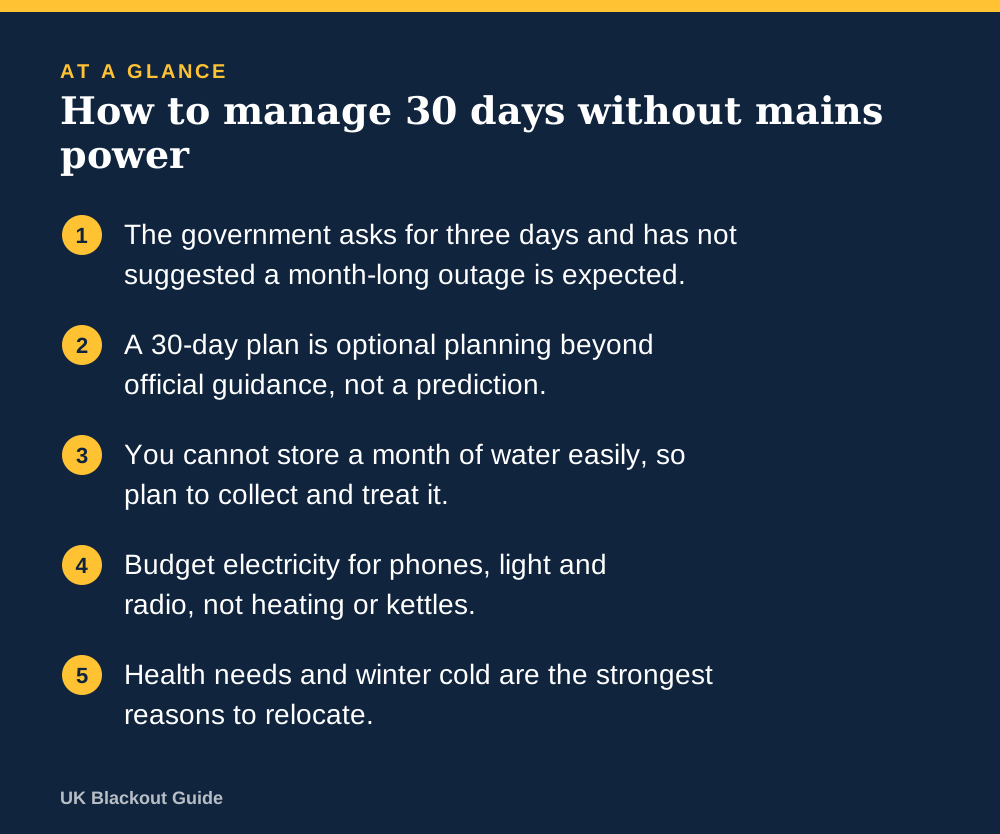
- The government asks for three days and has not suggested a month-long outage is expected.
- A 30-day plan is optional planning beyond official guidance, not a prediction.
- You cannot store a month of water easily, so plan to collect and treat it.
- Budget electricity for phones, light and radio, not heating or kettles.
- Health needs and winter cold are the strongest reasons to relocate.
Where 30 days sits against official planning
The government has not asked households to prepare for a month without electricity, and it has not suggested an outage of that length is expected. Its Be Ready campaign asks for three days, as general preparedness and not as a forecast. NESO, which runs Great Britain's electricity system, must have the capability by 31 December 2026 to restore 60% of demand in each region within 24 hours and all of it within five days. The National Risk Register describes a national outage as low likelihood but very high impact, and says restoring the transmission system could take up to about 7 days.
So 30 days is about four times the longest official figure for how long a national blackout could last. What follows is optional planning beyond official guidance, for people who like a wide margin. It is not something you need to have in place.
A plan for no power also covers part-time power
The longest recent UK cuts on record were local. After Storm Arwen in 2021 some rural homes were off for more than a week. That is what happened then, not a guide to what will happen next.
Disruption can also be partial. The official plan for a national energy shortage is rota power cuts, which could switch areas off for about three hours at a time by load block letter. No such cuts have been announced. A plan that copes with no supply at all will cope easily with a few hours off each day, because you can recharge everything whenever the power is on.
Water: you cannot store your way through a month
At the official 3 litres per person per day for drinking, 30 days is 90 litres each, or 360 litres for a family of four. That is 360 kilos of water before any is used for cooking or washing. Most homes can store a week or two at best.
The realistic month-long plan is a modest store plus the ability to collect and treat water, the three layers of a long-term water plan. Water companies normally provide alternative supplies during long interruptions, and you should use those first. Beyond that, a filter and a means of disinfection let you use rainwater or other sources you would not otherwise drink.
Food: a month from the cupboard
A month of food is a larger version of the cupboard you already have, kept fresh by rotating your stored food through normal meals, not a special purchase. The fridge is finished within hours and the freezer within about two days, so everything has to be tinned, dried or jarred, and you need a safe way to heat it.
An adult needs roughly 2,000 to 2,500 kcal a day, and our answer on how much food one person needs for 30 days turns that into a shopping list. Buy food you eat anyway, so nothing is wasted. The best long-life emergency food is worth a look for a compact reserve, but it should top up ordinary groceries, not replace them.
Electricity: a small budget you can refill
Over 30 days, stored charge is irrelevant. What matters is how much energy you can gather each day, which is the basis of running on solar and battery for weeks. A 100 W portable solar panel in the UK typically yields roughly 300 to 400 Wh on a clear summer day and often only 30 to 80 Wh on a dull winter day.
That is enough for phones, LED lighting and a radio in any season. In summer it stretches to a laptop and a router. Even the best portable solar panels will not run a kettle, a heater or, without several of them, a fridge-freezer.
A generator can fill winter gaps, but HSE rules limit home petrol storage to 30 litres without notification, so it is a supplement and not a month-long supply.
Run generators outdoors only, well away from doors and windows, and never plug one into a house socket. Carbon monoxide has no smell.
Health, hygiene and warmth set the real limit
Supplies are the easier half. The harder half is anything that depends on services: repeat prescriptions, refrigerated medicines, powered medical equipment and care visits. Talk to your pharmacist or clinician about what a sensible reserve looks like for you, and follow their advice. Do not stockpile medicines on your own initiative.
Sanitation in a long outage needs a routine: hand washing before food, a way to deal with toilet waste if water is short, and somewhere to store rubbish.
In winter, a month in an unheated house is a health risk. The NHS advises heating the rooms you use to at least 18°C, and you should know the signs of hypothermia at home.
Set a decision point for leaving
The most useful part of a 30-day plan is deciding in advance when you would stop, and whether you would stay at home or go elsewhere. If anyone in the house is ill, very young, very old or dependent on equipment, or if the house cannot be kept warm, staying for a month is the wrong goal.
Three days is the official ask and comes first. A week and a month are optional, and a month is only worth pursuing as far as it costs little: a deeper food cupboard, a water filter and a solar panel that also earns its keep on camping trips. Before you spend on panels, it is worth reading how well small solar power banks really work, because the cheapest solar products are often the least useful.
Common questions
Has the UK ever had a 30-day power cut?
Not on a national or regional scale. The longest recent examples we know of are rural homes off for more than a week after Storm Arwen in 2021.
Does the government recommend a month of supplies?
No. The Be Ready campaign asks households to manage for three days, and the government has not suggested an outage of a month is expected. Anything beyond three days is a personal choice.
Could I run my central heating from a power station for a month?
Gas boiler controls and pump draw about 100 to 150 watts, which is too much for a small solar setup in winter. Plan to heat people with clothing and bedding instead.
What is the cheapest useful step towards a longer plan?
A deeper cupboard of food you already eat, rotated through normal meals, and a few extra water containers.
- NESO, National Energy System Operator
- National Risk Register, Cabinet Office
- Be Ready campaign, UK government
- Health and Safety Executive
- NHS
Reviewed against these sources on 18 November 2026. If official advice has changed since, follow the official advice.
General information only. This page is not professional, safety, medical, legal or financial advice, and it is not official guidance. No national blackout has been forecast or announced, and nothing here suggests one is expected. We are independent and have no connection to the government or any energy company. Always check the official sources linked on this page. Full disclaimer
Keep reading
 Question
Can portable solar keep a household going in a long power cut?
What portable solar panels can and cannot power in a UK home during a long outage, with realistic summer and winter output and example daily loads.
Read: Can portable solar keep a household going in Guide
Preparing for 90 days: stock, rotation and routine
An honest look at preparing for 90 days: why it is far beyond official UK planning, what stock and rotation would involve, and where its limits are.
Read: Preparing for 90 days: stock, rotation and Guide
Off-grid power for weeks: solar plus battery
How to size a portable solar panel and power station for weeks without mains power in the UK, with a daily energy budget and honest winter figures.
Read: Off-grid power for weeks: solar plus battery Guide
A week without power: what changes after day three
Optional planning beyond the official three days: what changes by day seven of a power cut for water, cooking, freezer food, phone charging and cash.
Read: A week without power: what changes after day