On this page
A long-term water plan has three layers. Store three days of drinking water at 3 litres per person per day, which is the official advice. Know where you would top up, starting with your water company's alternative supplies. Keep a way to treat doubtful water: boiling, a filter or purification tablets. The second and third layers are optional planning beyond official guidance.
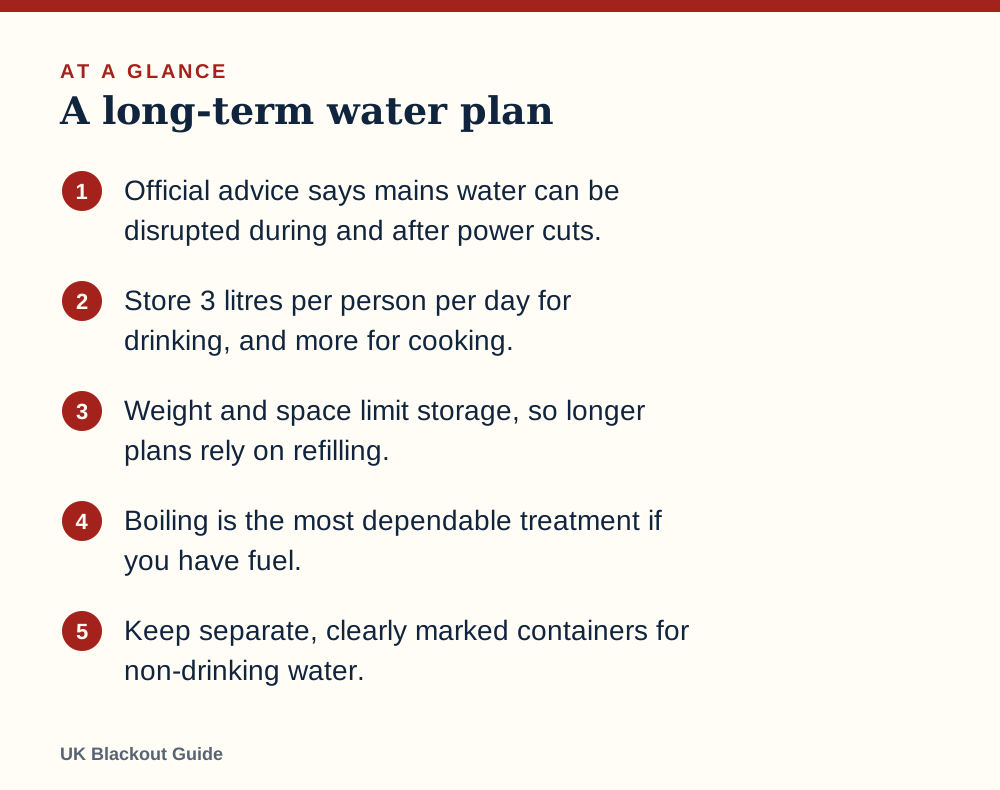
- Official advice says mains water can be disrupted during and after power cuts.
- Store 3 litres per person per day for drinking, and more for cooking.
- Weight and space limit storage, so longer plans rely on refilling.
- Boiling is the most dependable treatment if you have fuel.
- Keep separate, clearly marked containers for non-drinking water.
Why a power cut can become a water problem
Water reaches your tap with the help of electric pumps and powered treatment works, which is why whether tap water works in a power cut is not a given. Water companies have backup arrangements, and in most power cuts the taps keep running. Even so, the official Be Ready advice is plain that mains water can be disrupted during and after power cuts, and flats supplied by booster pumps can lose pressure early.
The government asks households to store three days of water. It has not asked anyone to plan for longer and has not suggested a long outage is expected, so layers two and three below are optional planning beyond official guidance. Each layer covers a longer period than the last.
Layer one: stored water for the first days
The official figure is 3 litres per person per day for drinking, with more for cooking and washing. For three days that is 9 litres each. A week is 21 litres each, and two weeks is 42.
Shop-bought bottled water is the simplest store. It is sealed, dated and easy to rotate. The cheaper route is filling clean, food-grade containers from the tap and refreshing them on a schedule. Keep either kind somewhere cool and dark, away from fuel, paint and cleaning products.
Storage has a hard limit, which is weight. A litre weighs a kilo, so a fortnight for a family of four is 168 kilos. Spread it across floors and cupboards, not one shelf, and let the weight inform how much water to store for your household.
Layer two: knowing where you would refill
Beyond the stored supply, the first place to look is official. Water companies normally arrange alternative supplies, such as bottled water collection points or tankers, when mains supply fails for a long period. Households on the Priority Services Register may be able to get water delivered, which is one more reason to sign up to the Priority Services Register if you qualify.
While the tap still runs, fill everything. Containers first, then clean saucepans and jugs. A bath full of water is not for drinking, but it will flush a toilet many times.
Your home also holds water already. A hot water cylinder contains a useful quantity, though drawing it off may need a plumber's knowledge of your system, and you should not drink from a loft tank without treating the water. Rain collected from a roof is useful for flushing and washing, but whether rainwater is safe to drink is a separate question to settle before you use it for anything else.
Layer three: making doubtful water safe
Treatment turns water you would not trust into water you can drink. There are three household methods of making water safe to drink, and each has a gap.
| Method | Deals with | Limits |
|---|---|---|
| Boiling | Bacteria, viruses and parasites | Needs fuel and time, does not remove chemicals or grit |
| Filter | Grit, bacteria and protozoa | Most household filters do not remove viruses or dissolved chemicals |
| Tablets | Bacteria and viruses | Need a waiting time, work poorly in cloudy water, leave a taste |
Boiling is the most dependable if you can do it, so it is worth knowing how to boil water without electricity. Bring the water to a rolling boil, then let it cool with a lid on.
Where fuel is short, filter first and then disinfect with water purification tablets. The filter clears the water so the tablets can work, and the tablets handle what the filter misses.
No household method makes water safe if it is contaminated with fuel, sewage or chemicals. If your water company issues a do not drink notice, follow it and use bottled water.
Keep drinking water and washing water apart
Most of the water a household uses does not need to be drinkable. For washing and toilets when water is short, flushing, mopping and the first rinse of dishes can use rainwater, bath water or water saved from washing.
Mark containers clearly, for example blue lids for drinking and tape on anything else, and never swap them. A single mix-up can make a whole family ill at the worst time.
Looking after the store
Water does not go off in the way food does, but containers and seals do age. Check bottled water against its date and replace home-filled containers on a regular schedule, cleaning them before refilling. Do it with the six-monthly kit check so it is not forgotten.
Label every container with the fill date. Use the old water on the garden, so rotating the store wastes nothing.
How far to take it
Three days of stored water meets the official advice and is the part everyone should do. A week or two of storage plus tablets is an optional margin. An emergency water filter and a rain butt extend the plan to months, which is far beyond anything official guidance asks for, and they are only worth having if the cost and space do not trouble you.
Common questions
Is it safe to store tap water in old drinks bottles?
Clean, food-grade bottles with tight lids are fine for short-term storage if you refresh them regularly. Do not reuse milk cartons or anything that held non-food liquids.
Do water filter jugs make unsafe water drinkable?
No. Ordinary kitchen jug filters improve taste. They are not designed to remove bacteria or viruses from untreated water.
How much water does a toilet flush use?
It varies with the cistern, but several litres each time. That is why flushing should use non-drinking water in a shortage.
Should I fill the bath when the power goes off?
In a long or wide-area cut it is a sensible precaution while the mains still runs. Use that water for flushing and washing, not drinking.
Reviewed against these sources on 18 November 2026. If official advice has changed since, follow the official advice.
General information only. This page is not professional, safety, medical, legal or financial advice, and it is not official guidance. No national blackout has been forecast or announced, and nothing here suggests one is expected. We are independent and have no connection to the government or any energy company. Always check the official sources linked on this page. Full disclaimer
Keep reading
 Question
How much emergency water does a family of four need?
How much water a family of four should store for a power cut: 12 litres a day for drinking, 36 litres for three days, plus extra for cooking and washing.
Read: How much emergency water does a family of Question
What runs out first in a long blackout?
The order in which things run out in a long, wide-area blackout: phone signal and charge, card payments and cash, fridge food, fuel and tap water.
Read: What runs out first in a long blackout? Guide
How to manage 30 days without mains power
Optional planning for 30 days without mains power, far beyond the three days UK guidance asks for: what water, food, energy and health would need.
Read: How to manage 30 days without mains power Guide
Preparing for 90 days: stock, rotation and routine
An honest look at preparing for 90 days: why it is far beyond official UK planning, what stock and rotation would involve, and where its limits are.
Read: Preparing for 90 days: stock, rotation and