On this page
Store 3 litres of drinking water per person per day for three days, which is 9 litres each. That is the figure on the government's Be Ready kit list, and it covers drinking only. Add more for cooking and washing if you have the space. A household of four needs 36 litres for drinking.
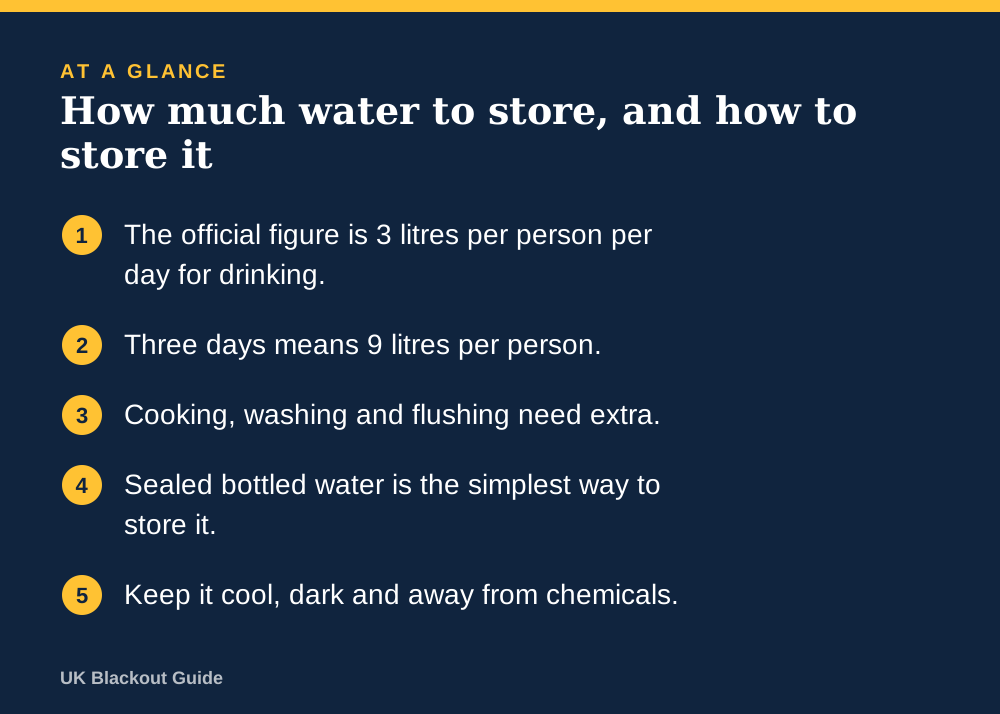
- The official figure is 3 litres per person per day for drinking.
- Three days means 9 litres per person.
- Cooking, washing and flushing need extra.
- Sealed bottled water is the simplest way to store it.
- Keep it cool, dark and away from chemicals.
The official figure, worked out for your household
Be Ready, the UK government's preparedness campaign, lists bottled water for three days at 3 litres per person per day for drinking, with more for cooking and washing. Multiply it out and you get this:
| People | Drinking water for 3 days | As 2 litre bottles |
|---|---|---|
| 1 | 9 litres | 5 (4.5 rounded up) |
| 2 | 18 litres | 9 |
| 3 | 27 litres | 14 (13.5 rounded up) |
| 4 | 36 litres | 18 |
| 5 | 45 litres | 23 (22.5 rounded up) |
We go through a worked example, including washing and cooking, in how much water a family of four needs.
Why you need water for a power cut at all
Water treatment works and pumping stations run on electricity. The official advice says mains water can be disrupted during and after power cuts, and the National Risk Register lists water among the services a national outage would affect.
In an ordinary local cut your taps will usually keep running. In a long or widespread one they might not, particularly in tall buildings that depend on pumps, which is the short answer to whether water works in a power cut.
What the 3 litres does not cover
Three litres is for drinking. On top of that, think about:
- Food and hot drinks. If your stored food needs no cooking, this is small. Dried pasta and rice use a lot.
- Hygiene. Hand washing, teeth and a basic wash. Sanitiser and wet wipes, both on the official kit list, cut this right down.
- Toilets. Flushing uses more water than everything else combined. It does not need to be drinking water, and washing and toilets when the water is off can run on rainwater or saved washing water.
- Babies and pets. Formula feeds need safe water, and a large dog can drink more than a litre a day.
If space is tight, protect the drinking allowance first and cover the rest with wipes and sanitiser.
Bottled water or your own containers
Sealed supermarket bottles are the simplest answer. They are clean, dated, cheap and easy to carry, and you can buy a few with each shop. How long bottled water lasts in storage depends mostly on keeping it sealed, cool and dark.
Bottle size is a matter of handling. Two litre bottles are easy to pour, easy to ration (one and a half per person per day) and light enough for children and older people. Five litre bottles are often cheaper per litre but awkward to pour from without spilling.
Refillable containers hold more in less space and suit households that want a larger reserve. Use containers sold for drinking water, clean them before filling, fill from the cold kitchen tap and label them with the date.
Do not reuse containers that have held milk, juice or anything non-food. Residues are hard to remove and can spoil the water. Our guide to the best water storage containers compares rigid and collapsible types.
Where to keep it
Choose somewhere cool and dark: under the stairs, the bottom of a wardrobe, under a bed. Sunlight and heat degrade plastic and encourage algae in containers you filled yourself.
Keep water away from petrol, paint, cleaning products and anything else with a strong smell, because some plastics let odours through over time. A garage shelf beside the fuel can is a poor choice.
If you can, split the supply between two places, so that a leak or a blocked cupboard does not cost you all of it.
Think about weight. Thirty-six litres weighs 36 kg, which is fine on a floor but not on a flimsy shelf. If you live in a flat with little storage, our emergency kit plan for flats has ideas for fitting it in.
Keeping it fresh
Sealed bottles carry a best-before date. Self-filled containers do not, so give them one: empty, rinse and refill them when you check your kit, which Be Ready suggests doing every six months. Use the old water on the garden.
Rotate bottled water the lazy way. Drink from the stored supply and put the new bottles at the back.
If you get warning, or run short
If a long cut looks likely and the taps still work, fill clean pans, jugs and bottles with drinking water straight away. A filled bath gives you water for flushing and washing, though not for drinking.
If your stored water runs out and the tap supply is in doubt, listen for instructions from your water company on a battery radio, then use the methods in making water safe to drink. It helps to keep a small back-up with your kit for exactly that moment, and we compare the options in the best water purification tablets, which take up almost no space in a drawer.
For reserves beyond three days, including where to collect water and how to ration it, see our longer-term water plan.
Common questions
Is 3 litres a day enough in hot weather?
The official figure is a baseline for drinking. In a heatwave, or for anyone who is ill, breastfeeding or doing physical work, allow more.
Can I store tap water in old fizzy drink bottles?
Clean bottles that held water or soft drinks are commonly reused for this. Wash them thoroughly, label them with the date and replace the water regularly. Do not reuse milk or juice bottles.
Does water in my hot water cylinder or loft tank count?
It can be used for washing and flushing, but stored household water is not kept to drinking standard. Treat it before drinking or keep it for other uses.
Do I need water for pets as well?
Yes. Add your pet's normal daily amount for three days on top of the household total.
Reviewed against these sources on 18 November 2026. If official advice has changed since, follow the official advice.
General information only. This page is not professional, safety, medical, legal or financial advice, and it is not official guidance. No national blackout has been forecast or announced, and nothing here suggests one is expected. We are independent and have no connection to the government or any energy company. Anything involving electricity, gas, fuel or food safety should be checked with a qualified professional or the relevant official body before you act on it. Always check the official sources linked on this page. Full disclaimer
Keep reading
 Buying guide
Best emergency water storage containers
Food grade water containers and jerry cans for an emergency drinking water store, picked from Amazon UK listings on capacity, fittings and ratings.
Read: Best emergency water storage containers Question
How long does bottled water last in an emergency kit?
How long sealed bottled water lasts in storage, what the best-before date means, how to store it at home and when to replace water you bottled yourself.
Read: How long does bottled water last in an Guide
Washing and toilets when the water is off
How to flush a toilet, wash and stay clean when the mains water is off in a power cut, how much water it takes and what to use when there is none to spare.
Read: Washing and toilets when the water is off Buying guide
Best camping stoves for power cuts
Portable gas camping stoves for hot food and drinks in a power cut, picked from Amazon UK listings, with firm rules on outdoor-only use and CO.
Read: Best camping stoves for power cuts