On this page
Sealed bottled water keeps until the best-before date printed on the bottle, and that date is about quality, not safety. Stored somewhere cool, dark and away from chemicals, it stays drinkable throughout. Water you have bottled yourself from the tap should be replaced roughly every six months, when you check your kit.
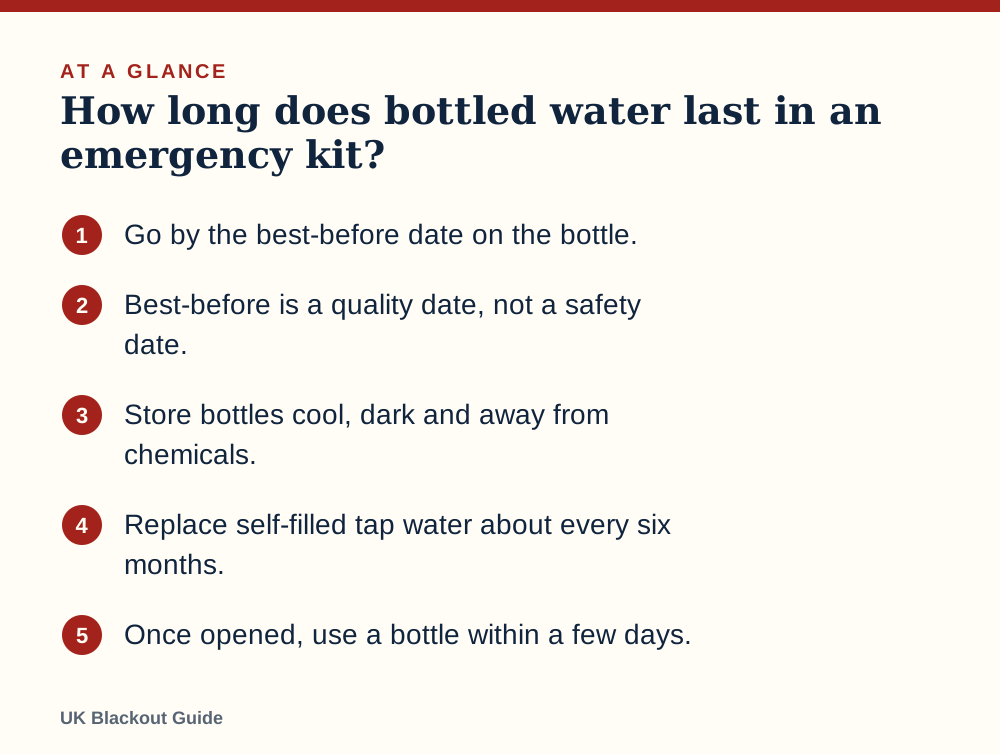
- Go by the best-before date on the bottle.
- Best-before is a quality date, not a safety date.
- Store bottles cool, dark and away from chemicals.
- Replace self-filled tap water about every six months.
- Once opened, use a bottle within a few days.
What the date on the bottle means
Water itself does not go off. The date on a sealed bottle is a best-before date, and the Food Standards Agency draws a clear line between the two kinds of date on food and drink: a use-by date is about safety, a best-before date is about quality.
So the date tells you how long the producer expects the water to taste as it should in that packaging. Over a long time, plastic bottles can let in traces of air and odours and the taste can turn flat or slightly plasticky.
For an emergency supply the simplest rule is to keep bottles within date. It costs almost nothing to do: drink the oldest and buy new.
Storage matters more than age
Where you keep the water affects it far more than how long you keep it.
- Cool. Heat speeds up the breakdown of plastic. Avoid lofts, conservatories, car boots in summer and cupboards next to boilers.
- Dark. Sunlight degrades bottles and encourages algae in any that have been opened.
- Away from chemicals. Plastic is slightly porous to vapours. Water stored beside petrol, paint, white spirit or strong cleaning products can pick up a taint.
- Sealed and off the floor. Keep the shrink-wrap on until you need it and stand packs on a shelf or board in a garage or shed.
Throw away any bottle that is leaking, bulging, cloudy or has a broken seal.
Water you bottle yourself
Tap water in your own containers has no best-before date, so set one. The government's Be Ready campaign suggests checking your emergency kit every six months, and that is a sensible moment to empty, rinse and refill them.
Use clean containers made for storing drinking water, fill them from the cold kitchen tap, cap them tightly and write the date on the side.
If stored tap water smells or tastes odd when you open it, use it for flushing or treat it first, as described in making water safe to drink.
How much to keep and how to rotate it
The official figure for how much water to store is 3 litres per person per day for three days, so 9 litres each.
Rotation is easy if the emergency supply is the same water you drink anyway. Put new packs at the back, take from the front, and the stock never gets old. The same habit is the basis of a long-term water plan if you ever want a larger reserve than three days.
Common questions
Is bottled water safe to drink after its best-before date?
The date is about quality. Sealed water stored well is unlikely to be harmful shortly after it, but it may not taste as fresh, and for an emergency supply it is simplest to keep stock in date.
Does sparkling water keep as long as still?
Go by the date on the bottle. Sparkling water gradually loses its fizz in storage, and still water is more useful for cooking, formula and washing.
How long does bottled water last once opened?
Treat an opened bottle like any other drink: keep it capped, keep it cool and use it within a few days.
Reviewed against these sources on 18 November 2026. If official advice has changed since, follow the official advice.
General information only. This page is not professional, safety, medical, legal or financial advice, and it is not official guidance. No national blackout has been forecast or announced, and nothing here suggests one is expected. We are independent and have no connection to the government or any energy company. Anything involving electricity, gas, fuel or food safety should be checked with a qualified professional or the relevant official body before you act on it. Always check the official sources linked on this page. Full disclaimer
Keep reading
 Buying guide
Best emergency water storage containers
Food grade water containers and jerry cans for an emergency drinking water store, picked from Amazon UK listings on capacity, fittings and ratings.
Read: Best emergency water storage containers Guide
How much water to store, and how to store it
How much drinking water a UK household should store for three days, how to store it safely at home and how to keep it fresh, using the official figure.
Read: How much water to store, and how to store it Guide
Washing and toilets when the water is off
How to flush a toilet, wash and stay clean when the mains water is off in a power cut, how much water it takes and what to use when there is none to spare.
Read: Washing and toilets when the water is off Buying guide
Best camping stoves for power cuts
Portable gas camping stoves for hot food and drinks in a power cut, picked from Amazon UK listings, with firm rules on outdoor-only use and CO.
Read: Best camping stoves for power cuts