On this page
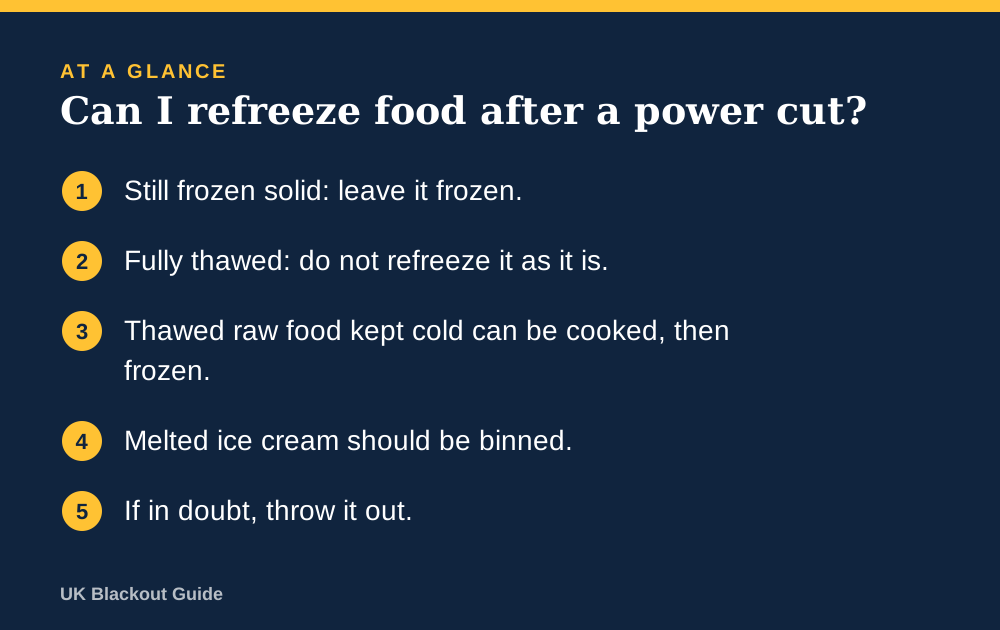
Food that is still frozen solid can stay in the freezer. Food that has fully defrosted should not simply be refrozen. Raw food that thawed and stayed cold can usually be cooked thoroughly and then frozen as a cooked dish, but anything that has been warm, or that you are unsure about, should be thrown away.
- Still frozen solid: leave it frozen.
- Fully thawed: do not refreeze it as it is.
- Thawed raw food kept cold can be cooked, then frozen.
- Melted ice cream should be binned.
- If in doubt, throw it out.
Sort the food into three piles
When the power returns, check the freezer before it has had time to refreeze everything. Then sort what you find.
| Condition | What to do |
|---|---|
| Hard, with ice crystals, no soft patches | It has stayed frozen. Leave it where it is. |
| Defrosted but still fridge-cold | Treat it as fresh, chilled food. Cook it and eat it within a day, or cook it and freeze the cooked dish. Do not put it back as it is. |
| Defrosted and no longer cold, or you cannot tell | Throw it away. |
This follows the Food Standards Agency's general position that defrosted food should not be refrozen raw, but can be cooked and then frozen. The FSA publishes the detail at food.gov.uk and is the place to check anything specific, and our guide to food safety in a power cut covers chilled food as well.
Why you should not just refreeze it
Freezing does not kill bacteria. It pauses them. When food thaws, they start to multiply again, and refreezing only pauses them at that higher level. The next time the food is defrosted, it starts from a worse position.
Cooking thoroughly is what resets the count. That is why "thawed raw mince" can become "frozen cooked bolognese" but should not go back in the freezer as raw mince.
Texture suffers too. Thawing and refreezing breaks down the structure of fruit, vegetables and fish, so even food that is safe may be disappointing.
Foods to be strict about
Some foods are not worth any risk once they have thawed and warmed: ice cream and frozen desserts, cooked rice dishes, shellfish, and ready meals containing meat, fish or dairy. Melted ice cream should always go.
Bread, plain baked goods, butter and hard cheese are far more forgiving and mainly lose quality.
Be stricter still if you are feeding a baby, someone pregnant, an older person or anyone with a weakened immune system.
Never taste food to decide whether it is safe. If in doubt, throw it out.
How to know what happened while you were away
The hard cases are the ones where you were not there, such as a cut during a holiday that ended before you got home. Food may have thawed and refrozen without your knowing. Misshapen tubs, ice cream that has sunk, and frozen puddles in the bottom of drawers are warning signs.
A thermometer with a memory, like those in our thermometer recommendations, removes the doubt.
A full freezer typically stays frozen for about 48 hours, as explained in how long a freezer lasts without power, so short cuts rarely cause this problem.
If you do lose food, photograph it before you bin it, because some home insurance covers freezer contents.
Common questions
Can I refreeze meat that still has ice crystals in it?
Meat that is still hard and icy has not defrosted and can stay frozen. If parts have gone soft, treat it as defrosted: cook it, then freeze the cooked dish.
Can I refreeze bread after a power cut?
Bread is low risk and can generally be refrozen, though it may be drier. Throw it away if it has gone mouldy or got wet from other thawing food.
How quickly should I cook thawed food?
Treat it like fresh chilled food and cook it within about a day, provided it has stayed fridge-cold. If it has been warm, do not use it.
Reviewed against these sources on 18 November 2026. If official advice has changed since, follow the official advice.
General information only. This page is not professional, safety, medical, legal or financial advice, and it is not official guidance. No national blackout has been forecast or announced, and nothing here suggests one is expected. We are independent and have no connection to the government or any energy company. Anything involving electricity, gas, fuel or food safety should be checked with a qualified professional or the relevant official body before you act on it. Always check the official sources linked on this page. Full disclaimer
Keep reading
 Buying guide
Best fridge and freezer thermometers for power cuts
Fridge and freezer thermometers that tell you whether food stayed cold through a power cut, including battery-free dials and max and min memory models.
Read: Best fridge and freezer thermometers for Guide
Food safety in a power cut: fridge and freezer rules
Fridge and freezer rules for a UK power cut: how long food stays safe, what to check when the power returns and what to throw away, based on FSA advice.
Read: Food safety in a power cut: fridge and Guide
Saving your freezer in a long power cut
What to do with a full freezer when a power cut runs past a day: how long it holds, backup power, cool boxes, what to cook first and when to let food go.
Read: Saving your freezer in a long power cut Question
How long does a freezer stay frozen without power?
A full freezer typically stays frozen for about 48 hours without power and a half-full one about 24 hours, if unopened. What affects it and what to do.
Read: How long does a freezer stay frozen without