On this page
A family of four needs 12 litres of drinking water a day, using the official figure of 3 litres per person per day. For the three days the government asks households to cover, that is 36 litres. Allow more for cooking and washing: 50 to 60 litres gives a comfortable three-day supply.
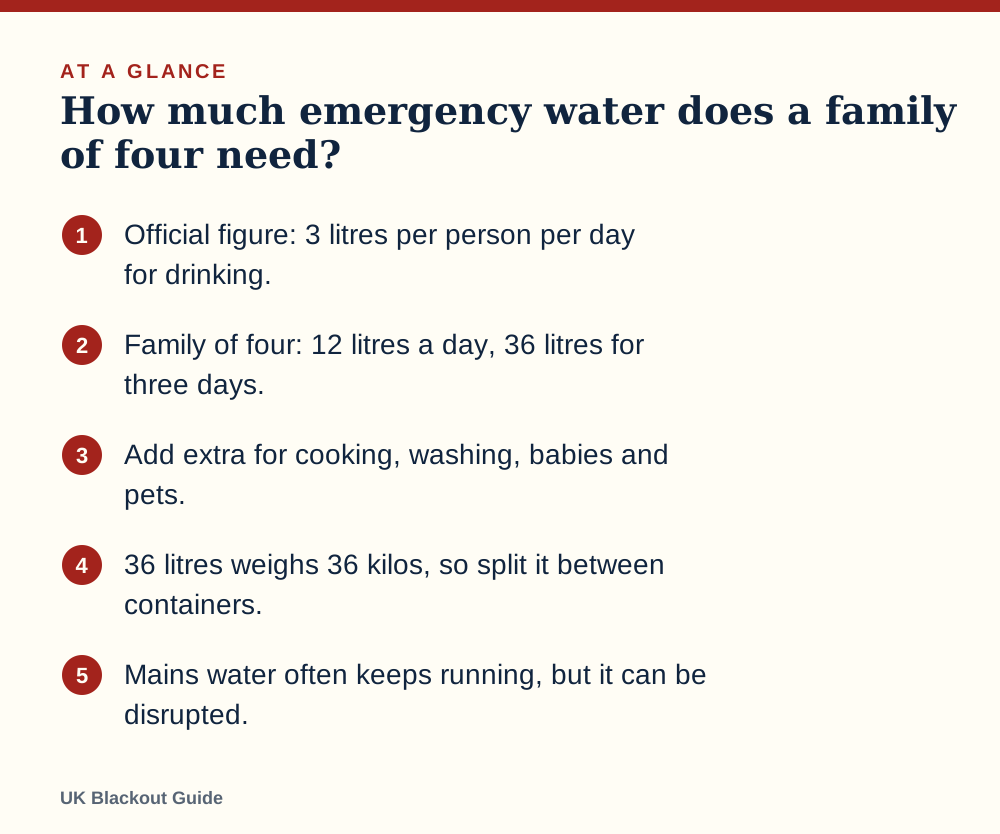
- Official figure: 3 litres per person per day for drinking.
- Family of four: 12 litres a day, 36 litres for three days.
- Add extra for cooking, washing, babies and pets.
- 36 litres weighs 36 kilos, so split it between containers.
- Mains water often keeps running, but it can be disrupted.
The sums for three days, a week and two weeks
The government's Be Ready campaign gives 3 litres per person per day for drinking, and says you need more for cooking and washing. For four people the drinking water works out as follows.
| Period | Drinking water | In 2-litre bottles |
|---|---|---|
| One day | 12 litres | 6 |
| Three days | 36 litres | 18 |
| One week | 84 litres | 42 |
| Two weeks | 168 litres | 84 |
Three days is the official target, and the government has not asked households to store more. The longer rows are optional planning, and they show why storage alone stops being practical after a week or so, and why a longer water plan relies on refilling and treating water as well.
What to add on top of drinking water
The 3-litre figure covers drinking. Cooking pasta or rice, making up formula, washing hands, brushing teeth and wiping down surfaces all take more. There is no official number for these, so treat the following as a planning allowance: an extra 1 to 2 litres per person per day covers basic cooking and hygiene if you are careful, which brings a family of four to 50 to 60 litres for three days.
Adjust for your household. A baby on formula needs safe water for feeds unless you keep ready-to-feed formula, which the official list prefers. A dog or cat needs its usual amount. Hot weather raises everyone's needs.
Toilet flushing uses far more than all of this, and should never come from your drinking store. Use rainwater or saved washing water, as explained in washing and toilets when water is short.
Where to put 36 litres
Thirty-six litres weighs 36 kilos and takes up about the space of a small suitcase. Bottled water from the supermarket is the easy route: three six-packs of 2-litre bottles fit under a bed or at the bottom of a wardrobe.
Refillable water containers cost less over time and create less waste. Fill them from the tap, label them with the date and refresh them regularly.
Keep water somewhere cool and dark, away from fuel and cleaning products, which matters more to how long bottled water lasts than the date on the label.
Whether you will need it
In most power cuts the taps keep running. Official advice still says mains water can be disrupted during and after power cuts, and some flats lose pressure early because they depend on pumps. Stored water covers that gap without you having to find out whether your tap will work on the day.
If the tap is running when a long cut starts, fill spare containers and saucepans straight away. Our main guide on how much water to store has figures for other household sizes.
Common questions
Is 2 litres per person per day enough?
The official UK figure in the Be Ready campaign is 3 litres per person per day for drinking. Plan on that, and more in hot weather.
Do children need the full 3 litres?
Young children drink less, but planning 3 litres for everyone gives a margin for cooking and spills. It also keeps the sums simple.
Can I count squash, juice and tinned food as water?
They help with fluid intake but do not replace plain water, which you also need for cooking, hygiene and medicines. Keep the full water store and treat other drinks as extra.
Reviewed against these sources on 18 November 2026. If official advice has changed since, follow the official advice.
General information only. This page is not professional, safety, medical, legal or financial advice, and it is not official guidance. No national blackout has been forecast or announced, and nothing here suggests one is expected. We are independent and have no connection to the government or any energy company. Always check the official sources linked on this page. Full disclaimer
Keep reading
 Guide
A week without power: what changes after day three
Optional planning beyond the official three days: what changes by day seven of a power cut for water, cooking, freezer food, phone charging and cash.
Read: A week without power: what changes after day Guide
A long-term water plan
How to plan water for a long outage in three layers: what to store, where to top up, and how to treat doubtful water by boiling, filtering or tablets.
Read: A long-term water plan Guide
Three days without power: the plan the government asks for
A day-by-day plan for three days without mains power, built on the UK government's Be Ready advice: water, food, light, radio, warmth and phone charge.
Read: Three days without power: the plan the Question
What runs out first in a long blackout?
The order in which things run out in a long, wide-area blackout: phone signal and charge, card payments and cash, fridge food, fuel and tap water.
Read: What runs out first in a long blackout?