On this page
The government asks households to be ready for three days. It has not asked anyone to prepare for a week and has not suggested a cut of that length is expected, so this page is optional planning beyond official guidance. After day three, freezer food has thawed, power banks are flat, and water, cooking, cash and fuel become the daily jobs.
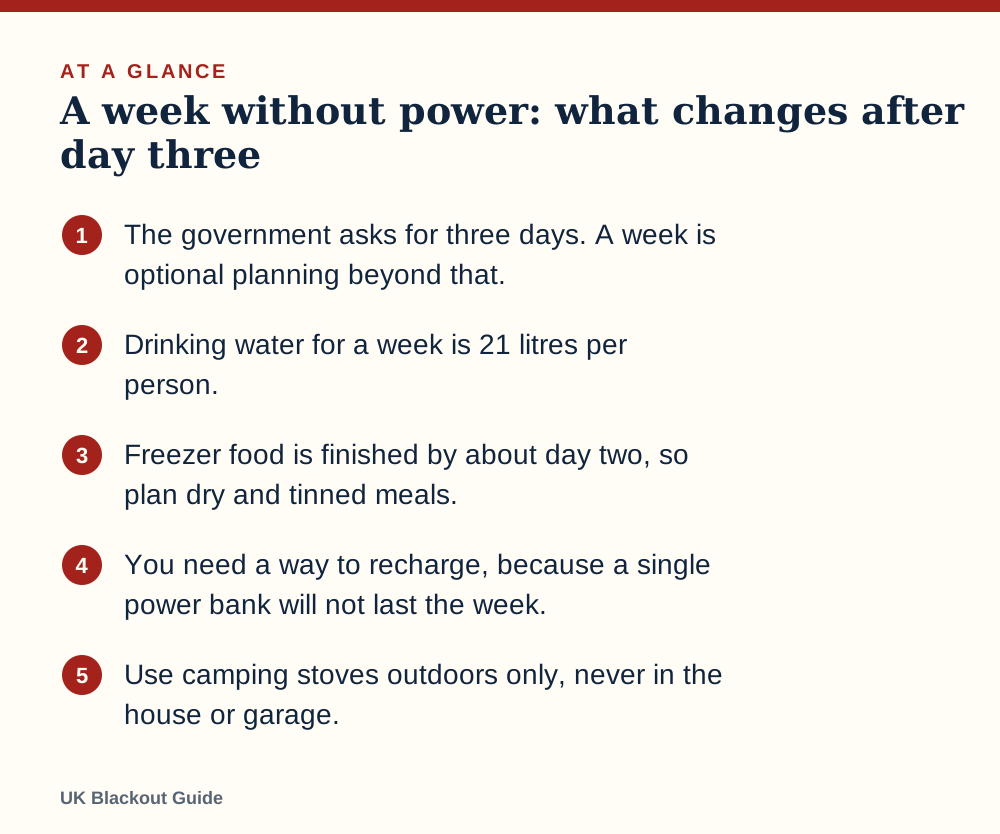
- The government asks for three days. A week is optional planning beyond that.
- Drinking water for a week is 21 litres per person.
- Freezer food is finished by about day two, so plan dry and tinned meals.
- You need a way to recharge, because a single power bank will not last the week.
- Use camping stoves outdoors only, never in the house or garage.
A week goes beyond what the government asks for
The government's Be Ready campaign asks households to be able to manage for three days. It has not asked anyone to prepare for a week, and it has not suggested that a power cut of that length is expected. Everything on this page is optional planning beyond official guidance. The same applies to our longer page on managing 30 days without mains power.
Week-long cuts have happened in the UK to a small number of homes. Storm Arwen in November 2021 cut power to about 1 million customers, and some rural properties in northern England and Scotland were off for more than a week. It is a record of one storm, not a sign of what will happen next.
The longer official figures concern the electricity system, not households. Under the Electricity System Restoration Standard, NESO must have the capability by 31 December 2026 to restore 60% of demand in each region within 24 hours and all of Great Britain's demand within five days. The National Risk Register rates a national outage as low likelihood but very high impact, and says restoring the transmission system could take up to about 7 days. Some households choose a week as a personal margin on that basis.
What changes between the first three days and the rest of the week
| Need | Days 1 to 3 | Days 4 to 7 |
|---|---|---|
| Water | Stored bottles | Refilling, collecting and treating |
| Food | Fridge, then freezer, then cupboard | Tins and dry goods only |
| Phone charge | Power bank | Car, solar or a power station |
| Money | Cash in your wallet | A planned cash reserve |
| Washing | Wipes and sanitiser | A proper wash routine with heated water |
| Mood | Novelty | Tiredness and boredom |
The pattern is that everything you could run down in the first three days now has to be replenished or replaced with a slower method.
Water becomes the first job of each day
At 3 litres per person per day for drinking, a week is 21 litres each and 84 litres for a family of four, before any cooking or washing. Few homes store that much, so the plan for a week is storage plus a way to top up.
Mains water may keep running, and you should fill containers whenever it does, because supply can be disrupted during and after power cuts. Keep some means of making doubtful water safe to drink, such as boiling or purification tablets, in case the advice from your water company changes.
Cooking takes over from cold meals
Three days of cold tins is tolerable. Seven is hard, especially in winter, and hot food and drinks do a lot for warmth and morale. If you have a gas hob it may light with a match while the gas supply continues. If you do not, a single-burner camping stove is the usual answer to cooking without electricity.
Camping stoves, barbecues and generators give off carbon monoxide. Never use them indoors, in a garage or in a tent. Fit an audible carbon monoxide alarm marked EN 50291.
Freezer contents will have gone by day two or three. A full freezer typically stays frozen for about 48 hours. Check whether thawed food can be refrozen before you decide what to keep, and if in doubt, throw it out.
Recharging replaces stored charge
One 20,000 mAh power bank gives about 3 to 4 phone charges. Across a week and a whole household, that is not enough, so you need a way to put energy back in. A car can charge phones while the engine runs. A portable power station holds far more than a power bank and can be topped up from one of the best portable solar panels, though UK winter yields are low.
If you are considering a generator instead, read the generator safety rules first.
Cash, fuel and the wider area
In a wide-area cut, card payments, cash machines and fuel pumps may not work. That happened locally in Lancaster in 2015 and across Spain and Portugal in April 2025. Keep notes and coins at home, and try to keep the car at least half full as a habit. The detail on whether petrol stations can serve fuel in a power cut is worth knowing before you set off to find some.
If the cut is local, deciding whether to stay at home or go elsewhere may have a simple answer: go somewhere that has power.
Looking after people for seven days
By the second half of the week the difficulties are human ones. Sleep suffers in a cold house, children get bored, and older relatives may quietly stop eating and drinking enough. Keep mealtimes, keep one warm room, and get outside in daylight.
Keep checking on neighbours, and ask your network operator about welfare support. After long cuts, compensation may also be available under Ofgem's Guaranteed Standards, so keep a note of when the power went off and came back. A pack of cards and a few of the best games for evenings without screens earn their place in a week-long plan.
Common questions
How likely is a week-long power cut in the UK?
No official body has put a figure on it. The National Risk Register rates a national outage as low likelihood but very high impact, and NESO's restoration standard is all of Great Britain's demand within five days. The week-long cuts on record followed severe storms in rural areas.
Is a week of supplies officially recommended?
No. The Be Ready campaign asks for three days, and the government has not suggested a week-long cut is expected. A week is a personal choice.
Can I keep a freezer going for a week on a power station?
Only with a large unit and a way to recharge it. A fridge-freezer averages 40 to 80 watts, which is roughly 1 to 2 kWh a day.
Will I get compensation for a week without power?
Possibly. Payments exist for long unplanned cuts under Ofgem's Guaranteed Standards, and the rules depend on the weather category. Check with Ofgem or your network operator.
- Be Ready campaign, UK government
- NESO, National Energy System Operator
- National Risk Register, Cabinet Office
- Food Standards Agency
- Ofgem
Reviewed against these sources on 18 November 2026. If official advice has changed since, follow the official advice.
General information only. This page is not professional, safety, medical, legal or financial advice, and it is not official guidance. No national blackout has been forecast or announced, and nothing here suggests one is expected. We are independent and have no connection to the government or any energy company. Always check the official sources linked on this page. Full disclaimer
Keep reading
 Question
Can portable solar keep a household going in a long power cut?
What portable solar panels can and cannot power in a UK home during a long outage, with realistic summer and winter output and example daily loads.
Read: Can portable solar keep a household going in Question
How much emergency water does a family of four need?
How much water a family of four should store for a power cut: 12 litres a day for drinking, 36 litres for three days, plus extra for cooking and washing.
Read: How much emergency water does a family of Question
What runs out first in a long blackout?
The order in which things run out in a long, wide-area blackout: phone signal and charge, card payments and cash, fridge food, fuel and tap water.
Read: What runs out first in a long blackout? Guide
How to manage 30 days without mains power
Optional planning for 30 days without mains power, far beyond the three days UK guidance asks for: what water, food, energy and health would need.
Read: How to manage 30 days without mains power