On this page
In a blackout lasting days, a folding 100 W panel is the most useful size: big enough to put a real dent in a power station on a bright day, small enough to store. Expect roughly 300 to 400 Wh on a clear summer day and often only 30 to 80 Wh on a dull winter day. Check the connector matches your battery.
- Solar is the only quiet, fuel-free way to refill a battery in a long cut.
- Winter output can be a tenth of a clear summer day.
- Connectors and voltage must match your power station.
- Panels with USB ports charge phones with no battery in between.
- Buy and try the panel before you need it.
In a blackout that lasts days, a battery is only as good as your way of refilling it. A portable solar panel is the quiet, fuel-free option, and it can sit in a garden, on a balcony or against a south-facing wall. It is also weather dependent, and the UK is not generous with winter sun. The realistic picture is in portable solar charging in the UK.
This list is ordered by usefulness when the grid is down: folding panels that refill a power station or 12 V battery, smaller USB panels that keep phones going with nothing in between, and one rigid panel for a fixed setup. Rooftop systems are a separate subject: most home solar shuts off in a power cut unless it has battery backup that can run independently of the grid, as explained in solar panels in a power cut.
Our picks for a power cut, at a glance




Renogy 100W Portable Solar Panel Kit, 20A Controller
★ 4.6 from 1,600 buyers · About £150 when checked 18 November 2026The listing describes a 100 W folding suitcase panel with tempered glass and a 20 A charge controller, for 12 V batteries and power stations. In a long cut that gives you two things to refill: a power station or a spare leisure battery. Rated 4.6 from about 1,600 buyers, at about £150.
- Charge controller included
- Works with 12 V batteries and power stations
- High rating
- Glass suitcase panels are heavier than fabric folding ones
- Check the lead fits your power station's input
ALLPOWERS 100W Foldable Solar Charger, USB and 18V DC
★ 4.4 from 938 buyers · About £140 when checked 18 November 2026The listing gives 100 W with dual 5 V USB outputs and an 18 V DC output. That covers both blackout jobs: phones and power banks straight from the panel, and a power station through the DC lead. Rated 4.4 from about 940 buyers, at around £140.
- USB and DC outputs on one panel
- Folds for storage
- Phones can charge with no battery in between
- Check the DC lead fits your power station
- Fewer ratings than the Renogy kit
DOKIO 110W Foldable Solar Panel Kit, 2.4kg
★ 4.3 from 1,100 buyers · About £85 when checked 18 November 2026The listing gives 110 W, a weight of 2.4 kg, a controller and two USB outputs, for around £85. It is described as suitable for 12 V batteries, so it can keep a spare car or leisure battery topped up through a long cut while the USB ports see to phones. Rated 4.3 from about 1,100 buyers.
- Light and easy to store
- USB outputs for phones
- Low price for the wattage
- Rating is lower than the Renogy
- Supplied controller is for 12 V batteries, not every power station
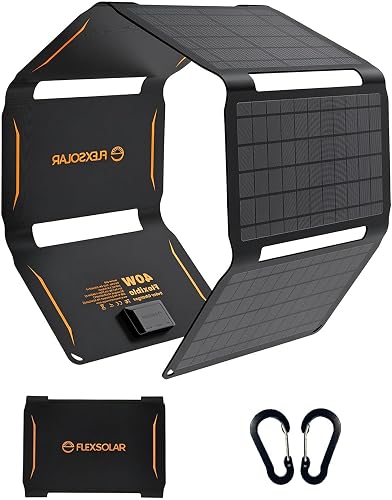
FlexSolar 40W Foldable Solar Charger, USB-C
★ 4.2 from 1,300 buyers · About £80 when checked 18 November 2026A 40 W folding panel with a USB-C output, so a phone or power bank plugs straight in with no power station needed. If phones and a radio are all you need to keep going for days, this is the simplest route. Rated 4.2 from about 1,300 buyers, at about £80.
- USB-C output
- Small enough for a windowsill or grab bag
- Too small to refill a power station in a sensible time
- Phone charging slows or stops when cloud passes
ALLPOWERS SE60 60W Foldable Solar Panel
★ 4.4 from 1,500 buyers · About £66 when checked 18 November 2026The listing gives 60 W and three outputs, which suits a 250 to 300 Wh power station or a couple of power banks, the size of kit many homes buy for lights and phones in a cut. Rated 4.4 from about 1,500 buyers, at around £65.
- Three outputs
- Good price
- Compact when folded
- Slow for anything above 300 Wh
ECO-WORTHY 200W Foldable Solar Panel
★ 4.3 from 190 buyers · About £155 when checked 18 November 2026Sold for power stations, with 200 W listed, at about £155. Twice the area means roughly twice the yield: perhaps 600 to 800 Wh on a clear summer day, which starts to matter if you are running a fridge-freezer from a battery. Rated 4.3 from about 190 buyers.
- Double the output of a 100 W panel
- Good price per watt
- Needs more space to lay out
- Confirm your power station's maximum solar input
Jackery SolarSaga 100W Portable Solar Panel
★ 4.5 from 1,800 buyers · About £273 when checked 18 November 2026If the battery you have bought for power cuts is a Jackery, the maker's own 100 W panel removes any doubt about connectors on the day. It has the most ratings on this list, 4.5 from about 1,800 buyers, but costs about £270.
- Made to pair with Jackery units
- Most buyer ratings here
- Expensive per watt
- Other brands of power station may need an adaptor
Renogy 100W 12V Monocrystalline Solar Panel
★ 4.6 from 1,400 buyers · About £70 when checked 18 November 2026A rigid framed 100 W panel sold for motorhomes, caravans and off-grid use, at around £70. Fixed to a shed or garage roof with a 12 V battery, it stays charged and ready before any cut begins. Rated 4.6 from about 1,400 buyers. It is a bare panel.
- Low price
- Suited to permanent outdoor mounting
- No controller or leads mentioned in the title
- Not foldable, so awkward to store indoors
How we chose
These were chosen from Amazon UK listings on 18 November 2026 on listed wattage, listed outputs, price and verified buyer ratings. This site has not hands-on tested any of them. Efficiency percentages quoted in listings are makers' claims and were not used to rank anything. Prices and stock change.
Expect far less than the number on the box
The wattage on a panel is its output in ideal test conditions. In the UK a 100 W portable panel typically yields roughly 300 to 400 Wh on a clear summer day and often 30 to 80 Wh on a dull winter day. A 1,000 Wh power station therefore needs about three good summer days from one panel, and in December it may barely keep a router and phones going.
Angle the panel at the sun, keep every cell out of shade and move it through the day. Charging through a window loses a lot. For plans that last longer than a weekend, read off-grid power for weeks.
Match the connector and the input limit
Power stations use several different solar input plugs, and each has a maximum solar wattage and voltage range. Before buying, look up your power station's solar input details and compare them with the panel listing. Buying the same brand, or a bundle, avoids the problem. Bundles appear in the portable power stations list.
If the panel's wattage is above your power station's solar input limit, the extra is wasted. If the voltage is outside its range, it may not charge at all.
Folding, suitcase or rigid
Fabric folding panels are light and store in a cupboard. Glass suitcase panels are heavier but stand up by themselves. Rigid framed panels cost least per watt and suit a shed roof or caravan, but they need a charge controller, cable and a 12 V battery to be useful. If that sounds like a project, whether solar panels can run a house off grid gives a sense of scale.
Whichever type you choose, think about where it will stand. A south-facing spot with no shade from chimneys, trees or railings matters more than the panel type.
Panels with USB ports
A panel with a USB output can charge a phone or power bank on its own. Charging a power bank is the better habit, because output dips with every cloud and some phones stop charging when that happens. Charge the bank by day and the phone from the bank at night. Other routes are in ways to charge a phone in a blackout.
A 40 W panel in good sun can deliver a useful phone charge in a few hours. In flat grey winter light it will be much slower, so start early in the day.
How much to spend on a solar panel for a blackout
Under £90 buys a 40 to 60 W folding panel, a 110 W budget kit or a bare rigid 100 W panel. That is enough to keep phones, power banks and a small power station going in decent light. The middle of the range, £100 to £160, buys a 100 W folding kit with a charge controller or a 200 W folding panel, which is the level at which a mid-size power station refills in a day or two of good sun. The high end, about £270 for a 100 W panel from a power station maker, buys a guaranteed match with that brand's connectors and nothing extra in output. It is overkill unless you own the matching power station. The catalogue also lists panel and power station bundles at around £950 and above, which belong with power stations for power cuts.
Common questions
Will a portable solar panel work in a British winter?
Yes, but weakly. A 100 W panel often gives only 30 to 80 Wh on a dull winter day, enough for phones and perhaps a router for a few hours.
Can I plug appliances straight into a solar panel?
No. Apart from USB devices on panels with USB ports, you need a power station or a battery with a controller in between.
Can I leave a folding panel outside?
Check the listing for a weather rating. Most folding panels cope with a shower but are not meant to live outdoors, and the connectors should be kept dry.
Is one 100 W panel enough?
For phones, lights and a router in summer, yes. For a fridge-freezer or winter use, you would need several panels and realistic expectations.
Reviewed against these sources on 18 November 2026. If official advice has changed since, follow the official advice.
General information only. This page is not professional, safety, medical, legal or financial advice, and it is not official guidance. No national blackout has been forecast or announced, and nothing here suggests one is expected. We are independent and have no connection to the government or any energy company. Products are chosen from retailer listings and buyer ratings and have not been tested by us; some links earn us a commission. Anything involving electricity, gas, fuel or food safety should be checked with a qualified professional or the relevant official body before you act on it. Always check the official sources linked on this page. Full disclaimer
Keep reading
 Guide
Backup power for your home: every option compared
Power banks, power stations, generators, solar panels, cars and UPS units compared: what each can run in a UK power cut, for how long, and who needs which.
Read: Backup power for your home: every option Question
Do solar power banks work in a blackout?
Solar power banks work as ordinary power banks, but the built-in panel is too small to refill them in UK light. What the panel adds, and what works better.
Read: Do solar power banks work in a blackout? Guide
Portable solar charging in UK weather: what to expect
What a portable solar panel really produces in UK weather, summer and winter, with worked examples of what that energy will run in a power cut.
Read: Portable solar charging in UK weather: what Guide
Do solar panels work in a power cut?
Why most UK rooftop solar switches off in a power cut, which battery systems keep working, and how portable panels can still give you power.
Read: Do solar panels work in a power cut?