On this page
Storm Arwen struck in November 2021 and cut power to about 1 million customers. Most were reconnected sooner, but some rural homes in northern England and Scotland were without electricity for more than a week, in cold weather. The government's Be Ready guidance asks households to be able to manage for three days. It has not asked anyone to prepare for longer, so keeping more is an optional step beyond official guidance.
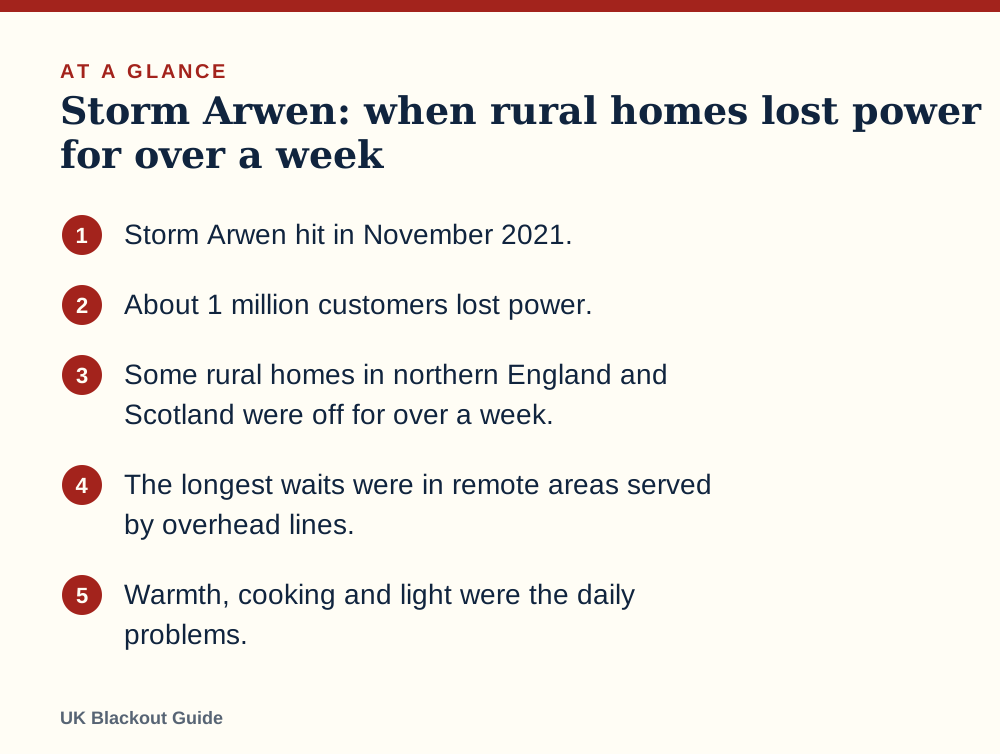
- Storm Arwen hit in November 2021.
- About 1 million customers lost power.
- Some rural homes in northern England and Scotland were off for over a week.
- The longest waits were in remote areas served by overhead lines.
- Warmth, cooking and light were the daily problems.
What happened in November 2021
Storm Arwen arrived in November 2021. About 1 million customers lost their electricity. Most were reconnected well before the last homes were.
For a smaller group it was far longer. Some rural homes in northern England and Scotland were off supply for more than a week. It was winter, so those households had no heating controls, no lighting through long nights, and in many cases no way to cook.
This page describes what happened in one storm. It is not a forecast. The government's Be Ready campaign asks households to be able to manage for three days. It has not asked households to prepare for a week and has not suggested a cut of that length is expected, so anything here beyond three days is optional planning beyond official guidance.
Nothing failed at national level. The grid kept running and most of the country noticed only bad weather. The damage was to local lines, repeated across a very large area, which is the usual pattern when storms cause power cuts.
Why remote homes wait longest
In the countryside, electricity mostly travels on overhead lines carried on poles. Wind and falling trees bring those lines down, and a big storm can do so in a great many separate places at once.
Engineers generally restore the largest groups of customers first, because one repair to a main line can bring back thousands of homes. A farmhouse at the end of a long single line may need its own repair, and it comes later in the queue. Blocked roads slow everything further.
Official guidance is to be able to manage for three days. If you live at the end of a lane and choose to keep more than that, a week without power is the optional next step to plan for.
Staying warm through a long winter cut
Cold was the hardest part for homes that were off for days. Almost every modern heating system needs electricity for its controls and pump, so gas and oil boilers stop along with electric heating.
Official advice is to wear layers, use blankets, and close doors and curtains. Over several days, the practical method for coping with a power cut in winter is to pick one room, live and sleep in it, and heat people instead of the space. The NHS advises keeping the rooms you use at 18°C or above, and it describes hypothermia as a body temperature below 35°C, with shivering, pale cold skin, slurred speech, confusion and tiredness as signs. Call 999 if you see them.
Hot food and drinks, safely
A hot meal and a hot drink make a cold house far easier to bear. With an electric cooker out of action, a camping stove is the usual answer, and where you can safely use a camping stove matters more than which one you buy.
Never use a camping stove, barbecue, patio heater or generator indoors, in a garage or in a tent. They give off carbon monoxide, which has no smell. Symptoms are headache, dizziness, nausea, breathlessness and collapse. Fit an audible alarm certified to EN 50291.
Light for long evenings
In late November it is dark by late afternoon. Several evenings of that need more than one torch and the batteries that happened to be in it. Be Ready's advice is that torches are safer than candles.
The paperwork side: registers and payments
Two things are worth sorting out before winter. The first is the Priority Services Register, which is free in England, Scotland and Wales. Many households qualify, including those with children under 5, older people, and anyone who relies on powered medical equipment. It tells your network operator who may need extra help in a long cut.
The second is knowing that compensation for long unplanned power cuts exists under Ofgem's Guaranteed Standards. The time limits and amounts depend on the weather category and are revised from time to time, so check the current position with Ofgem or your network operator.
The government's Be Ready campaign asks every household to be able to manage for three days. It has not asked for more. In Arwen some remote homes were off for longer, which is a record of one storm and not a forecast of the next. If you live somewhere remote, keeping extra supplies is your own choice beyond official guidance.
Common questions
How many homes lost power in Storm Arwen?
About 1 million customers lost power in November 2021.
How long were people without power after Storm Arwen?
Most were reconnected much sooner, but some rural homes in northern England and Scotland were off for more than a week.
Can I get compensation for a storm power cut?
Payments are available for long unplanned cuts under Ofgem's Guaranteed Standards. Thresholds and amounts depend on the weather category, so check with Ofgem or your network operator.
Reviewed against these sources on 18 November 2026. If official advice has changed since, follow the official advice.
General information only. This page is not professional, safety, medical, legal or financial advice, and it is not official guidance. No national blackout has been forecast or announced, and nothing here suggests one is expected. We are independent and have no connection to the government or any energy company. Always check the official sources linked on this page. Full disclaimer
Keep reading
 Guide
Storms and power cuts: what past UK storms teach us
Storms cause the UK's longest power cuts. What Storm Arwen and Storm Desmond showed about how long rural cuts last, and how to prepare before a warning.
Read: Storms and power cuts: what past UK storms Question
Do gas boilers work in a power cut?
Gas boilers stop in a power cut because the controls, ignition, fan and pump all need mains electricity. Here is why, and how to stay warm until it returns.
Read: Do gas boilers work in a power cut? Question
How long do power cuts usually last?
Most UK power cuts are fixed within a few hours. Storm damage can take days and rota cuts would last about three hours. The official figures explained.
Read: How long do power cuts usually last? Guide
Rota power cuts explained: load blocks and three-hour cuts
Rota power cuts are planned, rotating cuts of about three hours used only in a national energy shortage. How load block letters work and how to prepare.
Read: Rota power cuts explained: load blocks and