On this page
Storms are the most common cause of long power cuts in the UK. Wind brings trees onto overhead lines and floods can knock out substations. Storm Arwen in 2021 left some rural homes without power for more than a week. If a storm warning is issued, charge everything, fill flasks, and get light and warm bedding ready before the wind arrives.
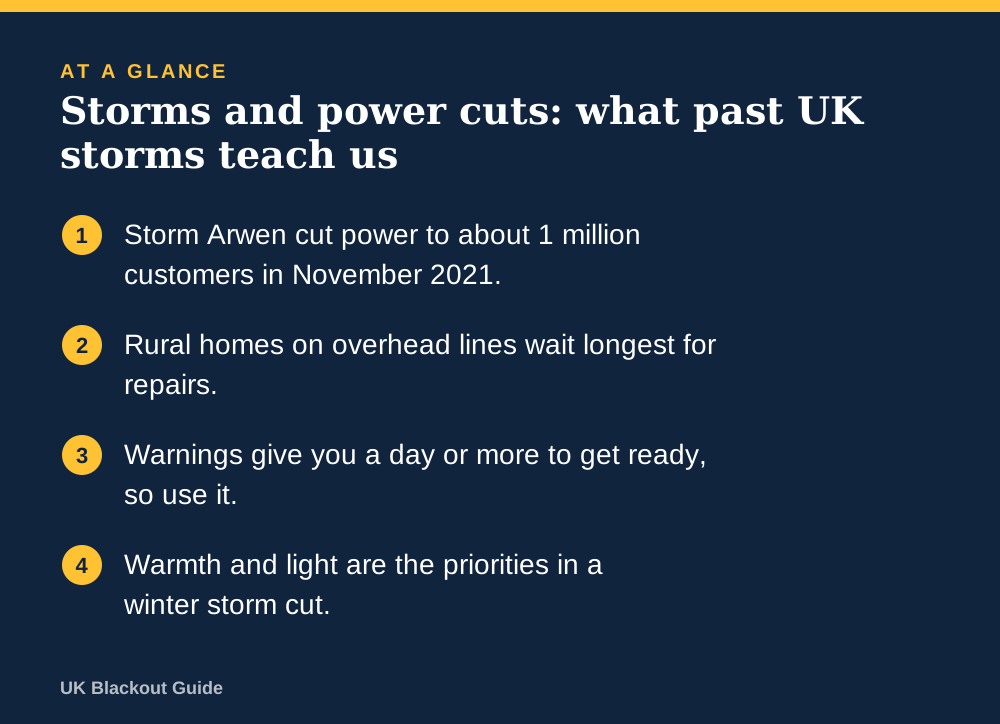
- Storm Arwen cut power to about 1 million customers in November 2021.
- Rural homes on overhead lines wait longest for repairs.
- Warnings give you a day or more to get ready, so use it.
- Warmth and light are the priorities in a winter storm cut.
Storm Arwen: a week in the cold
Storm Arwen struck in late November 2021. About 1 million customers lost power, and while most were reconnected far sooner, some rural homes in northern England and Scotland were off for more than a week.
The length of those cuts came down to the number of separate faults. Each fallen tree is its own repair job, often up a blocked lane, and remote homes at the end of a long line are fixed last because each repair there restores fewer people. Engineers work from the faults that bring back thousands towards the ones that bring back a handful.
Arwen also arrived with cold weather. Homes with gas or oil boilers lost heating as well as light, because a boiler needs electricity for its controls and pump. For households off for days, the cold indoors was the hard part.
Storm Desmond: one substation, a whole city
In the Lancaster power cut of December 2015, Storm Desmond showed a different kind of failure. Flooding reached a major substation in the city and cut power to about 61,000 properties at once. This was a single point of failure in a city, not hundreds of faults across the countryside.
The knock-on effects were the lesson. Mobile phones, internet, cash machines and card payments all failed locally. People could not ring relatives, look up information or pay for things. The local radio station, The Bay, kept broadcasting on a generator.
Lancaster showed how much else depends on electricity in one city. Battery radios and cash are both on the official Be Ready kit list.
What the two storms showed
These are accounts of what happened in two storms, not a forecast of the next one. A few practical points stand out.
- Information can fail first. In Lancaster, mobile and internet failed locally, and a radio station on a generator carried on broadcasting.
- Estimated restoration times can slip. Early estimates are made before the damage is fully surveyed, so allow for longer than you are told.
- Phones run flat or lose signal. Mobile masts need power too.
- Cold is the main health risk in a winter cut. Layers, blankets and one warm room matter more than anything else.
- Neighbours matter. Checking on neighbours is part of the official Be Ready advice for a power cut.
If you have older relatives or neighbours living alone, a storm warning is the moment to check on them.
Before the storm: use the warning
Unlike most power cuts, storms come with notice. The Met Office issues weather warnings, often a day or more ahead. Treat an amber or red wind warning as your cue to spend twenty minutes getting ready.
- Charge phones, power banks, rechargeable lanterns and laptops.
- Fill flasks with boiling water and fill a few bottles or jugs with drinking water.
- Put torches and lanterns where you can find them in the dark.
- Bring in or tie down anything loose in the garden.
- Bring blankets and sleeping bags downstairs.
- Fill the car with fuel and park away from trees.
- Make sure you have some cash and any medication you will need for the next few days.
- Save 105 in your phone.
Running through the full power cut checklist once in autumn means you only need to top up when a warning arrives.
Light for several nights
A storm cut can run well past one evening, as Storm Arwen showed. You need light that lasts several nights without a recharge, or that runs on batteries you can swap, so it pays to know how long LED lanterns last on each setting. Be Ready's advice is that torches and battery lights are safer than candles, and that applies even more when the wind is rattling the house and children are unsettled.
A lantern for the main room and a torch per person is a good baseline. Runtimes vary a great deal between models and brightness settings, so our recommended lanterns for power cuts are listed by runtime.
Staying warm when the heating is off
To keep warm in a power cut, heat people first and rooms second. Pick one room, ideally a small one with few outside walls, close the door and curtains, and gather everyone there. Wear several thin layers, a hat and socks. Eat regularly and have hot drinks from the flasks you filled.
At night, a sleeping bag rated for a cold home under a duvet is far warmer than a duvet alone.
Never use a barbecue, camping stove, patio heater or generator indoors, in a garage or in a porch for heat. They produce carbon monoxide, which has no smell and can kill. Symptoms include headache, dizziness, nausea and breathlessness. Fit an audible alarm that meets EN 50291.
The NHS describes hypothermia as a body temperature below 35°C. Signs include shivering, cold pale skin, slurred speech, confusion and tiredness. Call 999 if you see them.
During and after the storm
Stay indoors while the wind is high. After it drops, be careful outside, and know what to do if power lines are down: treat any fallen or low-hanging line as live, keep well away and report it on 105, or 999 if people are at risk.
Report your cut even if the whole village is off, and keep the fridge and freezer closed. A full freezer typically stays frozen for about 48 hours. After a long cut, ask your network operator about compensation. Payments under Ofgem's Guaranteed Standards depend on the weather category and the length of the cut, and the rules change over time, so check the current position in our guide to power cut compensation.
If your area is cut off for several days, network operators and councils often set up welfare points with hot food and charging. Listen to local radio for where they are.
Common questions
Are underground cables safe from storms?
They are protected from wind and falling trees, which is why towns usually fare better. Flooding can still damage the substations that feed them.
Should I buy a generator for storm season?
It can make sense for rural homes with repeated long cuts, but it must run outdoors, well away from doors and windows, and never be plugged into a house socket.
Is it safe to use candles during a storm power cut?
Official advice is that torches are safer. If you do use candles, keep them in stable holders, away from curtains and draughts, and never leave them unattended.
How do I find out when my power will be back after a storm?
Check your network operator's website or power cut map, call 105, and listen to local radio. Expect early estimates to change.
Reviewed against these sources on 18 November 2026. If official advice has changed since, follow the official advice.
General information only. This page is not professional, safety, medical, legal or financial advice, and it is not official guidance. No national blackout has been forecast or announced, and nothing here suggests one is expected. We are independent and have no connection to the government or any energy company. Always check the official sources linked on this page. Full disclaimer
Keep reading
 Explainer
Storm Arwen: when rural homes lost power for over a week
Storm Arwen cut power to about 1 million customers in November 2021, and some rural homes waited more than a week. What happened and what official guidance says.
Read: Storm Arwen: when rural homes lost power for Question
Do gas boilers work in a power cut?
Gas boilers stop in a power cut because the controls, ignition, fan and pump all need mains electricity. Here is why, and how to stay warm until it returns.
Read: Do gas boilers work in a power cut? Question
How long do power cuts usually last?
Most UK power cuts are fixed within a few hours. Storm damage can take days and rota cuts would last about three hours. The official figures explained.
Read: How long do power cuts usually last? Question
Will there be power cuts this winter?
Will there be power cuts this winter? Local cuts from storms and faults happen every winter. No national blackout is forecast. Where to check for yourself.
Read: Will there be power cuts this winter?