On this page
A good power cut checklist has four parts: things to set up before any cut, the first ten minutes, the hours while the power is off, and the checks when it returns. Print it and keep it with your torch, because the moment you need it is the moment your screen may not be an option.
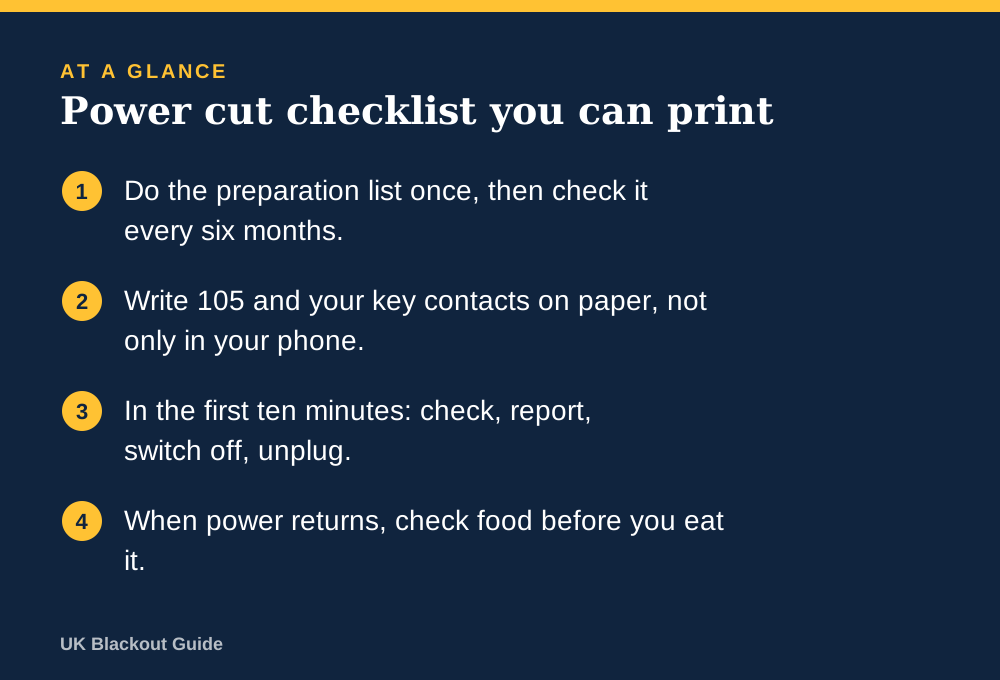
- Do the preparation list once, then check it every six months.
- Write 105 and your key contacts on paper, not only in your phone.
- In the first ten minutes: check, report, switch off, unplug.
- When power returns, check food before you eat it.
How to use this checklist
The four lists below follow the order things happen. The first one is the only one that takes any real effort, and you do it on an ordinary day. The other three are prompts for a tired brain in a dark house.
Print the page or copy the lists by hand, then tape them inside the cupboard where your torch lives. A checklist stored only on a phone is no help if the battery is at 4%.
Before any power cut: the one-off jobs
- Write down 105 (03457 643643 in Northern Ireland) and the name of your network operator.
- Find your load block letter at powercut105.com or on your bill. In a national shortage, planned cuts would be announced by load block letter.
- Join the Priority Services Register if you qualify. The Priority Services Register is free, and many households do, including those with children under five, older people and anyone using powered medical equipment.
- Put a torch in a fixed place on each floor, with spare batteries beside it.
- Keep a charged power bank and its cable together.
- Have a battery or wind-up FM radio and know where it is.
- Keep some cash in notes and coins. Card machines and cash points can fail in a wide cut, which is the case for keeping cash for an emergency.
- Write a paper list of phone numbers and any medication you take.
- Find your fuse box and learn what a tripped switch looks like.
- Ask your landline provider about battery backup if you depend on a digital landline.
The torch is the item people most often think they have and then cannot find. One per floor is the minimum. One per person is better.
For everything beyond the basics, including water, food and first aid, work from the full emergency kit list, which follows the government's Be Ready advice to be able to manage for three days.
The first ten minutes
- Stay still for a moment and let your eyes adjust. Then fetch the torch.
- Check the fuse box. If a switch has tripped, the fault is in your home.
- Look outside. Are the neighbours and street lights off too?
- Report it on 105.
- Switch off the oven, hob, iron, electric fires and fryers.
- Unplug the TV and computer to protect them from a surge when power returns. That is most of the answer to whether to unplug everything.
- Leave one light switched on so you know when the supply is back.
- Note the time the power went off.
While the power is off
- Keep the fridge and freezer closed. The Food Standards Agency says an unopened fridge should stay cold for around 4 hours, a full freezer for about 48 hours and a half-full one for about 24.
- Use torches and lanterns. Be Ready's advice is that torches are safer than candles.
- Close doors and curtains, add layers and blankets, and gather in one room.
- Put your phone on low power mode and keep it for calls and updates.
- Listen to local radio on FM for news.
- Check on neighbours, especially anyone elderly or unwell.
- Keep away from fallen power lines and report them on 105.
- Fill some containers with tap water in case the supply is affected later.
Never use a barbecue, camping stove, patio heater or generator indoors, in a garage or in a tent. They produce carbon monoxide, which has no smell. Headache, dizziness, nausea and breathlessness are symptoms. Get outside and call 999.
When the power comes back
- Check that the oven, hob and heaters are still off before you relax.
- Plug electronics back in one at a time over a few minutes.
- Check fridge and freezer food before eating any of it. If in doubt, throw it out.
- Reset clocks, timers, the boiler programmer and your alarm clock.
- Recharge power banks, torches and lanterns straight away.
- Replace anything you used from your kit.
- Tell your network operator if your power is still off when the neighbours are back on.
Buying a kit or building your own
You can tick off most of the preparation list from what is already in the house. A torch, a radio, a tin opener, blankets and a few bottles of water cover a typical evening cut. Be Ready suggests building a kit gradually and checking it every six months, and that pace is fine whichever side you take on ready-made and home-built kits.
If you would rather buy the core items in one go, a ready-made emergency kit saves time, though the contents vary a lot in quality. Look for useful contents and few fillers.
Whichever route you take, add a dependable torch for each floor if the kit only includes one.
Checklist
Power cut checklist you can print
- 105 and network operator written on paper
- Load block letter found and noted
- Priority Services Register checked
- Torch and spare batteries on each floor
- Power bank charged, cable with it
- Battery or wind-up FM radio
- Cash in notes and coins
- Paper list of contacts and medication
- Three days of water and no-cook food
- Kit checked every six months
Common questions
How often should I check my power cut kit?
Every six months, following Be Ready advice. Test the torches, recharge the power bank and replace any food, water or batteries close to their date.
Where should I keep the checklist?
On paper, in the same place as your main torch. Somewhere you can reach in the dark without climbing or searching is ideal.
Do I need everything on the list before a power cut happens?
No. A torch, a charged phone and the number 105 will get you through most short cuts. Add the rest gradually.
Reviewed against these sources on 18 November 2026. If official advice has changed since, follow the official advice.
General information only. This page is not professional, safety, medical, legal or financial advice, and it is not official guidance. No national blackout has been forecast or announced, and nothing here suggests one is expected. We are independent and have no connection to the government or any energy company. Always check the official sources linked on this page. Full disclaimer
Keep reading
 Buying guide
Best power cut essentials: the blackout kit worth buying
The blackout kit worth buying for a UK power cut: a battery torch, a lantern, a power bank, a wind-up radio, an automatic light and a flask, with picks.
Read: Best power cut essentials: the blackout kit Question
Power cut at my house but not the neighbours': why?
If your power is off but the neighbours' lights are on, the cause is usually a tripped switch in your fuse box, a meter with no credit or a local fault.
Read: Power cut at my house but not the Guide
How to prepare for a blackout in the UK
How to prepare for a blackout in the UK: the official Be Ready three-day list, the numbers to save, and the home checks to do. No blackout is forecast.
Read: How to prepare for a blackout in the UK Guide
Get blackout-ready in one evening
Get blackout-ready in one evening: a two-hour plan using what you own, based on the government's Be Ready list. No blackout is planned or forecast.
Read: Get blackout-ready in one evening