On this page
You can get blackout-ready in one evening by checking what you own against the government's Be Ready list, charging your power bank, filling water bottles and writing down 105 and your network operator. No blackout is planned or forecast, so anything missing can go on a shopping list for the coming weeks.
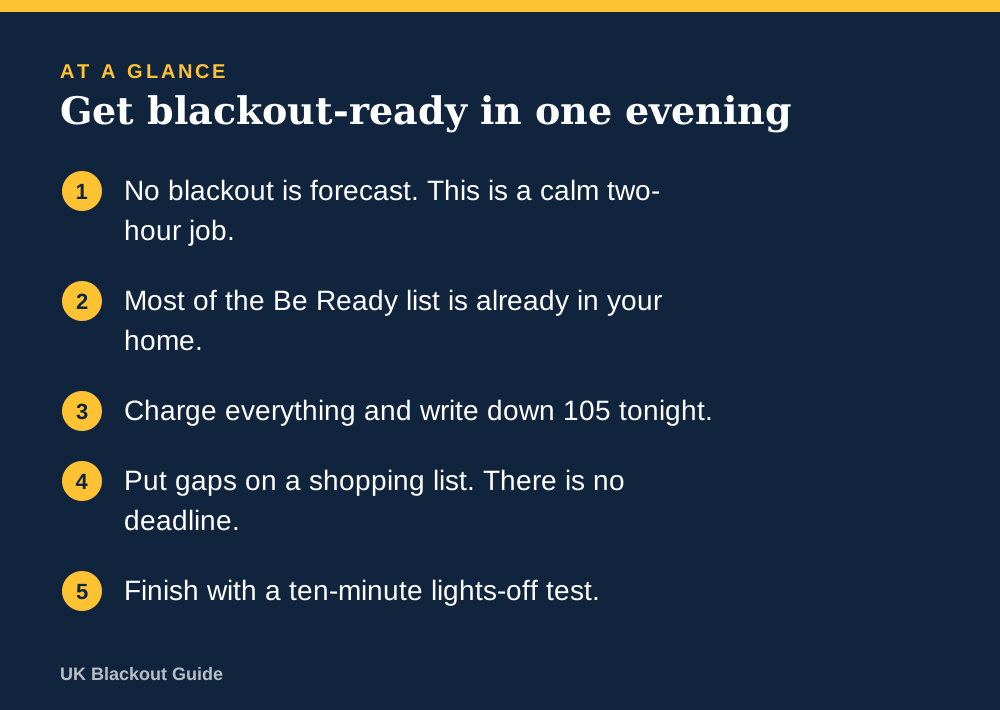
- No blackout is forecast. This is a calm two-hour job.
- Most of the Be Ready list is already in your home.
- Charge everything and write down 105 tonight.
- Put gaps on a shopping list. There is no deadline.
- Finish with a ten-minute lights-off test.
What one evening can and cannot do
One evening is enough to get blackout-ready to the standard the government describes, using mostly what you already own. The Be Ready campaign, launched on 22 October 2026, asks households to be able to manage for three days. It is general preparedness. No blackout has been announced or forecast, and nothing here has a deadline, so the blackout shopping list can wait for another day.
Tonight is for finding, charging and writing down, the first steps in preparing for a blackout in the UK. Buying comes later and can be spread out, which is what Be Ready advises.
First half hour: find what you already have
Walk round the house with a box. Collect every torch, every spare battery, any portable radio, power banks, charging cables, candles (to set aside, not to use), the first aid kit and a manual tin opener. Test each torch and radio. Throw away leaking batteries.
Most homes turn up more than expected: a head torch in the camping gear, a radio in the garage. Put what works in the box, and put the box somewhere everyone can reach in the dark, such as the cupboard under the stairs. If there is no working torch, that is the first thing to buy, and how many torches a household needs can wait until you have one.
Second half hour: charge and fill
Plug in every power bank, rechargeable torch and spare phone. A 20,000 mAh power bank gives a typical phone about 3 to 4 charges, so one full bank per phone covers three days of light use.
Next, water. Be Ready says 3 litres per person per day for drinking. Count the bottled water in the house and check the dates, bearing in mind how long bottled water lasts. If you are short, add bottled water to your shopping list, and tonight fill clean bottles or jugs from the tap as a stopgap.
Then check the food cupboard for three days of things that need no cooking: tins, crackers, cereal, long-life milk. Write down what is missing. Find the manual tin opener while you are there.
Last, gather blankets, sleeping bags and warm jumpers into one cupboard or bag. Official advice in a cut is to keep warm with layers and to close doors and curtains, and that is far easier when the bedding is already in one place. Put any essential medication on your list too, and ask your pharmacist what reserve is sensible for you.
Third half hour: write things down
On one sheet of paper, write:
- 105, the free power cut number for England, Scotland and Wales (03457 643643 in Northern Ireland)
- Your network operator's name, from powercut105.com
- Your load block letter, from the same site or your bill
- Phone numbers for family, neighbours, GP and pharmacy
- Each person's medication and doses
- Your local FM radio station's frequency
Be Ready lists a written list of contacts and medication for exactly this reason: a flat phone holds none of it. Tape the sheet inside a kitchen cupboard. It is the first page of a household emergency plan.
While you are at the computer, check whether you qualify for the Priority Services Register at thepsr.co.uk. It is free, and households with children under 5, older people and people who rely on powered medical equipment are among those who qualify.
Last half hour: a lights-off test
Turn off the lights and see how the house works for ten minutes. Find the torch from where you usually sit. Find the fuse box. Tune the radio to your local station on FM, or note the lack of a battery radio as a gap.
Notice the gaps. A dark staircase may want a second light. The cordless landline base will be dead, because it needs mains power. Children often enjoy the test, which makes a real power cut with children less strange for them.
Do not light candles for the test. Be Ready says torches are safer than candles. Never plan to use a barbecue or camping stove indoors, because of carbon monoxide.
The shopping list you finish with
By the end you should have a box, a sheet of paper and a short list of gaps. Typical gaps are bottled water, spare batteries, a radio and some cash in notes and coins. Buy the power cut essentials you are missing over the next few shops.
Set a phone reminder for six months from today. Be Ready advises checking the kit that often: change the water, test the lights, recharge the power bank.
Checklist
Get blackout-ready in one evening
- Collect and test every torch and radio
- Charge power banks and rechargeable lights
- Count bottled water against 3 litres per person per day
- Check for three days of no-cook food
- Write down 105, network operator and load block letter
- Write down contacts and medication
- Do a ten-minute lights-off test
- Set a six-month reminder
Common questions
Do I need to buy anything tonight?
No. Tonight is for checking what you own. Be Ready advises building a kit gradually, and no blackout is forecast.
Is tap water in bottles good enough?
It is a reasonable stopgap in clean, sealed containers kept cool and dark. Shop-bought bottled water is simpler for long storage.
What if I live alone?
The plan is the same with smaller quantities: 9 litres of water covers one person for three days. Tell a neighbour or relative where your contact sheet is.
Reviewed against these sources on 18 November 2026. If official advice has changed since, follow the official advice.
General information only. This page is not professional, safety, medical, legal or financial advice, and it is not official guidance. No national blackout has been forecast or announced, and nothing here suggests one is expected. We are independent and have no connection to the government or any energy company. Always check the official sources linked on this page. Full disclaimer
Keep reading
 Guide
How to prepare for a blackout in the UK
How to prepare for a blackout in the UK: the official Be Ready three-day list, the numbers to save, and the home checks to do. No blackout is forecast.
Read: How to prepare for a blackout in the UK Buying guide
Best power cut essentials: the blackout kit worth buying
The blackout kit worth buying for a UK power cut: a battery torch, a lantern, a power bank, a wind-up radio, an automatic light and a flask, with picks.
Read: Best power cut essentials: the blackout kit Question
What does the government say to keep at home for a power cut?
What to buy for the blackout, according to the government: the Be Ready list of water, food, a torch, an FM radio, a power bank, medication and cash.
Read: What does the government say to keep at home Guide
Blackout shopping list: what to buy first, and what can wait
What to buy for the blackout, in order: a shopping list based on the government's Be Ready kit, with what to buy first, what can wait and what to skip.
Read: Blackout shopping list: what to buy first,