On this page
A household emergency plan is one or two sheets of paper that say who to contact, where to meet, where the kit and shut-off points are, and who is responsible for what. Write it together in about an hour, print a copy for each adult and one for the kit, and review it every six months.
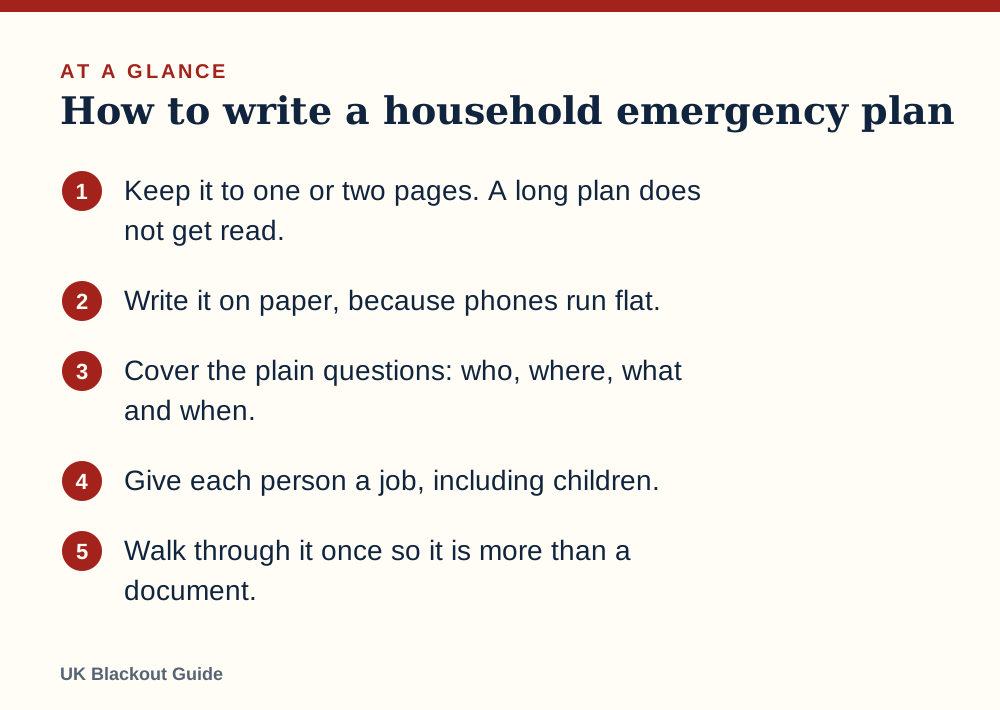
- Keep it to one or two pages. A long plan does not get read.
- Write it on paper, because phones run flat.
- Cover the plain questions: who, where, what and when.
- Give each person a job, including children.
- Walk through it once so it is more than a document.
What the plan is for
In the first minutes of a power cut, people waste time on small decisions. Who is collecting the children? Where is the torch? Should we ring Gran or go round? A plan answers those in advance, so that everyone can act without needing to reach each other first.
That matters because the things you would normally use to coordinate, mobile calls, messaging apps and home broadband, may be patchy. A plan on paper does not depend on any of them.
The government's Be Ready campaign asks households to be able to manage for three days. A plan is the cheap half of that. The other half is the kit, which you can build from our emergency kit list.
Section one: people and numbers
Begin with a list of everyone in the household and anyone who depends on you, such as a relative nearby. For each, write a mobile number, a daytime location (work, school, nursery) and that place's phone number.
Then add the service numbers:
- 105 for power cuts in England, Scotland and Wales, or 03457 643643 in Northern Ireland
- 0800 111 999 for a gas emergency
- GP surgery and pharmacy
- Bank, insurer and landlord or managing agent
- An out-of-area contact, a friend or relative in another region who can pass messages if local networks are overloaded
Add each person's medication and allergies. If anyone qualifies, note that you have joined the Priority Services Register, which is free.
Section two: where we meet and how we get in touch
Agree two meeting points. The first is right outside the home, for something like a fire. The second is a short walk away, such as a relative's house or a community building, for when you cannot get home or cannot stay there.
Then agree the order in which you will try to reach each other, the core of any family communication plan: a text first (texts often get through when calls do not), then a call, then the out-of-area contact, then simply going to the meeting point at an agreed time.
Decide who collects children, and tell the school who is allowed to. If everyone is at home, decide which radio station to tune to in an emergency and write its FM frequency on the plan.
Section three: the house
This part is a map in words. Write down where each of these is, in enough detail that a babysitter or neighbour could find it by torchlight:
| Thing | Where to write down |
|---|---|
| Emergency kit and torches | Which cupboard, which shelf |
| Consumer unit (fuse box) | Location and which switch is the main one |
| Gas emergency control valve | Usually by the gas meter |
| Water stopcock | Often under the kitchen sink |
| Stored water and food | Location and how many days it covers |
| Spare keys, document pouch, cash float | Known to adults only |
| Manual release for garage door or gate | Where the cord or key is |
If you are unsure how to work the shut-offs, how to turn off your gas, water and electricity takes you through each one.
The plan itself, with copies of the important documents worth copying, should live somewhere that survives a mishap.
Sizes are compared in our fire-resistant document bag picks.
Section four: who does what
Jobs stop people talking over each other. For a power cut, a simple split works:
- Light. One person fetches torches and lanterns and puts one in each room in use.
- Appliances. One person turns off the oven, hob, iron and heaters and unplugs the TV and computer, as official advice recommends.
- Information. One person checks whether it is only your house, reports it on 105 and switches on the battery radio.
- People. One person checks on anyone vulnerable in the house and on agreed neighbours.
Children can have real jobs: holding the torch, counting heads, looking after the pet. Having a role makes a dark house less frightening, a point we return to in explaining a power cut to a child.
If there is only one or two of you, the same list becomes an order of work.
Section five: stay or go
For almost every power cut, staying at home is the right choice. You have shelter, your supplies and your bed. Write that down as the default.
Then write the short list of reasons that would settle whether to stay or leave: someone's medical equipment cannot be powered, the house is too cold for a baby or frail person and cannot be warmed safely, there is flooding or fire, or the authorities tell you to. Note where you would go and what you would take. A packed bag makes that quick, and our grab bag recommendations show what suits.
If you smell gas, or a carbon monoxide alarm sounds, leave the building first and phone from outside. Gas emergency: 0800 111 999.
Test it, then put a date in the diary
Read the plan aloud together once it is written. Then try a ten-minute walk-through one evening: lights off at the wall, everyone does their job, somebody finds the stopcock. You will find at least one thing that needs changing, and that is the purpose.
Print a copy for each adult's bag or wallet, one for the fridge door and one for the kit. Give a copy to the out-of-area contact.
Review it every six months, when you check the kit. Children change schools, people change phones and prescriptions change. A plan that is a year out of date sends people to the wrong place.
Checklist
How to write a household emergency plan
- List household members, numbers and daytime locations
- Add 105, gas emergency, GP, bank and insurer numbers
- Choose an out-of-area contact
- Agree two meeting points
- Record where the kit and shut-off points are
- Give each person a job
- Write down when you would leave and where to
- Print copies and walk through it once
- Set a six-month review date
Common questions
Is there an official template for a household emergency plan?
The Be Ready campaign and the British Red Cross both publish preparedness guidance you can draw on. A plan written in your own words for your own home works just as well.
How long should the plan be?
One or two sides of A4. If it is longer, people will not read it in a hurry.
Do I need a plan if I live alone?
Yes. It becomes a list of who will check on you, who you will check on, and where everything is for anyone who comes to help.
Should children have a copy?
School-age children can carry a small card with two phone numbers and the meeting point.
Reviewed against these sources on 18 November 2026. If official advice has changed since, follow the official advice.
General information only. This page is not professional, safety, medical, legal or financial advice, and it is not official guidance. No national blackout has been forecast or announced, and nothing here suggests one is expected. We are independent and have no connection to the government or any energy company. Always check the official sources linked on this page. Full disclaimer
Keep reading
 Buying guide
Best fireproof document bags for emergency paperwork
Fire-resistant document bags for emergency paperwork: keep passports, policies, contacts and cash ready to grab. Seven Amazon UK listings compared.
Read: Best fireproof document bags for emergency Guide
Cash in an emergency: how much to keep and where
Why cash belongs in a UK power cut kit, how to work out a sensible amount for three days, which notes and coins to hold and where to keep them at home.
Read: Cash in an emergency: how much to keep and Guide
Important documents to copy and store
Which household documents to copy for an emergency, how to store paper and digital versions safely, and the one-page contact sheet worth writing first.
Read: Important documents to copy and store Buying guide
Best cash boxes for emergency cash at home
Lockable cash boxes for keeping emergency notes and coins ready at home for when card payments fail in a power cut. Eight Amazon UK listings compared.
Read: Best cash boxes for emergency cash at home