On this page

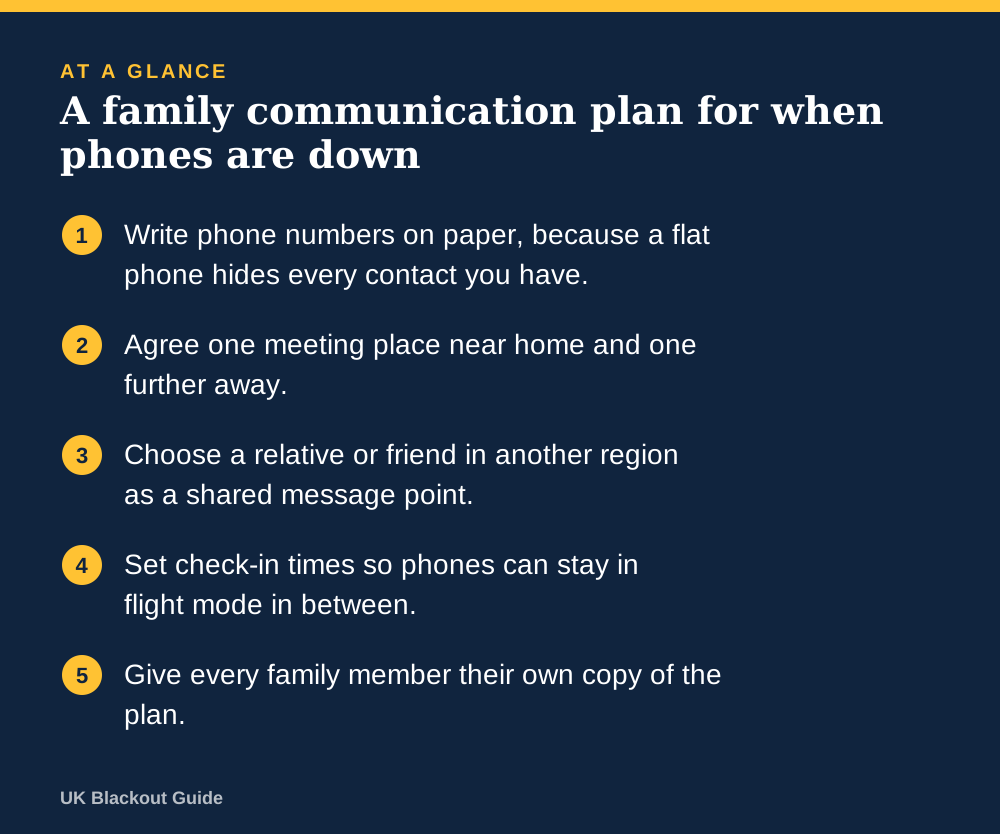
A family communication plan is one sheet of paper that says who you contact, how, and where you meet if phones stop working. Write down key numbers, pick a contact outside your area, agree two meeting places and set check-in times. It takes about half an hour and covers the gap when the mobile network is down.
- Write phone numbers on paper, because a flat phone hides every contact you have.
- Agree one meeting place near home and one further away.
- Choose a relative or friend in another region as a shared message point.
- Set check-in times so phones can stay in flight mode in between.
- Give every family member their own copy of the plan.
What the plan has to solve
Most power cuts are short and local, and your mobile keeps working throughout. The plan is for the less common day when the cut is wide, the masts near you have run down their backup power, and the people you care about are spread across school, work and home.
On that day three questions need answers nobody can look up: where is everyone, how do we get a message to each other, and where do we go if we cannot. The official Be Ready advice already asks every household to keep a written list of contacts. A communication plan builds on that list with a few decisions made in advance.
It sits alongside your wider household emergency plan, which covers things like turning off utilities and where the kit is kept.
Put the numbers on paper
Few people can recite more than one or two phone numbers now. Start by writing down, by hand or printed:
- Mobile numbers for every member of the household.
- Work, school and nursery office numbers.
- Two neighbours and two relatives.
- Your GP surgery and pharmacy.
- 105 for power cuts (03457 643643 in Northern Ireland) and 0800 111 999 for a gas emergency.
- Your out-of-area contact, explained below.
Make a copy for each adult's wallet, each child's school bag and the kit box. Keep one with your copies of important documents. A photo of the sheet on each phone is a useful extra, but the paper is the point.
Choose an out-of-area contact
In a regional outage, calls within the affected area can be hard to make while a call or text to somewhere unaffected still gets through. Pick one relative or friend who lives a good distance away and ask them to be the family's message point.
The rule is simple. If you cannot reach each other directly, everyone messages that person with where they are and where they are heading. They pass it on. Make sure they know they have the job, and that they have everyone's numbers too.
Agree where to meet and when to check in
Decide on two meeting places. The first is home, or a named spot just outside it if home is not safe to enter. The second is somewhere a short walk away that everyone knows and that will be open or accessible at any hour, such as a relative's house or a particular landmark. Be specific. The front gate of the library is a plan. Somewhere in town is not.
Then agree the default for each person. A typical version: children stay at school until collected by a named adult, the adult who works nearest collects them, everyone else makes their way home. Check your school's own emergency procedure and fit your plan around it.
Set check-in times as well. If phones are being kept in flight mode to save charge, agree that everyone switches on at the top of each hour for five minutes. That routine, and the settings behind it, are in making your phone battery last. A charged power bank in each adult's bag removes most of the worry, and we list good options in the best power banks for power cuts.
Short-range contact when phones are down
Once the mobile network has gone, the options narrow to walking round, leaving a note, or two-way radio. Notes are underrated. Agree a place, for example taped inside the front door, where anyone leaving the house writes the time and where they have gone.
Licence-free walkie-talkies can link a household with a relative or neighbour on the same street, or keep a parent in touch with older children playing nearby. They do not need any network at all. Their range in built-up areas is far shorter than the packaging suggests, which we explain in whether walkie-talkies work in a blackout.
If you buy a set, agree a channel and write it on the plan. Test the range between the places you would use them. Options are compared in the best walkie-talkies.
People who need a tailored plan
Young children need a version they can follow: who will collect them, which adults they can go with, and their home address learned by heart. Our guide to a power cut with children has ways to practise without frightening them.
For an older relative living alone, decide who checks on them and how soon. If they have a digital landline it may stop working in a cut, so do not assume silence means all is well. There is more in looking after older relatives in a power cut. Agreeing the same arrangement with a neighbour on their street gives you a second pair of eyes, as set out in checking on neighbours.
Anyone who is deaf, has hearing loss or a speech impairment should register for the emergency text service in advance. It takes two minutes, and the steps are in how to text 999.
Run through it once
Read the plan aloud at a meal. Ask each person where they would go and who they would message. You will find the gaps quickly: a child who does not know a grandparent's surname, a meeting place two people picture differently.
Then put a date on the sheet and check it every six months with the rest of your kit. Phone numbers, schools and jobs change more often than you would expect.
Checklist
A family communication plan for when phones are down
- Key phone numbers written on paper
- A copy for every bag, wallet and the kit box
- Out-of-area contact chosen and told
- Meeting place near home agreed
- Second meeting place agreed
- Who collects the children decided
- Hourly check-in time agreed
- Note-leaving spot agreed
- Plan dated and reviewed every six months
Common questions
Do text messages work when calls do not?
Often, yes. A text needs far less network capacity than a call and may be delivered later if it cannot go straight away, so keep trying short texts.
Should children carry the plan?
Yes. A small card in a school bag with names, numbers and the meeting place is enough. Tell them it is there.
How far away should the out-of-area contact be?
Far enough that a regional problem is unlikely to affect them too. A different part of the country is ideal.
Do we need walkie-talkies?
No. They are an optional extra for short distances. Paper numbers, meeting places and check-in times do most of the work.
Reviewed against these sources on 18 November 2026. If official advice has changed since, follow the official advice.
General information only. This page is not professional, safety, medical, legal or financial advice, and it is not official guidance. No national blackout has been forecast or announced, and nothing here suggests one is expected. We are independent and have no connection to the government or any energy company. Always check the official sources linked on this page. Full disclaimer
Keep reading
 Buying guide
Best walkie-talkies for emergencies when phones are down
Licence-free PMR446 walkie-talkies for keeping in touch when mobile networks are down in a power cut. Picked from Amazon UK listings on charging and pack size.
Read: Best walkie-talkies for emergencies when Question
Do walkie-talkies work in a blackout?
Walkie-talkies work in a blackout because they need no network, but range in UK streets is short. What licence-free PMR446 sets can and cannot do for you.
Read: Do walkie-talkies work in a blackout? Buying guide
Best battery radios for power cuts and blackouts
Battery radios for power cuts and blackouts, chosen from Amazon UK listings on AA battery power, FM and DAB bands, simple controls and buyer ratings.
Read: Best battery radios for power cuts and Buying guide
Best charging cables for an emergency kit
Spare charging cables for an emergency kit, so your power bank, car socket or wind-up radio can charge a phone in a power cut. Chosen from Amazon UK listings.
Read: Best charging cables for an emergency kit