On this page
Knock on the doors of neighbours who are older, live alone, have young children or use medical equipment, ideally within the first hour or two of a cut and again before dark. Say who you are, ask if they are warm and have light, and offer something specific such as a hot drink. Call 999 if someone seems confused, very cold or unwell.
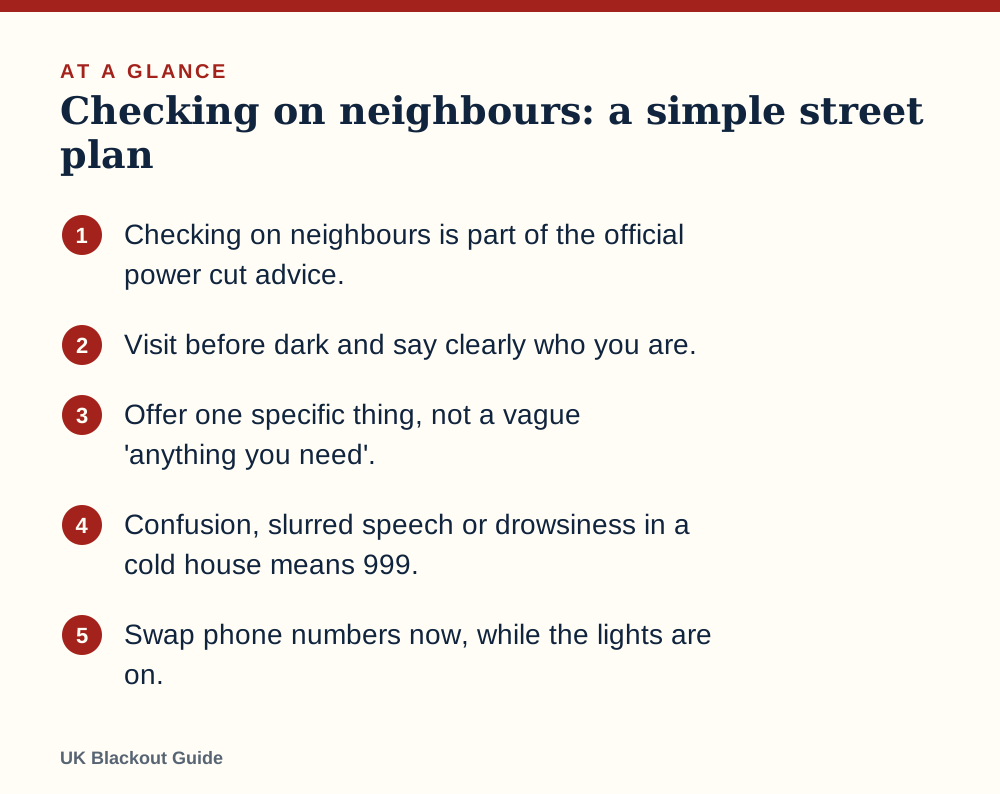
- Checking on neighbours is part of the official power cut advice.
- Visit before dark and say clearly who you are.
- Offer one specific thing, not a vague 'anything you need'.
- Confusion, slurred speech or drowsiness in a cold house means 999.
- Swap phone numbers now, while the lights are on.
Why a knock on the door still matters
The government's Be Ready advice for a power cut includes a short line that is easy to skip: check on neighbours. It is there because the official systems have limits. A network operator may know that a vulnerable person lives at number 14, but in a wide outage it could be many hours before anyone can ring or visit.
You are thirty seconds away. During Storm Arwen in November 2021, some rural homes were without power for more than a week, and it was often the people next door who noticed who needed help.
Who to check first
You do not need to visit the whole street. Think about who would find a cold, dark evening hardest:
- people in their late seventies and older, especially living alone
- anyone you know uses oxygen, a CPAP, a stairlift, a powerchair or a pendant alarm
- people recently home from hospital
- parents alone with a baby or several small children
- anyone with dementia, sight loss or hearing loss
- people who have recently moved in and know nobody
If you live in a block of flats, think about who is above the ground floor and cannot manage stairs when the lift is out.
How to knock without frightening anyone
An unexpected knock in a blackout can be alarming, and people are right to be wary. Go before dark if you can. Knock, step back from the door and call out your name and house number. Carry a lantern that lights your own face, not a torch pointed at theirs.
Do not be offended if they talk through a closed door or a window. That is sensible. Criminals sometimes pose as officials during outages, a pattern described in our guide to scams during power cuts. You can help by mentioning that genuine engineers carry identification and never ask for money.
If nobody answers and you expected them to be in, try the phone, look for signs of movement or light and ask the other neighbours. If you have real reason to think someone is hurt or collapsed inside, call 999.
What to ask, and what to look for
Keep it brief and practical. Four questions cover most of it:
- Are you warm enough?
- Have you got a torch or a light that works?
- Have you got something to eat and drink that does not need cooking?
- Is there any equipment or medicine you are worried about?
While you talk, notice things. The NHS lists the signs of hypothermia as shivering, cold and pale skin, slurred speech, confusion and tiredness. A person who seems muddled or drowsy in a cold house needs a 999 call, not a blanket and a goodbye. There is more in how to recognise hypothermia at home.
Look and listen for unsafe heating: a barbecue, camping stove or patio heater indoors, or a generator in a porch or garage. These produce carbon monoxide, which has no smell. If anyone has a headache, dizziness or nausea, get them into fresh air and call 999. Read more in carbon monoxide risks in power cuts.
Unattended candles are the other thing to spot. Offer a battery lantern in exchange if you have a spare.
Offer something specific
'Let me know if you need anything' rarely gets taken up. A specific offer does. Some that cost you little:
- A flask of hot water or tea, if you have a gas hob or camping stove you can use safely. A decent flask keeps drinks hot for hours, and we compare them in our list of the best flasks for hot drinks.
- Ten minutes of phone charging from your power bank.
- A spare torch and batteries.
- Reporting the cut for them on 105, or 03457 643643 in Northern Ireland. The steps are in how to report a power cut.
- A message to their family, if your phone has signal and theirs does not.
- A seat in your warm room for the evening.
If they are not yet on the Priority Services Register, mention it for when things are back to normal. It is free.
Staying in touch when phones are down
Mobile networks may only work for a limited time on backup power, and digital landlines fail when the router does. Agree a low-tech signal with the neighbours you are keeping an eye on. A card in the front window, a set time when you will knock, or a rota between three households all work.
For neighbours a few doors apart, licence-free walkie-talkies are a simple link that needs no network at all. Range in built-up streets is much shorter than the box suggests, as explained in whether walkie-talkies work in a blackout, but across a road or between floors they are reliable.
The walkie-talkies round-up covers suitable sets.
Set it up before you need it
The easiest time to do all of this is now. Swap phone numbers with the houses either side and opposite. Find out, tactfully, whether anyone relies on powered equipment. If you are not sure which company runs your local network, look up your network operator and share the name along with 105.
Some streets go a step further with a shared contact sheet and a note of who has a camping stove, a generator or first aid training. Our guide to community resilience explains how to start one without it becoming a committee.
Common questions
What if my neighbour will not open the door?
Speak through the door, say who you are and ask if they are all right. That is enough. Respect their caution and try again in daylight.
Should I give a neighbour my candles?
A battery torch or lantern is the safer gift. The official advice is that torches are safer than candles, especially for older people.
Who do I call if I am worried about a neighbour but it is not an emergency?
Call 105 to tell the network operator a vulnerable person is affected, NHS 111 for health concerns, or the police on 101 for a welfare concern. Call 999 if you think they are in danger.
Is it safe to run an extension lead to a neighbour from my generator?
No. Leads across paths and gardens are a trip and shock hazard, and generators must never be connected to house wiring without a properly fitted changeover switch.
Reviewed against these sources on 18 November 2026. If official advice has changed since, follow the official advice.
General information only. This page is not professional, safety, medical, legal or financial advice, and it is not official guidance. No national blackout has been forecast or announced, and nothing here suggests one is expected. We are independent and have no connection to the government or any energy company. Nothing here is medical advice: follow your own clinician, pharmacist or equipment supplier. Always check the official sources linked on this page. Full disclaimer
Keep reading
 Buying guide
Best battery smoke alarms that work in a power cut
Battery smoke alarms that work in a power cut, chosen from Amazon UK listings on sealed battery life, stated standards, pack size and buyer ratings.
Read: Best battery smoke alarms that work in a Buying guide
Best CPAP battery backups for power cuts
CPAP battery backups for a power cut at night, chosen from Amazon UK listings on stated watt-hours, voltage and machine compatibility, with runtime maths.
Read: Best CPAP battery backups for power cuts Buying guide
Best rechargeable fans for a summer power cut
Rechargeable fans that run from their own battery in a summer power cut and top up from a power bank. Seven Amazon UK listings compared on stated runtime.
Read: Best rechargeable fans for a summer power cut Question
Can I get a free backup battery for my landline for power cuts?
Who can get a free battery backup for a digital landline, how to ask your phone provider, how long it lasts and what to do if you do not qualify for one.
Read: Can I get a free backup battery for my