On this page
Streets cope best when neighbours know each other before anything happens. Swap phone numbers and door numbers on paper, agree who will check on whom, and share what each household has: a radio, a gas hob, a charged power station, a car. Official advice in a power cut includes checking on neighbours.
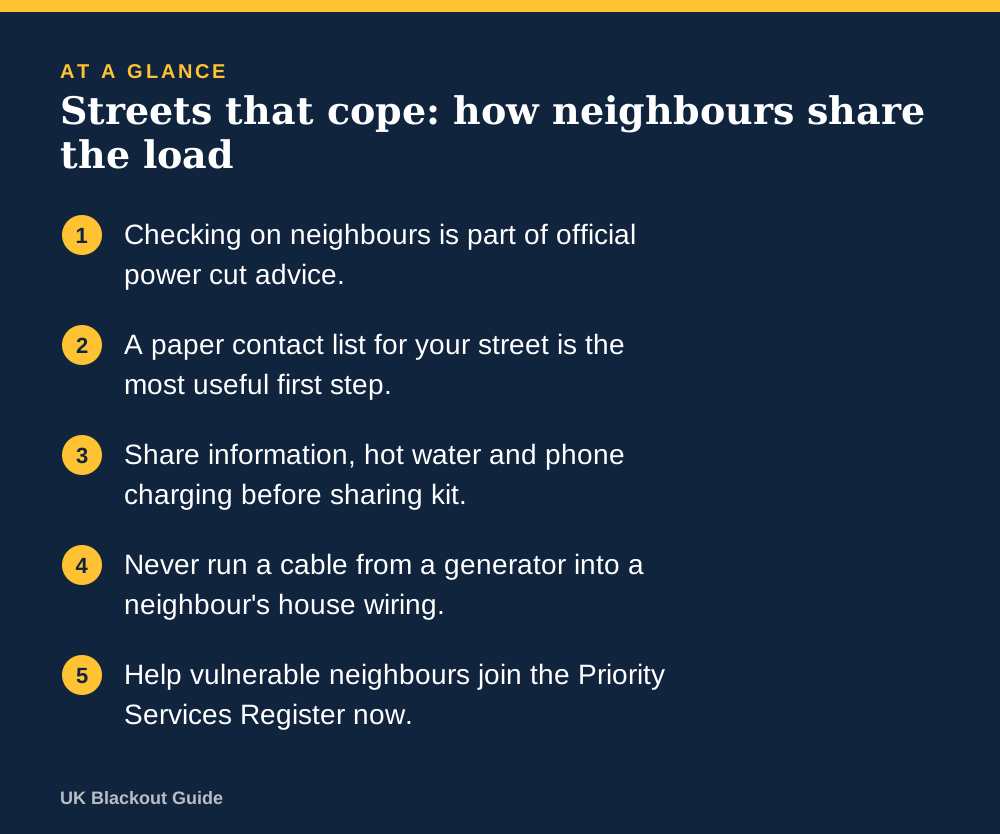
- Checking on neighbours is part of official power cut advice.
- A paper contact list for your street is the most useful first step.
- Share information, hot water and phone charging before sharing kit.
- Never run a cable from a generator into a neighbour's house wiring.
- Help vulnerable neighbours join the Priority Services Register now.
What past power cuts show about neighbours
The Lancaster power cut of December 2015 began when Storm Desmond flooded a substation. About 61,000 properties lost power, and mobile networks, internet, cash machines and card payments failed locally. People could not look anything up or call for advice. A local radio station, The Bay, kept broadcasting on a generator, and information travelled the old way, from person to person.
Two other events are on record. After Storm Arwen in 2021 some rural homes were without power for more than a week. In Spain and Portugal in April 2025, battery radios and cash proved useful when phones and card payments were disrupted. These are accounts of what happened, not signs of what will happen here, and the government has not suggested a long outage is expected. The government's Be Ready advice for power cuts includes checking on neighbours.
The paper list: ten minutes that does the most
The single most useful thing a street can do costs nothing. Make a list of house numbers, names and phone numbers for the households willing to take part, print it and give everyone a copy. Phone contact lists are no help when batteries are flat.
Add a line for anything people are happy to share: who has a gas hob, a wood burner, a battery radio, a first aid qualification, a four-wheel drive. Add who might need a knock on the door: someone living alone, a new baby, a person with medical equipment. Keep it voluntary and keep it private to the street.
An existing group makes this easy, be it a residents' association, a Neighbourhood Watch scheme or a street messaging group. A messaging group is fine for organising, as long as the paper list exists as well.
Who checks on whom
In a long cut, good intentions fade unless there is a simple arrangement. Pair households up, so each has one other to check twice a day: once in the morning and once before dark. Knock, speak face to face and ask specific questions. Are they warm, have they eaten and had a hot drink, do they have their medicines, is their phone charged.
Know the signs to look for. The NHS lists shivering, cold pale skin, slurred speech, confusion and tiredness as signs of hypothermia, and the advice is to call 999. Headache, dizziness and nausea in a house using a fuel-burning heater could be carbon monoxide poisoning.
Do one thing in advance for anyone older, disabled or with young children: help them sign up to the Priority Services Register. It is free, it tells the network operator who needs support first, and it is a sound first step in looking after older relatives in a power cut.
What a street can share
Information. One household with a working radio can keep twenty informed. Write the main points from each bulletin on a sheet in a front window or on a board at the end of the road, with the time. This also stops rumours, which travel fast when phones are down.
Hot water and hot food. A gas hob that still lights, or a camping stove used outdoors, can fill flasks for several houses. A flask of hot water lets an older neighbour make tea and fill a hot water bottle, so a flask that keeps water hot is a small expense that helps several houses.
Charging. Someone with a power station, a solar panel or a car can charge phones for others. A typical phone charge uses very little energy, so this is cheap to offer.
Space and warmth. A house with a wood burner can be the warm room for an afternoon. It also gives people company, which matters more as days pass.
Transport and errands. Share car journeys to collect water or medicines, and to save fuel, since petrol stations may not be able to pump in a wide-area cut.
Keeping in touch when phones do not work
On most streets, walking to a door is the answer. Across a larger area, such as a village, a farm or between blocks of flats, licence-free two-way radios fill the gap. They need no network and no subscription.
Agree a channel and fixed times to switch on, such as on the hour, to save batteries. These are shared public channels, so keep messages short and do not say anything private. Buildings and hills shorten the range, one of the limits explained in whether walkie-talkies work in a blackout.
Sharing safely
A few rules keep goodwill from causing harm.
Never connect a generator to house wiring through a socket, yours or a neighbour's. Back-feed can kill engineers working on the line. Run generators outdoors only, away from every household's doors and windows, because carbon monoxide has no smell.
Do not lend barbecues or camping stoves for indoor use. Follow food safety rules when cooking for others, especially with food from a thawing freezer. If in doubt, throw it out.
Be careful with other people's medicines. Do not share prescription drugs. Fetch help instead.
Stay alert to strangers offering paid help, fuel or repairs at the door. Genuine network engineers carry identification, and our guide to scams during power cuts lists the common tricks.
Start small, before you need it
None of this needs a committee. Knock on the doors either side of yours this week, swap numbers and mention that you have a radio or a camping stove. That one conversation is most of the benefit.
If your street wants to go further, a shared communication plan adapted for neighbours gives it a structure. Many parish and community councils also keep a community emergency plan, and they usually welcome volunteers.
Common questions
Do I have to share my supplies with neighbours?
No. Sharing is a choice. Information, a hot drink and a phone charge cost you little and tend to be repaid, but your household's needs come first.
What if I do not know my neighbours?
Start with the houses either side. A short note through the door with your name and number, offering to swap contacts for emergencies, is usually well received.
Can a street share one generator?
Only by bringing devices to it or using suitable outdoor extension leads to individual appliances. It must never be connected to any home's wiring without a changeover switch fitted by a qualified electrician.
Who helps vulnerable people officially in a long cut?
Network operators prioritise households on the Priority Services Register, and councils may open rest centres. Neighbours fill the gap until that help arrives.
Reviewed against these sources on 18 November 2026. If official advice has changed since, follow the official advice.
General information only. This page is not professional, safety, medical, legal or financial advice, and it is not official guidance. No national blackout has been forecast or announced, and nothing here suggests one is expected. We are independent and have no connection to the government or any energy company. Always check the official sources linked on this page. Full disclaimer
Keep reading
 Question
Can portable solar keep a household going in a long power cut?
What portable solar panels can and cannot power in a UK home during a long outage, with realistic summer and winter output and example daily loads.
Read: Can portable solar keep a household going in Question
How do I wash clothes without power?
How to wash and dry clothes by hand in a long power cut using two buckets, a little detergent and as little water as possible, and what to wash first.
Read: How do I wash clothes without power? Question
How long could a national blackout last?
How long a national blackout in Great Britain could last, based on NESO's restoration standard, the National Risk Register and what happened in past events.
Read: How long could a national blackout last? Guide
How to manage 30 days without mains power
Optional planning for 30 days without mains power, far beyond the three days UK guidance asks for: what water, food, energy and health would need.
Read: How to manage 30 days without mains power