On this page
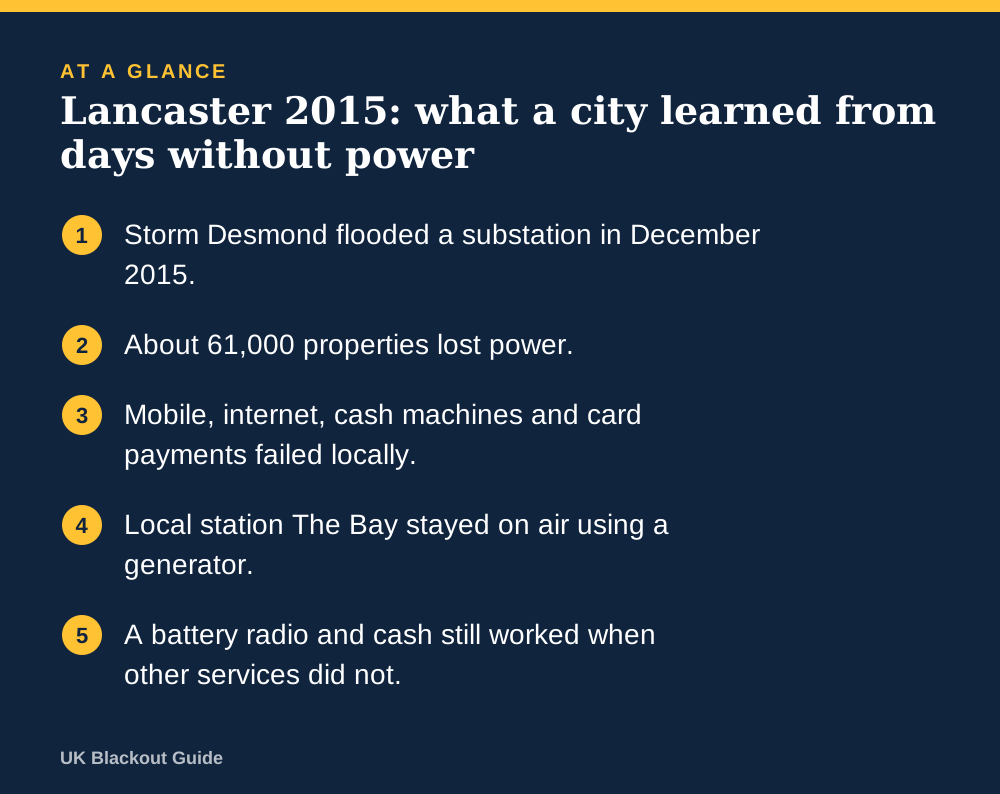
In December 2015, flooding from Storm Desmond swamped a substation and cut power to about 61,000 properties in and around Lancaster. Mobile phones, internet, cash machines and card payments all failed locally. The local radio station The Bay kept broadcasting on a generator, so people with a battery or car radio could still hear local news.
- Storm Desmond flooded a substation in December 2015.
- About 61,000 properties lost power.
- Mobile, internet, cash machines and card payments failed locally.
- Local station The Bay stayed on air using a generator.
- A battery radio and cash still worked when other services did not.
One flooded substation, 61,000 properties
Storm Desmond brought severe flooding to north-west England in December 2015. In Lancaster the water reached a substation serving the city and the surrounding area, and about 61,000 properties lost their electricity.
The cause was simple and physical. Nothing went wrong with the national grid, and there was no shortage of power in the country. A single piece of local equipment was under water, and everything downstream of it went dark. Storms and floods are a familiar cause of longer power cuts in the UK.
A modern city without its digital services
Lancaster is remembered because of what else stopped. Within a short time, several everyday services were gone.
- Mobile phone networks failed locally.
- Home and business internet went down.
- Cash machines stopped working.
- Shops could not take card payments.
People could not ring relatives, look up the news, withdraw money or pay by card, all at the same moment. Official Be Ready advice is that mobile networks may work only temporarily in some areas on backup power, and Lancaster showed what that gap feels like.
The area affected was small compared with a national outage, and the rest of the country was working normally a short drive away. The National Risk Register describes knock-on effects on mobile, internet and payments for a national outage, which it rates as low likelihood but very high impact. Lancaster was a local flood, and it is described here as what happened, not as a sign of what will happen elsewhere.
The radio station that stayed on air
One service kept going. The Bay, the local commercial radio station, carried on broadcasting using a generator. With phones and internet down, broadcast radio was a way for information to reach people that did not depend on those networks.
Anyone with a battery radio or a car radio could listen. Anyone relying on a smartphone, a smart speaker or a mains-only set could not.
That is why a battery or wind-up radio is on the government's Be Ready kit list. It is worth finding your local stations before you need them and keeping a written note of their radio frequencies with the set.
Cash became the only way to pay
With card terminals and cash machines both out of action, the money already in people's purses was all they could spend. A household with a few notes in the house could still buy essentials from any shop able to trade. A household without had no quick way of getting any.
The official kit list asks for cash in notes and coins. When you are keeping cash for an emergency, a modest amount in small denominations is enough, kept somewhere sensible at home.
If you use candles for light, never leave one burning unattended and keep them away from curtains and children. Be Ready's advice is that torches are safer than candles.
What Lancaster's experience means for your home
The story is about dependence more than darkness. Light is easy to replace with a torch. Information and money are harder, because the usual sources all fail together.
Three cheap things answer those gaps: a battery radio for power cuts, some cash, and a plan agreed beforehand for how family members would find each other with no phones.
The other resource is people. With no way to call, the only way to find out how someone is coping is to knock on the door. Be Ready's advice for any power cut includes checking on neighbours, and it costs nothing to do.
Common questions
What caused the Lancaster power cut in 2015?
Flooding during Storm Desmond in December 2015 swamped a substation, cutting supply to about 61,000 properties.
Did mobile phones work in Lancaster during the cut?
No. Mobile and internet services failed locally, along with cash machines and card payments.
How did people in Lancaster get information?
The local radio station The Bay kept broadcasting on a generator, so people with battery or car radios could follow what was happening.
Reviewed against these sources on 18 November 2026. If official advice has changed since, follow the official advice.
General information only. This page is not professional, safety, medical, legal or financial advice, and it is not official guidance. No national blackout has been forecast or announced, and nothing here suggests one is expected. We are independent and have no connection to the government or any energy company. Always check the official sources linked on this page. Full disclaimer
Keep reading
 Guide
Could a cyber attack cause a UK blackout?
The government has not said a cyber attack is expected to cause a UK blackout. How grid control systems work in general terms, and what households can do.
Read: Could a cyber attack cause a UK blackout? Question
Do card payments and cash machines work in a power cut?
Card machines and cash machines need both electricity and a data connection, so they often fail in a power cut. Why cash is on the official kit list.
Read: Do card payments and cash machines work in a Explainer
How the BBC plans to keep broadcasting in a blackout
A BBC report on 7 November 2026 set out how it would keep broadcasting on FM radio through a long blackout. What it said and what radio you need to hear it.
Read: How the BBC plans to keep broadcasting in a Explainer
The 2025 Spain and Portugal blackout: lessons for UK households
On 28 April 2025 Spain and Portugal lost all power for most of a day. Phones, cards and trains failed. What happened and the practical lessons for UK homes.
Read: The 2025 Spain and Portugal blackout: lessons