On this page
Keep at least two spare cables in the emergency kit that match your phones and every power source you would use in a power cut. That usually means a USB-A to USB-C cable for car sockets, older power banks and wind-up radios, plus USB-C to USB-C for newer power banks. Multi-packs from well-reviewed brands cost well under £10.
- A power bank is no use in a cut without a cable that fits
- Match both ends: your power source and your device
- USB-A to USB-C suits car sockets, older banks and wind-up radios
- USB-C to USB-C suits most recent phones and power banks
- Store the spares with the power bank, not in a random drawer
A charged power bank is on the official Be Ready kit list. It is no use without a cable that fits, and cables are the part that goes missing, frays or turns out to have the wrong plug on one end. A spare set costs a few pounds and removes a silly single point of failure.
This list covers USB-C cables, in both USB-C to USB-C and USB-A to USB-C forms, mostly in multi-packs. Cables are one half of charging a phone in a blackout, and the power source is the other.
Our picks for a power cut, at a glance




Anker USB-A to USB-C cable (1.8 m, 2 pack)
★ 4.6 from 152,700 buyers · About £6.63 when checked 18 November 2026Many power banks, car chargers and wind-up radios still have the older rectangular USB-A output. This braided two-pack connects those to a USB-C phone. It is the most reviewed cable here by a distance, at 4.6 from about 152,700 buyers, and costs under £10.
- About 152,700 buyer ratings
- Braided, 1.8 m
- Fits older USB-A outputs
- USB-A outputs often charge more slowly than USB-C
Anker USB-C to USB-C cable 60W (1.8 m, 2 pack)
★ 4.6 from 88,700 buyers · About £6.99 when checked 18 November 2026This two-pack of 1.8 m nylon cables is listed at 60W (3A), enough for phones, tablets and many smaller laptops. It carries 4.6 from about 88,700 buyers, a huge body of feedback, and costs under £10. USB-C at both ends suits most recent phones and power banks. In a power cut that covers the usual pairing of a recent phone and a recent power bank.
- 4.6 from about 88,700 buyers
- 60W stated
- Two cables at 1.8 m
- Needs a USB-C port on the charger or power bank
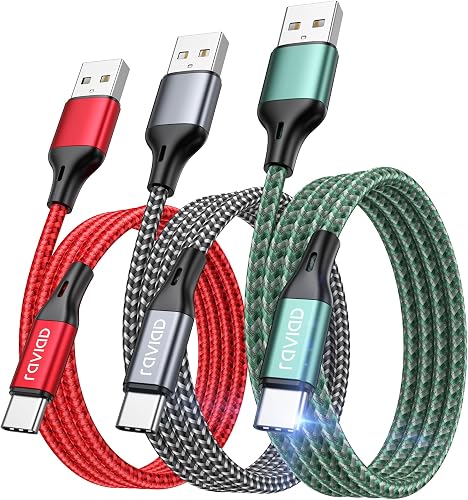
RAVIAD USB-A to USB-C cable (2 m, 3 pack)
★ 4.6 from 11,500 buyers · About £8.99 when checked 18 November 2026Three 2 m cables for under £10, rated 4.6 from about 11,500 buyers. Three is a useful number: one with the power bank, one in the car and one in the grab bag. The 2 m length lets a phone reach the sofa from a power station on the floor.
- Three cables in the pack
- 2 m length
- 4.6 rating
- USB-A at one end, so check your charger ports
USB-C to USB-C 60W cable (2 m, 3 pack)
★ 4.4 from 2,400 buyers · About £7.99 when checked 18 November 2026This unbranded pack lists three 2 m nylon braided USB-C to USB-C cables at 60W, for under £10. It is rated 4.4 from about 2,400 buyers. It suits a household where every phone and the power bank are all USB-C. Three cables let several phones share a power station at once during a long cut.
- Three 2 m cables
- 60W stated
- Braided
- No brand name on the listing
- Lower rating than the Anker pack
Samsung official USB-C to USB-C cable (1 m)
★ 4.4 from 15,600 buyers · About £5.40 when checked 18 November 2026An official Samsung cable at 1 m, rated 4.4 from about 15,600 buyers and priced under £10. A short cable is tidier in a grab bag or coat pocket and has less to tangle when a phone sits beside a power bank. The title describes it as a data cable and gives no wattage, so check the listing if you need fast charging.
- Phone maker's own cable
- Compact 1 m length
- Single cable
- No wattage in the title
Belkin braided USB-C to USB-C 60W (2 pack)
★ 4.4 from 1,000 buyers · About £6.99 when checked 18 November 2026Belkin lists this two-pack as braided, soft and flexible, at 60W and 5 ft long. It is rated 4.4 from about 1,000 buyers and costs under £10. A flexible cable is easier to coil into a small kit pouch.
- Known accessory brand
- Described as soft and flexible
- 60W stated
- Fewer ratings than the Anker cables
How we chose
These picks were chosen from Amazon UK listings on 18 November 2026, using the stated specification, the price and verified buyer ratings. Nothing here has been hands-on tested by us, so every claim comes from the listing itself. Prices and stock change, so check the listing before you buy.
Check both ends before you buy
Look at the output ports on your power bank, car charger and wall plug, then at the charging port on each phone. Buy cables that match those pairs. Every cable on this list ends in USB-C, which covers recent Android phones, recent iPhones and most tablets. Older iPhones with a Lightning port, and older gadgets with micro USB, need their own cable, and none is listed here, so buy those separately if anyone in the house needs one. If you expect to be charging a phone from your car, check that socket too, because the USB-A end still matters there.
Wattage matters for laptops, less for phones
A phone draws roughly 10 to 20 W while charging, and any decent cable handles that. A laptop wants 45 to 65 W, so the cable must be rated for it and have USB-C at both ends. The 60W cables above are suitable for phones and many smaller laptops. If you plan to run a laptop from a battery, check the laptop's own wattage, because whether a power bank can charge a laptop depends on it as much as on the cable. Pair the cable with one of the high-capacity power banks made for laptops.
Length and build
Short cables, around 1 m, are neat for a power bank in a pocket. Longer ones, around 2 m, help when the power source has to stay put, such as a power station on the floor or a car socket with the phone passed to the back seat. Braided cables are sold as more resistant to fraying at the ends, which is where most cables fail. Whatever you buy, plug each one in when it arrives and confirm the phone shows it is charging. A dud is easy to return this week and useless to discover in the dark.
Where to keep the spares
A spare cable only helps if you can find it. Tape or band one to the power bank itself. Put another in the car and one in the bag you would take if you had to leave. Label them so they do not drift into daily service, because a spare that has migrated to a teenager's bedroom is not a spare. When you do your six-monthly kit check, test the cables along with the power bank.
How much to spend on spare cables for an emergency kit
Every cable in this catalogue costs under £10, so there is no true high-end tier to recommend and we have not invented one. At the budget end, under £6, you get a single 1 m cable. The middle, under £7, buys a two-pack from a heavily reviewed brand, which is the sensible default. The top of the range, about £8 to £9, buys three 2 m cables in one pack. Paying more than this for a phone cable gains nothing in a power cut. Put the money into a second pack with the other connector type, so both USB-A and USB-C sources are covered.
Common questions
How many spare cables should I keep?
At least two that fit your main phone, kept with the power bank and in the car. Add one for each different connector type in the house.
Does a cheap cable charge more slowly?
It can, if it is not rated for the power your charger offers. For phones the difference is usually small. For laptops, check the stated wattage.
Do cables wear out in storage?
Not in any way that matters, if they are kept dry and loosely coiled. Test them at each kit check.
Can one cable charge everything?
Only if every device and every power source uses the same connectors. Most homes need two types.
Reviewed against these sources on 18 November 2026. If official advice has changed since, follow the official advice.
General information only. This page is not professional, safety, medical, legal or financial advice, and it is not official guidance. No national blackout has been forecast or announced, and nothing here suggests one is expected. We are independent and have no connection to the government or any energy company. Products are chosen from retailer listings and buyer ratings and have not been tested by us; some links earn us a commission. Always check the official sources linked on this page. Full disclaimer
Keep reading
 Guide
Calling 999 in a power cut
How to reach 999 in a UK power cut from a mobile, landline or by text, what to try if there is no signal, and which number to ring for which problem.
Read: Calling 999 in a power cut Question
Can I text 999 in an emergency?
You can text 999 in the UK through emergencySMS, but only after registering your phone. How to register, what to put in the text and when it will not work.
Read: Can I text 999 in an emergency? Guide
Digital landlines and power cuts: what changed
Digital landlines need mains power, so they stop in a power cut unless you have battery backup. How to check your line and keep a way to call for help.
Read: Digital landlines and power cuts: what changed Question
Do walkie-talkies work in a blackout?
Walkie-talkies work in a blackout because they need no network, but range in UK streets is short. What licence-free PMR446 sets can and cannot do for you.
Read: Do walkie-talkies work in a blackout?