On this page
The mAh figure on a power bank tells you how much energy it stores, and watts tell you how fast it can deliver it. Expect about 65% of the stated mAh to reach your phone, so a 20,000 mAh bank gives roughly 3 to 4 charges of a typical phone, and a 10,000 mAh bank about one and a half.
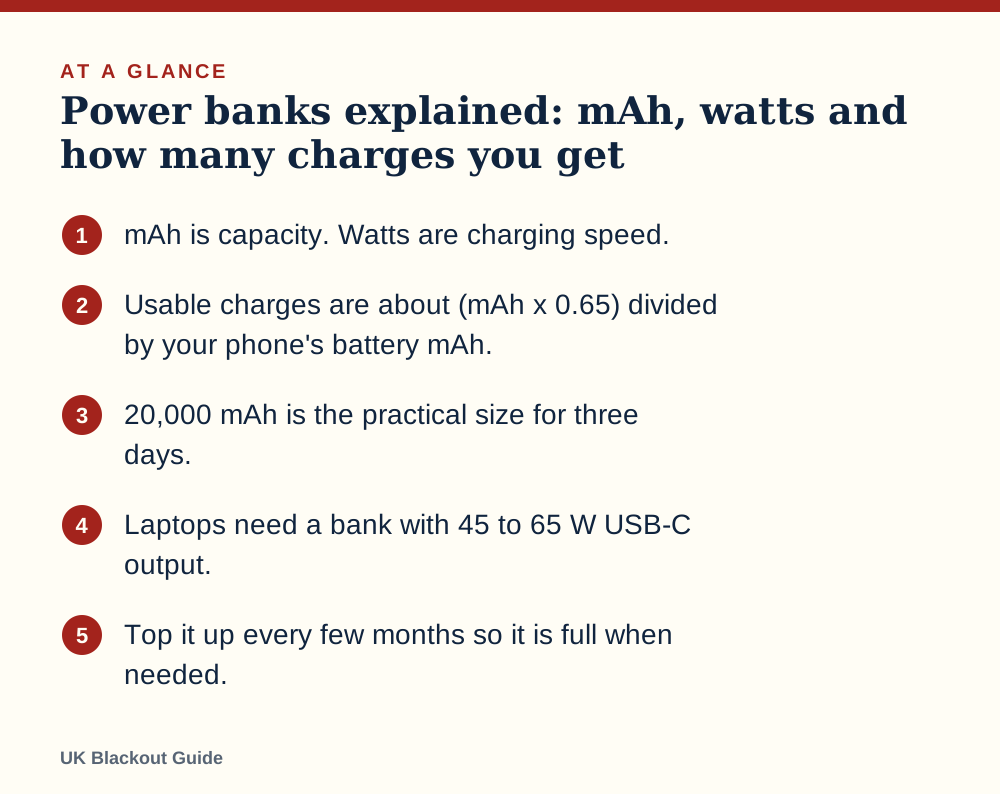
- mAh is capacity. Watts are charging speed.
- Usable charges are about (mAh x 0.65) divided by your phone's battery mAh.
- 20,000 mAh is the practical size for three days.
- Laptops need a bank with 45 to 65 W USB-C output.
- Top it up every few months so it is full when needed.
mAh is the size of the tank
Milliamp-hours (mAh) measure how much charge a battery holds. A bigger number means more stored energy and a heavier, pricier bank. Common sizes are 5,000, 10,000, 20,000 and 30,000 mAh.
The figure refers to the cells inside the bank, which sit at about 3.7 volts. USB delivers power at 5 volts or more, so the bank has to convert it, and some energy is lost as heat along the way. Your phone loses a little more as it charges. That is why a 20,000 mAh bank never fills a 5,000 mAh phone four times.
How many charges you really get
A reliable rule of thumb is that about 65% of the stated capacity reaches your phone. The sum is: power bank mAh, times 0.65, divided by your phone's battery mAh. You can find your phone's battery size in its specifications online.
| Power bank | Usable (x 0.65) | Phone with 3,500 mAh battery | Phone with 5,000 mAh battery |
|---|---|---|---|
| 5,000 mAh | 3,250 mAh | 0.9 charges | 0.65 charges |
| 10,000 mAh | 6,500 mAh | 1.9 charges | 1.3 charges |
| 20,000 mAh | 13,000 mAh | 3.7 charges | 2.6 charges |
| 30,000 mAh | 19,500 mAh | 5.6 charges | 3.9 charges |
Old banks hold less than new ones, and cold rooms reduce output a little further, so treat these as best cases. For more examples see how many phone charges to expect from each size.
Watts decide how fast it charges and what it can charge
Capacity tells you how much, and wattage tells you how quickly. A basic USB port delivers 5 to 10 W. A USB-C port with Power Delivery (PD) can supply 20 W or more, which is what modern phones use for fast charging.
Wattage matters most for bigger devices. A laptop typically draws 45 to 65 W, and most will refuse to charge from a low-power port. If you want to keep a laptop going, you need a bank whose USB-C output is rated in that range. Our answer on charging a laptop from a power bank explains what to check.
The cable counts too. A thin old cable can limit a fast port to a crawl, so keep a decent one with the bank. Our list of charging cables for an emergency kit covers the types.
Choosing a size for power cuts
The Be Ready campaign asks households to be able to manage for three days and lists a charged power bank in its kit. For one adult using a phone sparingly, 20,000 mAh covers that comfortably. A household of four is usually better served by two or three medium banks than one huge one, because people can be in different rooms and one fault does not leave everyone without.
Go bigger if you have a laptop or tablet to feed, or several small USB devices such as lanterns, a radio and a heated gilet. A 30,000 mAh bank holds roughly 110 Wh, which is a useful reserve. Our round-up of high-capacity power banks focuses on models with laptop-level output.
Above that size you are into power station territory, with mains sockets and capacities measured in watt-hours. See how portable power stations differ if you want to run a router or a lamp.
Features that help in the dark
A few details make a real difference when the lights are out. A percentage display is better than four vague dots. Pass-through charging lets the bank charge while it charges a phone, which is handy when the power returns briefly during rota cuts of about three hours at a time. A low-current mode stops the bank shutting off when it feeds something tiny such as a USB light.
A built-in torch is a nice extra but no substitute for a real one. Built-in solar panels are best ignored when comparing capacity. Be wary of very cheap banks claiming enormous capacities in a small case: the laws of chemistry have not changed. If a panel on the case still appeals, our best solar power banks for emergencies sets out what to expect from one.
Storing a power bank so it works on the day
Lithium batteries slowly lose charge on the shelf. A bank charged in spring may be well down by winter, which is when you are most likely to need it. Check it every few months, and fold it into the routine in our guide to checking your emergency kit twice a year. How quickly the charge fades is covered in how long a power bank holds its charge.
Charge power banks on a hard surface, not on a bed or sofa. Stop using one that is swollen, cracked, very hot or smells odd, and take it to a battery recycling point. Do not put it in the household bin.
Keep the bank somewhere you can find by feel, with its cable attached by a band. The same bank will happily run other low-power comforts in a cold house: see running a heated gilet from a power bank.
Common questions
Is a higher mAh power bank always better?
No. Larger banks are heavier, slower to refill and cost more. Choose the smallest size that covers three days of your real use, and consider two medium banks over one large one.
What does 22.5 W or 65 W on the box mean?
It is the maximum power the bank can deliver through its fastest port. Phones need around 20 W for fast charging, and laptops usually need 45 to 65 W.
Can I leave a power bank plugged in all the time?
It is better to charge it, unplug it and top it up every few months. Constant charging adds wear and is unnecessary.
Why does my power bank switch off when charging earbuds or a small light?
Many banks cut out when the current is very low. Look for a low-current or trickle mode if you plan to run small USB devices.
Reviewed against these sources on 18 November 2026. If official advice has changed since, follow the official advice.
General information only. This page is not professional, safety, medical, legal or financial advice, and it is not official guidance. No national blackout has been forecast or announced, and nothing here suggests one is expected. We are independent and have no connection to the government or any energy company. Anything involving electricity, gas, fuel or food safety should be checked with a qualified professional or the relevant official body before you act on it. Always check the official sources linked on this page. Full disclaimer
Keep reading
 Buying guide
Best laptop power banks for working through a power cut
Laptop power banks for working through a power cut: high-output USB-C banks from Amazon UK listings, with the watts and capacity you need to keep going.
Read: Best laptop power banks for working through a Buying guide
Best phone chargers for a blackout
Nine ways to keep a phone charged in a blackout: power banks, crank and solar chargers, car chargers and cables from Amazon UK, compared honestly.
Read: Best phone chargers for a blackout Buying guide
Best power banks for power cuts and blackouts
Seven 20,000 mAh power banks from Amazon UK for keeping phones charged through a power cut or blackout, with the sums on how many charges you really get.
Read: Best power banks for power cuts and blackouts Question
Can a power bank charge a laptop in a power cut?
A power bank can charge a laptop if both use USB-C Power Delivery and the bank supplies enough watts. What output and capacity to look for, with examples.
Read: Can a power bank charge a laptop in a power