On this page
There is no single official emergency station in the UK. In a power cut, tune a battery radio to your BBC local radio station on FM for information about your area, and to a UK-wide BBC station for national news. The BBC has described how it would keep broadcasting on FM from an emergency studio. Find both stations in advance.
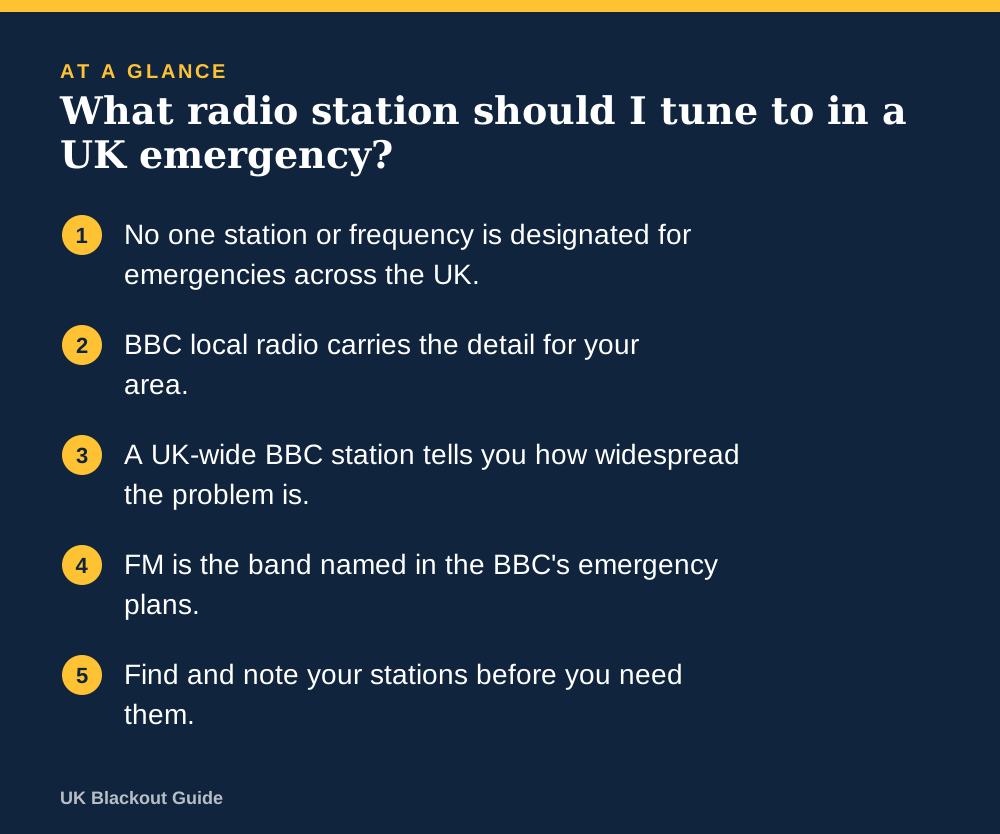
- No one station or frequency is designated for emergencies across the UK.
- BBC local radio carries the detail for your area.
- A UK-wide BBC station tells you how widespread the problem is.
- FM is the band named in the BBC's emergency plans.
- Find and note your stations before you need them.
Start with your local BBC station
In a power cut the questions you want answered are local. Which areas are off, when engineers expect to restore supply, whether schools are open, where to get help. Your BBC local radio station is where those answers are most likely to be broadcast, because gathering and reading out that information during emergencies is part of what local radio does.
In England that means the BBC station for your county or city. In Scotland, Wales and Northern Ireland, the BBC's national station for your nation fills the same role. If you have never listened to yours, find it this week and note where it sits on the FM dial at your address, the first of the radio frequencies to write down.
Then check a national station
A national BBC station tells you whether you are dealing with a fault in your district or something much wider, which changes how you plan the next day. News bulletins come round on the hour, so you can listen for five minutes and switch off.
A BBC report on 7 November 2026 described the BBC emergency broadcasting plan, under which it would keep broadcasting on FM radio from an emergency studio, with generator-backed transmitters and supplies for at least three days. The report described contingency arrangements and was not a forecast of an outage. It is the main reason FM comes first in every kit list.
Commercial and community stations
Local commercial and community stations can be very useful, particularly those with a studio in your town. In the Lancaster power cut of December 2015, when a flooded substation cut power to about 61,000 properties, the local station The Bay kept broadcasting on a generator while mobile, internet and card payments failed locally.
The caution is that many commercial stations now share programmes made elsewhere, and you cannot know in advance which have backup power. Add one to your list as a third choice, not your first.
Have the right radio and try both bands
Official Be Ready advice is to use a battery or wind-up radio and to try FM and digital. If your usual station is missing on DAB, switch to FM before you assume it is off air.
Save your local station as preset one and a national station as preset two, so that getting news in a blackout takes one button press.
Common questions
What frequency is the emergency station on?
There is not one. FM frequencies differ by area, so tune your own radio at home and write down what you find.
Will local radio definitely be on air in a blackout?
Not guaranteed. It depends on backup power at studios and transmitters. That is why you should note more than one station.
Does it matter which national BBC station I choose?
Choose one with regular news bulletins that you receive clearly on FM at home. Note a second as a spare.
Reviewed against these sources on 18 November 2026. If official advice has changed since, follow the official advice.
General information only. This page is not professional, safety, medical, legal or financial advice, and it is not official guidance. No national blackout has been forecast or announced, and nothing here suggests one is expected. We are independent and have no connection to the government or any energy company. Always check the official sources linked on this page. Full disclaimer
Keep reading
 Buying guide
Best battery radios for power cuts and blackouts
Battery radios for power cuts and blackouts, chosen from Amazon UK listings on AA battery power, FM and DAB bands, simple controls and buyer ratings.
Read: Best battery radios for power cuts and Guide
Emergency radios: FM, DAB, wind-up and solar explained
What to look for in an emergency radio for UK power cuts: FM and DAB, battery, wind-up and solar power, useful features, and how to keep it ready to use.
Read: Emergency radios: FM, DAB, wind-up and solar Guide
How to get news in a blackout
How to get reliable news in a UK blackout when the internet and mobile networks struggle: battery radio first, then your phone, your car and your street.
Read: How to get news in a blackout Guide
Radio stations and frequencies to write down now
FM frequencies vary by area, so find yours now. A ten-minute method for finding, testing and writing down the radio stations to use in a UK power cut.
Read: Radio stations and frequencies to write down