On this page
Copy the papers you would need to prove who you are, get medical care, make an insurance claim and contact people without your phone. Keep printed copies in a fire-resistant pouch at home and a second set somewhere else. The government's Be Ready kit list includes printed documents and a written list of contacts and medication.
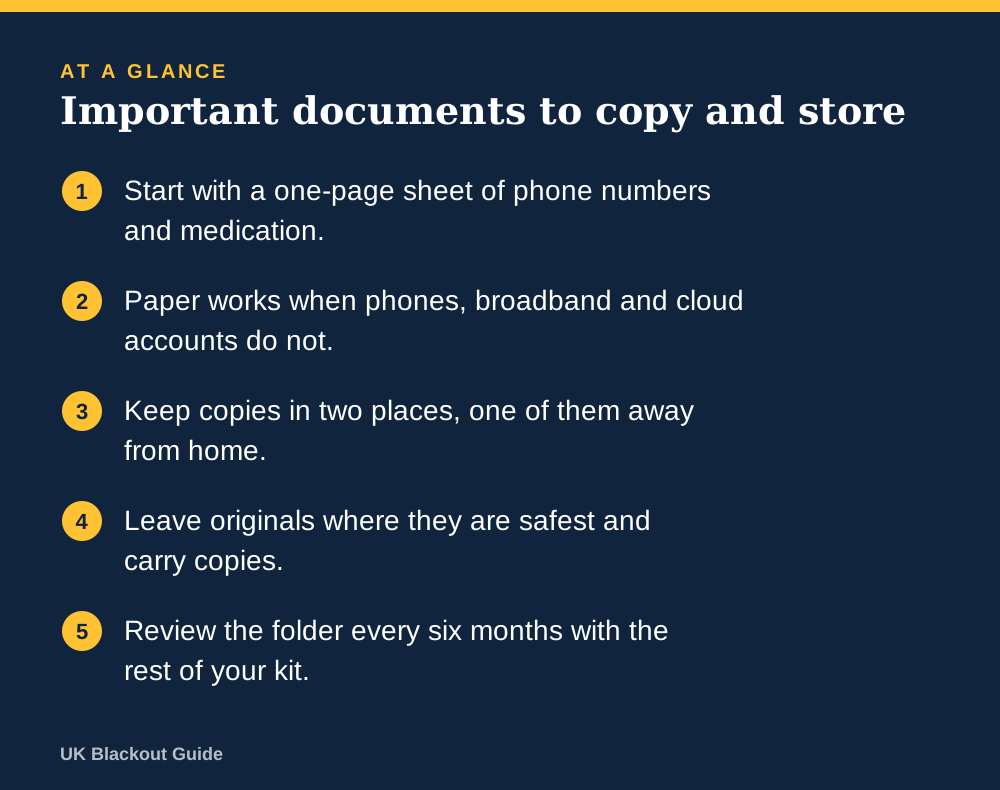
- Start with a one-page sheet of phone numbers and medication.
- Paper works when phones, broadband and cloud accounts do not.
- Keep copies in two places, one of them away from home.
- Leave originals where they are safest and carry copies.
- Review the folder every six months with the rest of your kit.
Write the one-page sheet first
If you do only one thing, write a single sheet of paper with the numbers and facts that currently live only in your phone. A phone with a flat battery or no signal knows nothing.
Put on it: family and close friends' numbers, your GP surgery and pharmacy, work and school, your energy supplier, 105 for power cuts (03457 643643 in Northern Ireland), the gas emergency number 0800 111 999, your bank's lost-card line and your insurer's claims line. Add each person's medication, dose and any allergies.
Be Ready asks for exactly this: a written list of contacts and medication. Make a copy for each adult and one for the kit. It is also the backbone of a written household emergency plan.
The documents worth copying
You do not need to photocopy the filing cabinet. Aim for the papers that are slow or awkward to replace, or that someone else will ask to see.
| Group | What to copy | Why you might need it |
|---|---|---|
| Identity | Passport photo page, driving licence, birth and marriage certificates | Proving who you are, replacing lost originals |
| Health | Repeat prescription list, NHS numbers, care plans, equipment details | Getting treatment away from your usual GP |
| Insurance | Home, car, pet and life policy schedules with policy numbers | Starting a claim by phone |
| Home | Tenancy agreement or mortgage details, recent utility bill | Proof of address, landlord contact |
| Money | Bank names, sort codes and helpline numbers (not PINs or passwords) | Reaching your bank without the app |
| Energy | Supplier account number, meter numbers, your load block letter | Reporting faults, following rota cut schedules |
| Pets | Microchip number, vaccination record, vet details | Kennels, emergency vets |
If anyone at home relies on powered medical equipment, add the supplier's emergency number and the settings prescribed, as our guide to medical equipment in a power cut suggests.
Your load block letter can be found at powercut105.com or on some bills, and how to find your load block letter takes you through it.
Paper first, because paper needs no battery
Printed copies are the point of the exercise. In a wide power cut you may have no broadband, patchy mobile data and a phone you are rationing. Paper can be read by torchlight and handed to someone.
Print in black and white on ordinary paper, and write the date on the front sheet. Put them in a plastic wallet inside something that resists heat and water, such as a fire-resistant document bag.
Keep the pouch where you could grab it on the way out, close to or inside your grab bag.
Keep a second set somewhere else
One set at home protects you from a power cut. It does not protect you from a house fire or flood. A second set kept elsewhere covers both.
A sealed envelope with a relative or trusted friend works well, and you can hold theirs in return. Some people keep a set at work. Choose somebody who lives far enough away that the same flood or fire would not reach both houses.
Originals such as passports and certificates are usually best left at home in the pouch, or with a bank or solicitor if you already use one for that. Copies travel. Originals stay put.
Digital copies, done safely
Scans are a useful third layer. Photograph or scan each document and save the files in two forms: in a cloud account you can reach from any device, and on an encrypted USB stick or in a password-protected folder that works offline.
The offline copy matters because cloud storage needs the internet, and home internet usually fails in a power cut. Saving the key files to your phone for offline viewing takes two minutes and means they open with no signal at all.
Protect the cloud account with a strong password and two-step verification, two of our household cyber security basics, since these scans are exactly what an identity thief wants. Never store PINs or full passwords with the scans.
Keeping it current
A contact sheet with an old mobile number or a prescription you stopped last year is worse than none. Be Ready suggests checking your kit every six months, and the document folder belongs in that check.
Each time, confirm phone numbers, replace renewed insurance schedules, update medication, and reprint anything that has changed. If you keep a small cash float in a lockable box, such as one from our round-up of cash boxes, count it at the same visit.
Shred the old copies. A folder of out-of-date personal papers in the recycling is a gift to a fraudster.
Checklist
Important documents to copy and store
- Write the one-page contact and medication sheet
- Copy identity documents for each person
- Copy insurance schedules with policy and claims numbers
- Note supplier account, meter numbers and load block letter
- Put the paper set in a fire-resistant pouch
- Give a sealed second set to someone you trust
- Save scans to the cloud and to an offline copy
- Set a six-month reminder to update everything
Common questions
Should I keep my passport in my emergency kit?
Keep the original somewhere secure at home and put a copy in the kit. If you have to leave home for more than a night, take the original with you.
Is it safe to photograph documents on my phone?
Yes, provided the phone has a screen lock and the cloud account has a strong password and two-step verification. Do not store PINs or passwords alongside them.
Do I need certified copies?
Not for an emergency folder. Ordinary photocopies are enough to give reference numbers and start replacing lost originals.
Reviewed against these sources on 18 November 2026. If official advice has changed since, follow the official advice.
General information only. This page is not professional, safety, medical, legal or financial advice, and it is not official guidance. No national blackout has been forecast or announced, and nothing here suggests one is expected. We are independent and have no connection to the government or any energy company. Always check the official sources linked on this page. Full disclaimer
Keep reading
 Buying guide
Best fireproof document bags for emergency paperwork
Fire-resistant document bags for emergency paperwork: keep passports, policies, contacts and cash ready to grab. Seven Amazon UK listings compared.
Read: Best fireproof document bags for emergency Guide
Cash in an emergency: how much to keep and where
Why cash belongs in a UK power cut kit, how to work out a sensible amount for three days, which notes and coins to hold and where to keep them at home.
Read: Cash in an emergency: how much to keep and Guide
How to write a household emergency plan
How to write a one-page household emergency plan for power cuts: contacts, meeting points, who does what, where the kit is and when to stay or leave.
Read: How to write a household emergency plan Buying guide
Best cash boxes for emergency cash at home
Lockable cash boxes for keeping emergency notes and coins ready at home for when card payments fail in a power cut. Eight Amazon UK listings compared.
Read: Best cash boxes for emergency cash at home