On this page
To prepare for a blackout in the UK, follow the government's Be Ready list: three days of water and no-cook food, a torch, an FM radio, a charged power bank, medication, warm bedding and cash. Save 105 in your phone and find your network operator. No blackout is planned or forecast, so build this gradually.
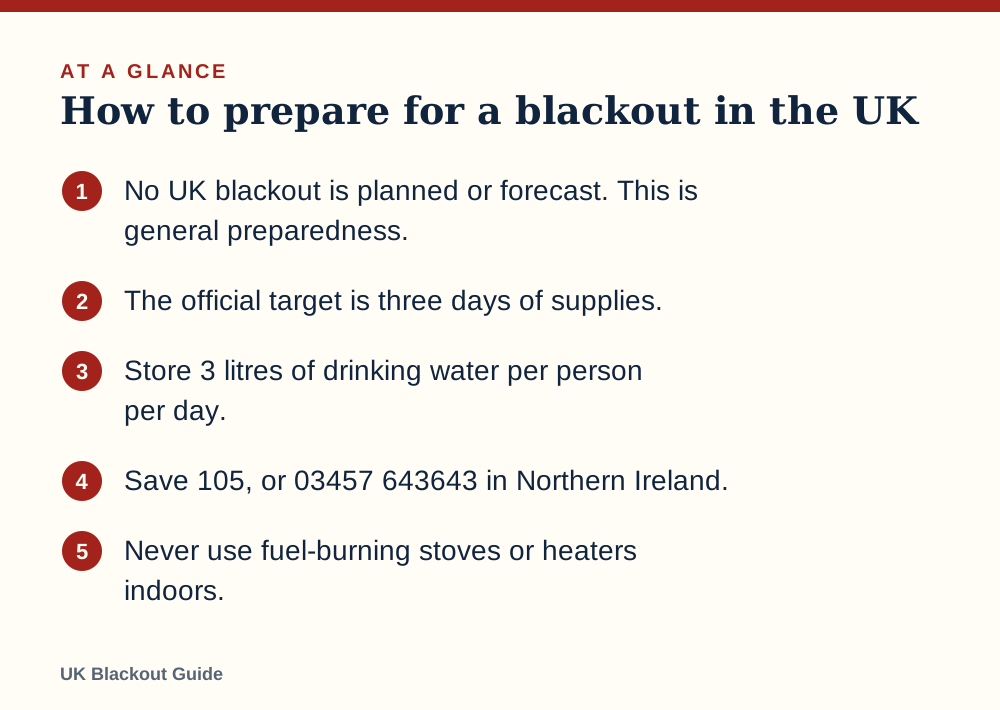
- No UK blackout is planned or forecast. This is general preparedness.
- The official target is three days of supplies.
- Store 3 litres of drinking water per person per day.
- Save 105, or 03457 643643 in Northern Ireland.
- Never use fuel-burning stoves or heaters indoors.
Start with the official three-day list
To prepare for a blackout in the UK, build the three-day kit the government describes and learn who to call. That is the whole job, and you can do it in stages.
The Be Ready campaign (beready.campaign.gov.uk), launched on 22 October 2026, asks households to be able to manage for three days. It is presented as general preparedness, not a forecast. No UK blackout has been announced, planned or predicted, and the same kit serves you in the ordinary local power cuts that storms and faults cause. Our item-by-item 72-hour emergency kit guide covers the list in detail. This page puts the steps in order.
Water and food come first
On how much water to store, Be Ready says to keep 3 litres of drinking water per person per day, with more for cooking and washing. For a family of four over three days that is 36 litres as a minimum. Mains water can be disrupted during and after power cuts, which is why it is on the list. Shop-bought bottled water is the simplest route. If you would rather fill your own, use containers made for drinking water.
For a three-day food supply, pick things you already eat that need no cooking or fridge: tinned fish, beans, fruit, crackers, cereal bars, long-life milk. Add a manual tin opener.
Light, news and a charged phone
Be Ready lists a battery or wind-up torch with spare batteries, and says torches are safer than candles. Keep one of the torches suited to power cuts where you can find it in the dark, such as by the bed or the fuse box.
A battery or wind-up FM radio is how official information would reach you if broadband and mobile data stopped. The campaign advises trying both FM and digital.
A charged power bank completes the set. A 20,000 mAh bank gives a typical phone about 3 to 4 charges, and stretching your phone battery makes that go further.
Warmth without mains power
Official advice is to keep warm with layers and blankets and to close doors and curtains. Gather blankets, sleeping bags and warm clothing in one place. Many gas boilers stop in a power cut because their controls and pump need electricity, as explained in whether gas boilers work in a power cut.
Never use a generator, barbecue, camping stove or patio heater indoors, in a garage or in a tent. Carbon monoxide has no smell. Fit an audible alarm marked EN 50291.
For anything longer than an evening, the one-warm-room method in our guide to keeping warm in a power cut is the next step. The NHS advises heating rooms you use to at least 18°C in normal times, and says shivering, confusion and slurred speech are signs of hypothermia that need a 999 call.
Numbers and information to write down
These cover who to call in a power cut. Save them now, and write them on paper as well:
- 105: free, to report a power cut in England, Scotland and Wales. In Northern Ireland call 03457 643643.
- Your network operator: find it at powercut105.com. It fixes faults. Your supplier does not.
- Your load block letter: also at powercut105.com or on some bills. It would matter only if rota cuts of about three hours were ever used in a national shortage.
- 0800 111 999: the gas emergency number.
Be Ready also lists a written list of contacts and medication, printed copies of documents, and cash in notes and coins, because card payments can fail. Our answer on how much cash to keep at home discusses sensible amounts.
People who need extra support
The Priority Services Register is free. Households with children under 5, older people and people who rely on powered medical equipment are among those who qualify. Join at thepsr.co.uk or through your supplier or network operator. Northern Ireland uses Customer Care Registers.
If you use medical equipment at home, ask your clinician or equipment supplier what to do in a power cut and follow their advice. If you depend on a landline, ask your provider about battery backup, since digital landlines need mains power. Add baby supplies (ready-to-feed formula is preferred) and pet food if they apply to you.
Know what to do on the day
The official steps during a cut are short. Keep away from power lines. Turn off irons, ovens, electric fires and fryers. Unplug the TV and computer, because of the surge when power returns. Keep fridge and freezer doors closed: the Food Standards Agency says a fridge stays cold for around 4 hours unopened and a full freezer for about 48 hours. Check on neighbours.
Our step-by-step page on what to do in a power cut covers the first minutes. Be Ready says to check your kit every six months, so set a reminder. Change the water, test the torch and radio, and recharge the power bank.
Checklist
How to prepare for a blackout in the UK
- Three days of drinking water, 3 litres per person per day
- Three days of food that needs no cooking, plus a tin opener
- Torch and spare batteries
- Battery or wind-up FM radio
- Charged power bank and cable
- First aid kit and essential medication
- Blankets and warm clothing in one place
- Cash in notes and coins
- 105 and your network operator written down
- Priority Services Register joined, if you qualify
Common questions
Is a blackout expected in the UK?
No. No blackout has been announced, planned or forecast. Be Ready is general preparedness advice.
How long should I prepare for?
The government asks households to be able to manage for three days. It has not asked for longer.
Do I need a generator to be prepared?
No. Generators are not on the Be Ready list. A torch, an FM radio and a power bank are the powered items it names.
How much does it cost to prepare?
It depends on what you already own. Most of the list is ordinary food, water and bedding, and Be Ready advises building it gradually.
Reviewed against these sources on 18 November 2026. If official advice has changed since, follow the official advice.
General information only. This page is not professional, safety, medical, legal or financial advice, and it is not official guidance. No national blackout has been forecast or announced, and nothing here suggests one is expected. We are independent and have no connection to the government or any energy company. Always check the official sources linked on this page. Full disclaimer
Keep reading
 Guide
Get blackout-ready in one evening
Get blackout-ready in one evening: a two-hour plan using what you own, based on the government's Be Ready list. No blackout is planned or forecast.
Read: Get blackout-ready in one evening Buying guide
Best power cut essentials: the blackout kit worth buying
The blackout kit worth buying for a UK power cut: a battery torch, a lantern, a power bank, a wind-up radio, an automatic light and a flask, with picks.
Read: Best power cut essentials: the blackout kit Guide
Blackout shopping list: what to buy first, and what can wait
What to buy for the blackout, in order: a shopping list based on the government's Be Ready kit, with what to buy first, what can wait and what to skip.
Read: Blackout shopping list: what to buy first, Question
What does the government say to keep at home for a power cut?
What to buy for the blackout, according to the government: the Be Ready list of water, food, a torch, an FM radio, a power bank, medication and cash.
Read: What does the government say to keep at home