On this page
- Work out whether it is your home or the whole street
- Report it, even if you think someone else already has
- Make the house safe before you do anything else
- Get light without lighting a flame
- Protect the food and the warmth you already have
- Save your phone and check on other people
- If the power is still off after a few hours
- Checklist
- Common questions
Check whether the cut is only in your home by looking at your fuse box and the street outside. If the neighbours are off too, report it on 105, switch off anything that makes heat, unplug the TV and computer, use a torch instead of candles and keep the fridge and freezer shut.
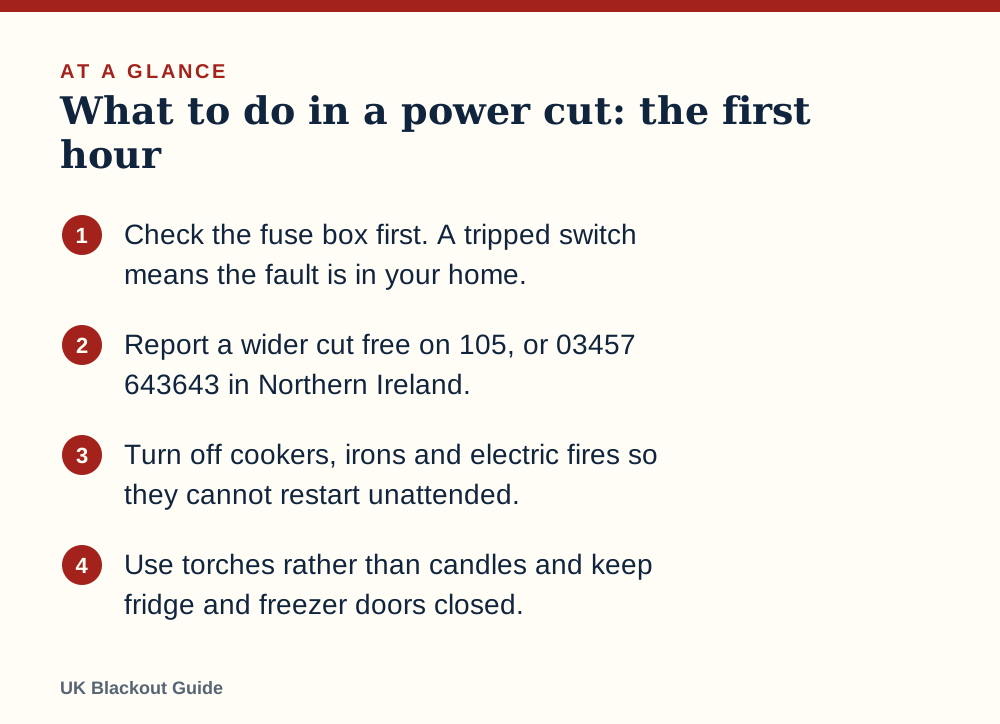
- Check the fuse box first. A tripped switch means the fault is in your home.
- Report a wider cut free on 105, or 03457 643643 in Northern Ireland.
- Turn off cookers, irons and electric fires so they cannot restart unattended.
- Use torches rather than candles and keep fridge and freezer doors closed.
Work out whether it is your home or the whole street
Pick up a torch and go to your fuse box (the consumer unit), the first step in working out why your power has gone off. If one of the switches has flipped to the off position, the fault is inside your home. Unplug whatever you had just switched on, push the switch back up and see if it holds.
If every switch is still on, look outside. Dark houses and dead street lights mean the fault is on the network. If the neighbours still have light and you have a prepayment meter, check that it has credit.
Do not open or touch the electricity meter or the sealed main fuse beside it. Those belong to the network and the supplier, and only their engineers work on them.
Report it, even if you think someone else already has
Call 105. It is free from mobiles and landlines in England, Scotland and Wales and puts you through to the company that runs the cables in your area. In Northern Ireland the number is 03457 643643.
Your energy supplier sends the bill but does not fix faults, so there is no point ringing them. The network operator does the repair, and reporting a power cut helps even when others have: the more reports it gets, the faster it can pin down where the fault is. Most operators also show known faults on a live map if your phone still has data.
Make the house safe before you do anything else
Walk round and deal with what to switch off in a power cut, starting with anything that makes heat: the oven and hob, irons, electric fires, fryers, hair straighteners. If the power returns while you are out or asleep, none of them should come back on unattended.
Then unplug the television and computer. Supply can come back with a brief surge, and sensitive electronics are the items most likely to suffer. Leave one ceiling light switched on so you can see when the power returns.
If the cut followed a storm, stay well away from any fallen or sagging power lines and anything touching them. Treat every line as live and call 105 to report it. If someone is in danger, call 999.
Get light without lighting a flame
The official Be Ready advice is blunt: torches are safer than candles. A candle left on a windowsill or knocked by a child or a pet is a house fire, and in a power cut the fire service is busy.
A simple, inexpensive torch for each person is a sensible target, kept where each person can find it by touch. The torch on your phone works, but it eats the battery you will want for calls and updates.
The other useful light is one you never have to look for. Plug-in automatic power cut lights that switch themselves on when the mains fails will light your hallway and stairs in the first seconds, which is when most trips and falls happen.
Protect the food and the warmth you already have
Leave the fridge and freezer closed, the first rule of food safety in a power cut. The Food Standards Agency says an unopened fridge should stay cold for around 4 hours, a full freezer typically stays frozen for about 48 hours, and a half-full one for about 24. Every time the door opens, that clock runs faster.
Heat works the same way. Close internal doors and curtains, put on another layer before you feel cold, and gather in one room. Most gas boilers stop too, because their pump and controls need electricity, as we explain in whether gas boilers work in a power cut.
Never bring a barbecue, camping stove, patio heater or generator indoors for heat or cooking. They produce carbon monoxide, which has no smell and can kill.
Save your phone and check on other people
Mobile masts may keep working for a while on backup power, but not everywhere and not indefinitely. Turn the screen brightness down, close what you do not need and keep calls short. A battery or wind-up radio will bring you local news without touching your phone, and a wind-up radio needs no batteries at all.
If you have older or unwell neighbours, knock on the door. Anyone who relies on powered medical equipment, is of pension age or has children under five should also be on the free Priority Services Register, which tells the network operator to look out for them in a cut.
If the power is still off after a few hours
Most cuts are fixed within hours, and the operator can usually give an estimated time when you report the fault. If yours runs on into the first 24 hours without power and beyond, the priorities shift from safety to pacing yourself: food, warmth, phone charge and sleep.
Checklist
What to do in a power cut: the first hour
- Check the fuse box for a tripped switch
- Look outside to see if neighbours and street lights are off
- Report the cut on 105 (03457 643643 in Northern Ireland)
- Switch off the oven, hob, iron and electric heaters
- Unplug the TV and computer
- Leave one light switched on
- Use torches, not candles
- Keep the fridge and freezer closed
- Close doors and curtains to hold heat
- Check on vulnerable neighbours
Common questions
Should I call my energy supplier about a power cut?
No. Your supplier handles billing. Faults are fixed by your network operator, which you reach free on 105 in England, Scotland and Wales.
Is it safe to reset a tripped switch in the fuse box?
Yes, once you have unplugged the appliance you had just turned on. If the switch trips again straight away, leave it off and call a qualified electrician.
Can I use my gas hob in a power cut?
Many gas hobs can be lit with a match when the electric ignition is dead, so check your manual. Use it for cooking only, never to heat the room.
How long will the power be off?
Most faults are repaired within a few hours. Storm damage in rural areas can take longer, and your network operator will give an estimate when you report the cut.
Reviewed against these sources on 18 November 2026. If official advice has changed since, follow the official advice.
General information only. This page is not professional, safety, medical, legal or financial advice, and it is not official guidance. No national blackout has been forecast or announced, and nothing here suggests one is expected. We are independent and have no connection to the government or any energy company. Always check the official sources linked on this page. Full disclaimer
Keep reading
 Buying guide
Best power cut essentials: the blackout kit worth buying
The blackout kit worth buying for a UK power cut: a battery torch, a lantern, a power bank, a wind-up radio, an automatic light and a flask, with picks.
Read: Best power cut essentials: the blackout kit Question
Power cut at my house but not the neighbours': why?
If your power is off but the neighbours' lights are on, the cause is usually a tripped switch in your fuse box, a meter with no credit or a local fault.
Read: Power cut at my house but not the Guide
How to prepare for a blackout in the UK
How to prepare for a blackout in the UK: the official Be Ready three-day list, the numbers to save, and the home checks to do. No blackout is forecast.
Read: How to prepare for a blackout in the UK Guide
Get blackout-ready in one evening
Get blackout-ready in one evening: a two-hour plan using what you own, based on the government's Be Ready list. No blackout is planned or forecast.
Read: Get blackout-ready in one evening