On this page
Switch off anything that makes heat, such as ovens, hobs, irons, electric fires and fryers, so it cannot restart unattended. Unplug the TV and computer, because power can return with a surge. Leave the fridge and freezer plugged in and closed, and leave one light switched on so you know when the supply is back.
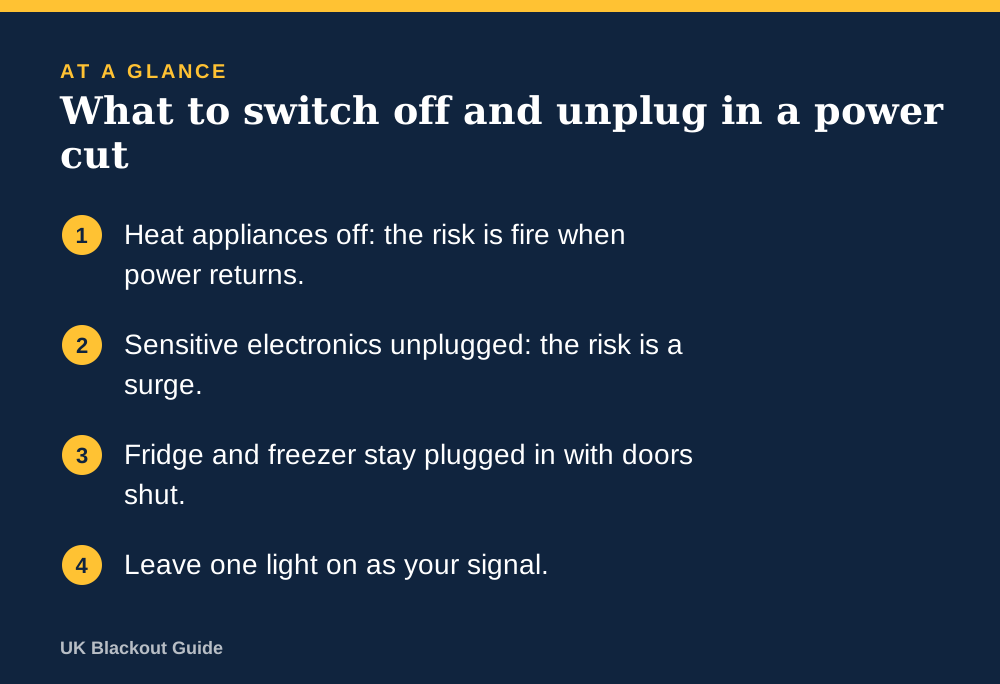
- Heat appliances off: the risk is fire when power returns.
- Sensitive electronics unplugged: the risk is a surge.
- Fridge and freezer stay plugged in with doors shut.
- Leave one light on as your signal.
Two risks, two kinds of appliance
There are only two reasons to touch a switch in a power cut. Sorting your appliances into those two groups makes the job quick.
The first is fire. Anything that was making heat when the power failed will start making heat again the moment it returns. If you have gone to bed, gone out, or put a tea towel down on the hob in the dark, that is how a kitchen fire starts. The official Be Ready advice names irons, ovens, electric fires and fryers for this reason.
The second is surge. When supply is restored, the voltage can spike or flicker for a moment. Most appliances shrug it off. Electronics with delicate circuit boards sometimes do not, which is why Be Ready says to unplug the TV and PC, and why protecting appliances from power surges is worth a little effort.
Appliance by appliance
| Appliance | What to do | Why |
|---|---|---|
| Oven, hob, grill | Turn every dial to off | Fire risk on return |
| Iron, hair straighteners, tongs | Switch off and unplug | Fire risk on return |
| Electric fire, fan heater, oil radiator | Switch off at the wall | Fire risk, and a heavy load on restart |
| Deep fat fryer, toaster, kettle | Switch off at the wall | Fire risk on return |
| Electric blanket | Switch off and unplug | Should not come on unattended |
| TV, games console, set-top box | Unplug | Surge |
| Desktop computer, monitor, printer | Unplug | Surge |
| Broadband router | Unplug, or leave on a surge protected lead | Surge |
| Washing machine, dishwasher, tumble dryer | Switch off at the machine | Stops it restarting mid-cycle at 3am |
| Fridge and freezer | Leave plugged in, doors shut | They need to restart as soon as power returns |
| One ceiling light | Leave switched on | Tells you the power is back |
If you cannot remember what was on, the hob and the iron are the two to check twice, and a printed power cut checklist saves relying on memory.
What you can leave alone
You do not need to go round every socket in the house. Lamps, phone chargers, clocks and most small appliances are not a fire risk and are rarely harmed. The honest answer to whether you should unplug everything is no: do the heat list, do the expensive electronics, and stop.
Leave the fridge and freezer plugged in. Food safety in a power cut depends on them starting again the moment supply returns, and the Food Standards Agency's guidance is simply to keep the doors shut.
Leave the main switch on your fuse box alone as well. Turning the whole house off means you will not know when the power is back, and the freezer will not restart until you remember. The exception is flooding or damage to your wiring, when isolating the supply is the right call and it pays to know how to turn off your gas, water and electricity.
Gas appliances and the boiler
Most modern gas boilers stop in a power cut because the pump, fan and controls are electric. You do not need to switch the boiler off, and most will restart on their own. Some need the reset button pressed afterwards.
A gas hob that you have lit with a match is a different matter. Turn it off when you finish cooking and never leave it burning for warmth.
A gas hob or oven is for cooking only. Using one to heat a room, or bringing a barbecue or camping stove indoors, risks carbon monoxide poisoning. If you smell gas at any time, call the gas emergency line on 0800 111 999.
Surge protection you set up in advance
Unplugging works every time, but only if you are at home and awake. For the cluster of electronics around a TV or a desk, a surge protected extension lead does the job when you are not. It will not stop every possible fault, and it is no substitute for unplugging in a thunderstorm, but it is cheap cover for equipment worth hundreds of pounds.
If you want a computer to stay on through brief cuts as well, a UPS battery backup adds a battery to the same idea.
The chance that a power cut will damage appliances on any single occasion is low. The precautions are cheap, which is the argument for taking them.
Switching back on in the right order
When the power comes back and the light comes on, wait a few minutes before plugging anything back in. Supply sometimes drops out again shortly after it is restored while engineers reconnect sections of the network.
Then bring things back gradually: check the fridge and freezer are running, plug in the router, then the TV and computer. Leave the big heaters until last.
Common questions
Should I turn off the main switch on my fuse box?
Not in a normal power cut. Leave it on so the fridge and freezer restart automatically. Isolate the supply only if there is flooding or damage to your wiring.
Do I need to unplug phone chargers and lamps?
No. They are not a fire risk and are very unlikely to be damaged.
Is my electric oven dangerous if I leave it switched on?
It will heat up again when power returns, which is a fire risk if anything has been left on or in it. Turn all the dials to off.
Does a surge protector work if the power cuts out repeatedly?
It limits voltage spikes each time, but its protective parts wear with use. Check the indicator light and replace the lead when it goes out.
Reviewed against these sources on 18 November 2026. If official advice has changed since, follow the official advice.
General information only. This page is not professional, safety, medical, legal or financial advice, and it is not official guidance. No national blackout has been forecast or announced, and nothing here suggests one is expected. We are independent and have no connection to the government or any energy company. Always check the official sources linked on this page. Full disclaimer
Keep reading
 Buying guide
Best surge protectors for power cuts
Surge protectors for power cuts: extension leads that guard a TV, computer or router from the spike when the mains returns, chosen from Amazon UK listings.
Read: Best surge protectors for power cuts Question
Can a power cut damage appliances?
A power cut rarely harms appliances by itself. The risk comes from surges and flickering when supply returns, and from computers losing power mid-task.
Read: Can a power cut damage appliances? Question
Should I unplug everything in a power cut?
You do not need to unplug everything in a power cut. Turn off heat appliances, unplug the TV and computer, and leave the fridge and freezer plugged in.
Read: Should I unplug everything in a power cut? Guide
What to do when the power comes back on
What to do when the power comes back on after a cut: reconnect appliances safely, check fridge and freezer food, reset the boiler and restock your kit.
Read: What to do when the power comes back on