On this page
- The day at a glance
- Hour one: settle the house and find out what you can
- Hours one to four: bank what is still working
- Hours four to twelve: eat from the fridge and shrink the house
- Overnight: light, warmth and nothing left burning
- Hours twelve to twenty-four: decide, recharge, check in
- If there is still no end in sight
- Common questions
The first hour is for safety and reporting. After that, a day without power is about rationing three things: cold in the fridge, heat in the house and charge in your phone. An unopened fridge holds for around 4 hours and a full freezer for about 48, so plan meals around what will spoil first.
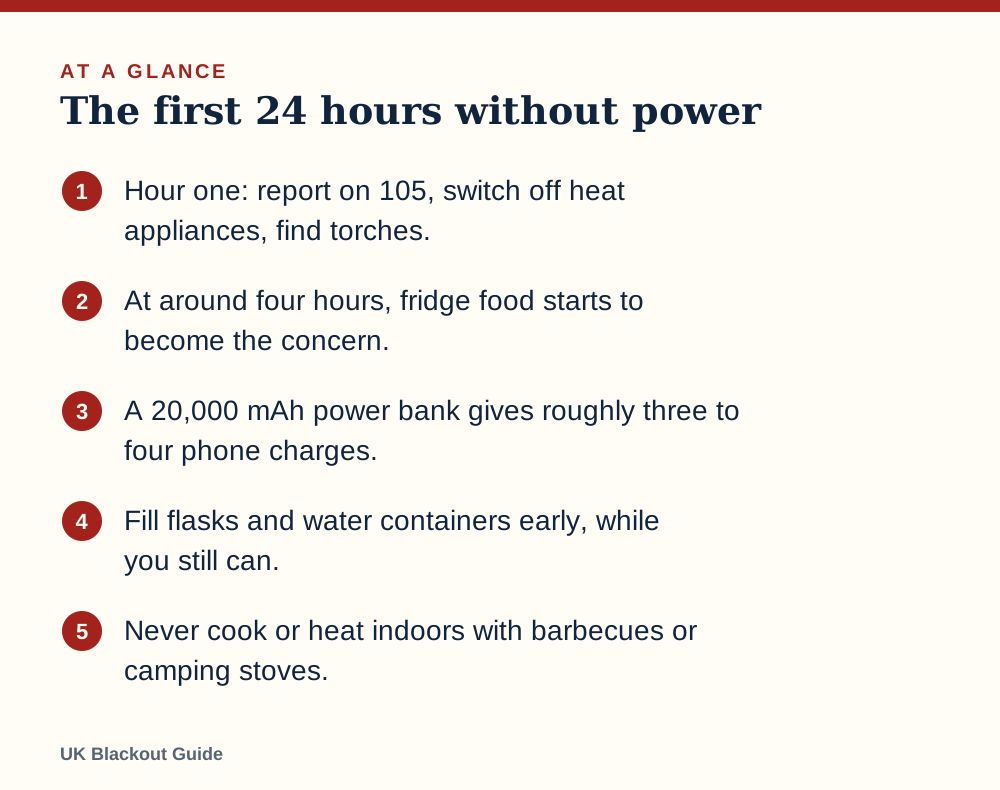
- Hour one: report on 105, switch off heat appliances, find torches.
- At around four hours, fridge food starts to become the concern.
- A 20,000 mAh power bank gives roughly three to four phone charges.
- Fill flasks and water containers early, while you still can.
- Never cook or heat indoors with barbecues or camping stoves.
The day at a glance
| Time since the cut | What matters most |
|---|---|
| 0 to 1 hour | Safety, reporting, light |
| 1 to 4 hours | Phone battery, water, a hot drink in the flask |
| 4 to 12 hours | Eating the fridge food first, holding heat in one room |
| Overnight | Sleeping warm, safe lighting, no flames left burning |
| 12 to 24 hours | Freezer decisions, recharging, checking on others |
Most UK power cuts end long before the bottom row. This plan is for the ones that do not, and it assumes you have already done the basics in our first-steps guide to a power cut.
Hour one: settle the house and find out what you can
Report the cut on 105 (03457 643643 in Northern Ireland) and ask for the estimated restoration time. Write it down along with the time the power went off. You will need that start time later for food decisions and for any compensation claim.
Turn off the oven, hob, iron and electric heaters, unplug the TV and computer, and leave one light on as a signal. Put a torch in every room you are using. If you have no idea how long this kind of fault usually takes, our answer on how long power cuts tend to last gives the realistic range.
Hours one to four: bank what is still working
Some things keep going for a while and then stop. Mobile masts may run on backup power for a limited time. Mains water can be disrupted during and after a cut. If the taps are running, fill a few jugs, pans or containers now. The official figure to plan around is 3 litres of drinking water per person per day, and our guide to how much water to keep at home shows how to work it out for your household.
If you have a gas hob that lights with a match, or the kettle has only just boiled, fill a flask. One pan of boiled water kept hot in a flask means tea, a hot water bottle or warm washing water hours later without relighting anything.
Put your phone into low power mode, drop the brightness and stop scrolling, the first steps in making a phone battery last. The sums are simple: usable charges are roughly the power bank's mAh multiplied by 0.65, divided by your phone's battery size. A 20,000 mAh power bank gives a typical phone about three to four full charges, which is several days if you are careful.
Hours four to twelve: eat from the fridge and shrink the house
How long fridge food lasts without power is short. The Food Standards Agency says a fridge should stay cold for around 4 hours if you leave it shut. So at about the four-hour mark, open it once, take out what you plan to eat for the next meal, and close it again. Cooked meats, dairy and leftovers are the things to use or lose first. The rule that covers everything else is the FSA's own: if in doubt, throw it out.
Leave the freezer alone. Unopened, a full one typically stays frozen for about 48 hours and a half-full one for about 24.
In cold weather, this is also when the house starts to cool noticeably. Pick the smallest room you can all sit in, close its door and curtains, and bring blankets and layers to it. Heating people is far easier than heating rooms, which is the whole idea behind the one warm room approach.
Do not use a barbecue, camping stove, patio heater or generator inside the house, garage or a tent. They give off carbon monoxide, which you cannot smell. Headache, dizziness, nausea and breathlessness are warning signs. Get into fresh air and call 999.
Overnight: light, warmth and nothing left burning
Lanterns suit the evening better than torches. A torch lights a spot. A lantern on a table lights a room well enough to eat, read and play cards, and one charge or set of batteries on a low setting will usually see you through several evenings.
Before bed, blow out any candles, check the hob is off, and put a torch within reach of every bed. Sleep in layers with a hat if the house is cold. Extra blankets under you matter as much as the ones on top.
Hours twelve to twenty-four: decide, recharge, check in
By the next morning you will have a better idea of scale. Call 105 again for an update, and listen to local radio on a battery or wind-up set. If you have a car, it is a warm place with a radio and a phone charger. Run the engine outside only, never in a garage.
A half-full freezer is now near its 24-hour mark. If the cut looks likely to continue, cook what you can safely cook, or ask a neighbour with power or a full freezer for space. Check on anyone nearby who is elderly, unwell or alone.
If there is still no end in sight
A cut that runs past 24 hours is rare, but it happens, usually after severe storms. The government's Be Ready campaign asks households to be able to manage for three days for exactly that reason. Our plan for three days without power carries on from here.
Common questions
When should I start worrying about food in the fridge?
After about four hours with the door kept shut. From then on, eat perishable food promptly or throw it away, following Food Standards Agency advice.
Will my mobile phone work for the whole 24 hours?
Not necessarily. Masts may run on backup power only temporarily and in some areas, so send essential messages early and keep a battery radio for news.
Should I go to a hotel or stay with family?
If someone in your home is frail, very young or relies on powered medical equipment and the house is getting cold, moving to somewhere with power is a sensible choice.
Can I get money back for a long power cut?
Payments are available for long unplanned cuts under Ofgem's Guaranteed Standards. The rules depend on the weather and change over time, so check with Ofgem or your network operator.
Reviewed against these sources on 18 November 2026. If official advice has changed since, follow the official advice.
General information only. This page is not professional, safety, medical, legal or financial advice, and it is not official guidance. No national blackout has been forecast or announced, and nothing here suggests one is expected. We are independent and have no connection to the government or any energy company. Always check the official sources linked on this page. Full disclaimer
Keep reading
 Buying guide
Best power cut essentials: the blackout kit worth buying
The blackout kit worth buying for a UK power cut: a battery torch, a lantern, a power bank, a wind-up radio, an automatic light and a flask, with picks.
Read: Best power cut essentials: the blackout kit Guide
Planned power cuts: how to get ready when you have notice
Planned power cuts explained: maintenance cuts from your network operator, rota cuts in a national shortage, and how to get your home ready the day before.
Read: Planned power cuts: how to get ready when you Buying guide
Best emergency preparedness gifts
Ten emergency preparedness gifts that work in a power cut: radios, power banks, head torches, hand warmers and flasks picked from Amazon UK listings.
Read: Best emergency preparedness gifts Guide
How to prepare for a blackout in the UK
How to prepare for a blackout in the UK: the official Be Ready three-day list, the numbers to save, and the home checks to do. No blackout is forecast.
Read: How to prepare for a blackout in the UK