On this page
A planned power cut is one you are told about in advance. Most are local maintenance by your network operator, with written notice of the date and times. The other kind, rota cuts in a national energy shortage, would last about three hours at a time by load block letter. Either way, you can prepare the day before.
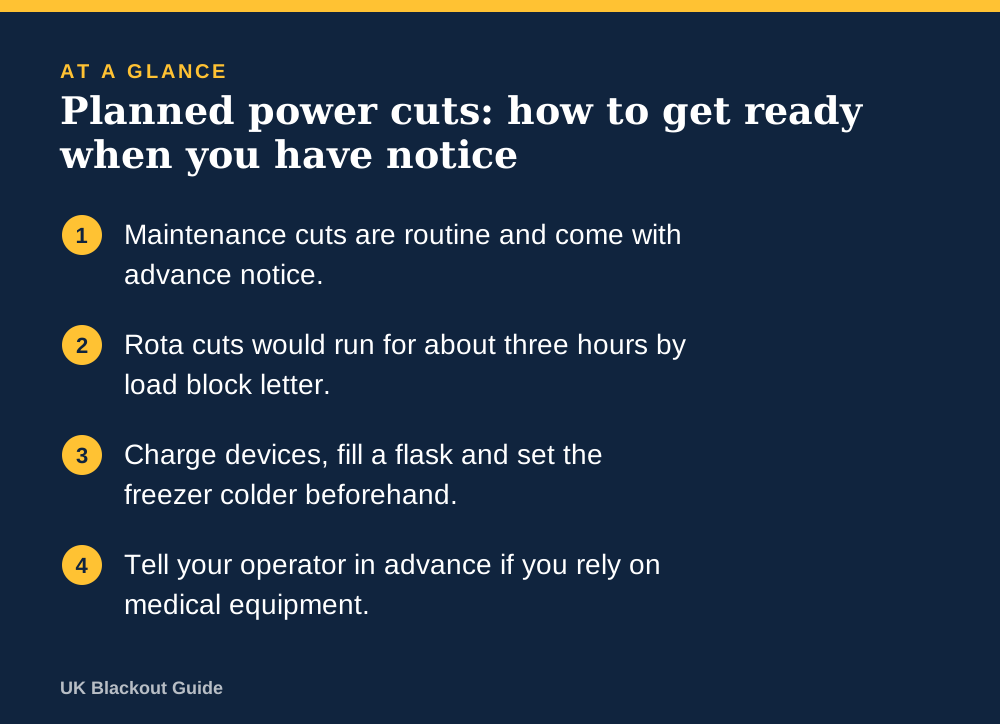
- Maintenance cuts are routine and come with advance notice.
- Rota cuts would run for about three hours by load block letter.
- Charge devices, fill a flask and set the freezer colder beforehand.
- Tell your operator in advance if you rely on medical equipment.
Two very different kinds of planned cut
People use the phrase for two things, and it helps to keep them apart.
| Planned maintenance | Rota cuts | |
|---|---|---|
| Why | Engineers need to work safely on local cables or substations | A national shortage of electricity |
| Who decides | Your network operator | Government and the system operator |
| How common | Routine, happening somewhere every week | An emergency measure, not in use today |
| Area | A few streets | Whole load blocks across the country in turn |
| Length | Stated in your notice, often part of a working day | About three hours at a time |
If a card has come through your door, it is the first kind. Nothing about it suggests a wider problem with supply.
Planned maintenance: what the notice tells you
Network operators have to switch off sections of the network from time to time to replace equipment, connect new homes or cut back trees near overhead lines. They tell affected households in advance, normally by letter or card, and often by text if they have your number.
The notice gives the date, the expected start and finish times, and a contact number. Keep it. If the work is cancelled or runs over, that reference makes the phone call quicker.
If the timing is a serious problem, for instance because someone at home uses electrical medical equipment, ring the number on the notice straight away. Operators can sometimes offer extra support, and people on the Priority Services Register should be given particular consideration. If you are not sure who sent the notice, find your network operator and check with them directly.
A genuine notice never asks for money or bank details. If a caller or someone at the door wants payment to keep your power on or to reconnect you, it is one of the common power cut scams.
Rota cuts: the emergency plan for a national shortage
Rota power cuts are a contingency plan that exists in case Great Britain ever cannot generate or import enough electricity to meet demand. Supply would be switched off to different areas in turn, so that the shortfall is shared out and the system stays stable. Planned cuts of this kind would last about three hours at a time.
Every address belongs to a load block, identified by a letter. A published schedule would show which letters are off at which times. You can find your load block letter at powercut105.com or on some electricity bills.
No rota cuts are scheduled, and the government's Be Ready campaign is presented as general preparedness, not as a forecast of shortages. It is still worth five minutes to look up your letter and write it down.
The day before: get the house ready
A cut you know about is a far easier thing than one you do not. Use the notice period.
- Charge everything. Phones, laptops, power banks, rechargeable torches and lanterns.
- Turn the fridge and freezer to a colder setting a few hours ahead, and do not open them during the cut. The Food Standards Agency says an unopened fridge should stay cold for around 4 hours, and a full freezer typically stays frozen for about 48.
- Cook ahead or plan a meal that needs no cooking.
- Do the laundry and run the dishwasher so nothing is stuck mid-cycle.
- Get cash out if you will need to pay for anything nearby while local tills are down.
- Move the car out of a garage with an electric door.
- Save your work and plan to be offline if you work from home.
A fully charged power bank for power cuts covers phones for the whole of any planned cut. A 20,000 mAh bank gives a typical phone about three to four charges.
Just before it starts
In the last half hour, boil the kettle and fill a flask for power cuts. It is the cheapest piece of preparation there is, and it means hot drinks through the cut and warm water for a baby's bottle or a wash.
Then switch off the oven, hob, iron and electric heaters, unplug the TV and computer, and leave one light on so you can see when the supply returns. Put a torch where you can reach it if the cut will run past dusk.
A planned cut is no reason to bring a camping stove, barbecue or generator indoors. They produce carbon monoxide, which has no smell. For three hours, a flask and a blanket do the job safely.
If someone at home depends on electricity
Advance notice is most valuable to people who rely on powered medical equipment, stairlifts, telecare alarms or medicines kept in a fridge. Three hours is manageable with a plan and worrying without one.
Speak to your equipment supplier or clinician about battery backup and how long it lasts, and follow their advice. Make sure you are on the free Priority Services Register, which covers England, Scotland and Wales. Northern Ireland has Customer Care Registers. If anyone becomes unwell during a cut, call 999.
When it runs late or you were not told
Maintenance usually finishes on time, but jobs overrun. If your power is still off well after the stated end, call 105 (03457 643643 in Northern Ireland).
If the power went off with no notice at all, treat it as an ordinary fault and report it. Ofgem's Guaranteed Standards set out when compensation for a power cut is due, including for some failures around planned work. The rules and amounts change over time, so check with Ofgem or your operator.
Common questions
Can I ask for a planned power cut to be moved?
You can ask, using the number on the notice. Operators cannot always change the date, but they may offer support if someone in the home is vulnerable.
Are rota power cuts happening in the UK now?
No. They are an emergency plan for a national shortage and none are scheduled.
Does a planned cut affect my gas or water?
Gas supply continues, though most boilers will not run without electricity. Water is normally unaffected in a short local cut.
Will my alarm go off during a planned cut?
Some burglar alarms beep or sound when mains power drops. Check your manual beforehand so you know how to silence it.
Reviewed against these sources on 18 November 2026. If official advice has changed since, follow the official advice.
General information only. This page is not professional, safety, medical, legal or financial advice, and it is not official guidance. No national blackout has been forecast or announced, and nothing here suggests one is expected. We are independent and have no connection to the government or any energy company. Always check the official sources linked on this page. Full disclaimer
Keep reading
 Buying guide
Best power cut essentials: the blackout kit worth buying
The blackout kit worth buying for a UK power cut: a battery torch, a lantern, a power bank, a wind-up radio, an automatic light and a flask, with picks.
Read: Best power cut essentials: the blackout kit Guide
The first 24 hours without power
An hour-by-hour plan for the first 24 hours without electricity at home: what to do first, when food becomes a risk and how to ration phone battery.
Read: The first 24 hours without power Buying guide
Best emergency preparedness gifts
Ten emergency preparedness gifts that work in a power cut: radios, power banks, head torches, hand warmers and flasks picked from Amazon UK listings.
Read: Best emergency preparedness gifts Guide
How to prepare for a blackout in the UK
How to prepare for a blackout in the UK: the official Be Ready three-day list, the numbers to save, and the home checks to do. No blackout is forecast.
Read: How to prepare for a blackout in the UK