On this page
The government does not tell you to buy anything for a specific blackout, because none is planned or forecast. Its Be Ready campaign lists what to keep at home to manage for three days: water, food that needs no cooking, a tin opener, a torch, an FM radio, a power bank, first aid, medication, warm bedding and cash.
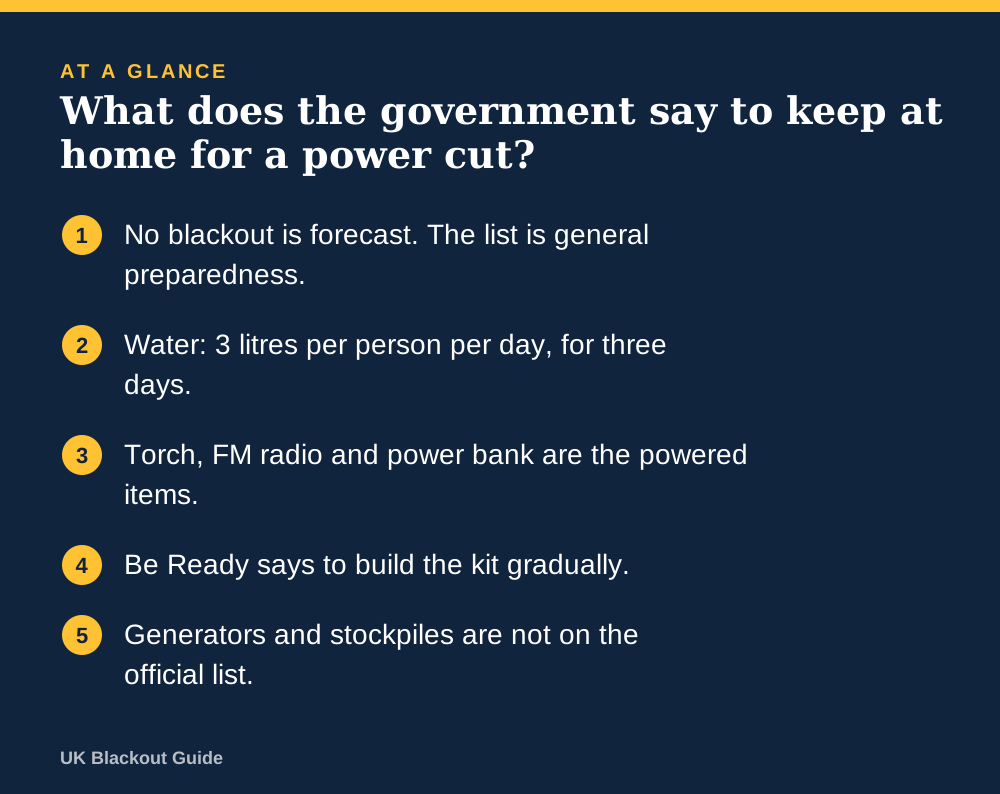
- No blackout is forecast. The list is general preparedness.
- Water: 3 litres per person per day, for three days.
- Torch, FM radio and power bank are the powered items.
- Be Ready says to build the kit gradually.
- Generators and stockpiles are not on the official list.
The official list, in full
The government's advice on what to buy for a blackout is the Be Ready kit list, and it is short. Be Ready (beready.campaign.gov.uk), launched on 22 October 2026, asks households to be able to manage for three days as general preparedness. No blackout has been announced or forecast. If you need to buy some of it, our blackout shopping list puts the items in order of what to buy first.
The campaign lists:
- Bottled water for three days: 3 litres per person per day for drinking, more for cooking and washing
- Non-perishable food for three days that needs no cooking or fridge, and a tin opener
- A battery or wind-up torch with spare batteries
- A battery or wind-up FM radio
- A charged power bank
- A first aid kit and essential medication
- Hand sanitiser and wet wipes
- Blankets, sleeping bags and warm clothing
- Cash in notes and coins
- Printed copies of documents, and a written list of contacts and medication
- Baby supplies (ready-to-feed formula preferred, nappies) and pet food, if you need them
The three items most homes need to buy
Most of the list is already in your cupboards. The gaps are usually the powered items, the torch, radio and power bank found on any power cut essentials list. Be Ready says torches are safer than candles.
The radio is for official information if broadband and mobile data stop. Be Ready advises trying both FM and digital.
A power bank keeps one phone going for days if you use it lightly.
What is not on the list
Be Ready does not tell households to buy a generator, a power station, a camping stove or months of food. It does not ask anyone to stockpile. Its advice is to build the kit gradually and check it every six months.
You may still choose extras, and our guide on what not to buy for a power cut explains which ones tend to be wasted money. If you add any fuel-burning item, never use it indoors: carbon monoxide has no smell.
Buying it without a big bill
Add two or three items to each weekly shop, which is the method behind building an emergency kit on a budget. Start with water and tins, then the torch and batteries, then the radio and power bank.
Common questions
Does the government say to buy a generator?
No. A generator is not on the Be Ready list. The powered items it lists are a torch, an FM radio and a power bank.
How much water does the government say to store?
Be Ready says 3 litres per person per day for drinking, for three days, with more for cooking and washing. That is 9 litres per person as a minimum.
Do I have to buy everything at once?
No. Be Ready advises building the kit gradually and checking it every six months.
Reviewed against these sources on 18 November 2026. If official advice has changed since, follow the official advice.
General information only. This page is not professional, safety, medical, legal or financial advice, and it is not official guidance. No national blackout has been forecast or announced, and nothing here suggests one is expected. We are independent and have no connection to the government or any energy company. Always check the official sources linked on this page. Full disclaimer
Keep reading
 Guide
Blackout shopping list: what to buy first, and what can wait
What to buy for the blackout, in order: a shopping list based on the government's Be Ready kit, with what to buy first, what can wait and what to skip.
Read: Blackout shopping list: what to buy first, Guide
Build an emergency kit for under £50
How to build a three-day UK emergency kit cheaply: what you already own, what to buy first, what can wait, and the few items where cheap is a false saving.
Read: Build an emergency kit for under £50 Guide
72-hour emergency kit UK: the Be Ready list, item by item
72 hour kit UK: the government's Be Ready three-day list explained item by item, with quantities per person, what each item is for and how to store it.
Read: 72-hour emergency kit UK: the Be Ready list, Question
Why are shops selling out of torches and emergency radios?
Why some shops are reported to be selling out of torches and radios after the Be Ready launch, what the official advice is, and what to buy in their place.
Read: Why are shops selling out of torches and