On this page
You can build a three-day emergency kit for very little by starting with what you already own, then adding one or two things a week. Buy in this order: water and tinned food, a torch with spare batteries, a small FM radio, then a power bank. The official advice is to build a kit gradually, not all at once.
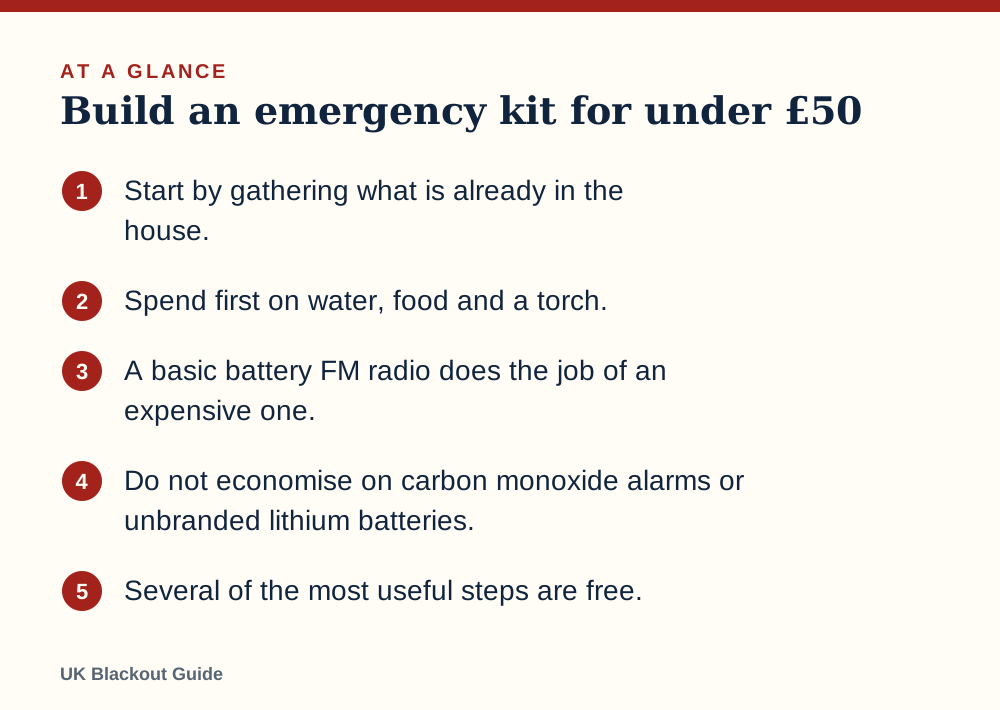
- Start by gathering what is already in the house.
- Spend first on water, food and a torch.
- A basic battery FM radio does the job of an expensive one.
- Do not economise on carbon monoxide alarms or unbranded lithium batteries.
- Several of the most useful steps are free.
Start with a search of your own cupboards
Before spending anything, walk round the house with a box. Most homes already have a torch, a few candles they should stop relying on, some tins, a blanket or two, plasters and paracetamol, and a tin opener in a drawer.
Put the small items in the box and note what is missing against the full emergency kit list. For many households the gaps are just stored water, a radio that works without mains, spare batteries and cash. That is a much shorter shopping list than the one in your head.
The order to buy things in
If money is tight, sequence matters more than total spend. Buy the basics first.
- Water. Supermarket own-brand bottled water is among the cheapest things in the shop. You need 3 litres per person per day for three days, so 9 litres each.
- Food you already eat. Add two or three extra tins or packets to each weekly shop. Nothing special, nothing freeze-dried.
- A torch and spare batteries. One per adult if you can, one for the household if you cannot.
- A battery FM radio.
- A power bank.
- Cash. A few pounds in coins and small notes put aside each week.
Spread over six or eight weekly shops, none of these steps should feel like a large purchase. Prices change, so treat any figure you see quoted as a rough guide. We give some ballpark bands in what an emergency kit costs.
Where the cheap option is fine
A basic LED torch that takes AA batteries is all a power cut needs. Brightness figures on the box matter far less than whether it has a low setting and whether you have spare cells. Our list of good torches for power cuts includes plain, inexpensive ones for that reason.
The same goes for radios. The job is to pick up FM when the internet is down, and a pocket-sized battery set does that as well as a feature-laden one. Compare a few in our round-up of battery FM and DAB radios.
Food is the other easy saving. Own-brand tins of beans, soup, fish and fruit keep for a long time and get eaten anyway. See which foods are worth keeping in for ideas that need no cooking.
Where cheap is a false saving
Three things are worth paying a fair price for.
Anything with a lithium battery. Power banks from unknown sellers with implausible capacity claims are a fire risk and usually hold far less than the label says. Buy a modest capacity from a recognised brand instead of a huge one from nobody.
Carbon monoxide alarms. If you have any gas or solid fuel appliance, fit an audible alarm certified to EN 50291. This is not the item to hunt bargains on.
Batteries. The very cheapest zinc cells run down fast and are more prone to leaking in storage. Alkaline cells from a known brand cost a little more and last much longer. We compare the options in which batteries to keep in stock.
Never try to save money by heating or cooking indoors with a barbecue, camping stove or patio heater. Carbon monoxide has no smell and can kill.
The parts of being prepared that cost nothing
Some of the most useful steps are free.
- Write key phone numbers on paper, including 105 for power cuts (03457 643643 in Northern Ireland).
- Find your network operator and load block letter at powercut105.com and write them down.
- Check whether you qualify for the Priority Services Register. It is free, and many households do, including those with children under 5 and older people.
- Learn where your fuse box, stopcock and gas valve are.
- Keep your phone and power bank topped up when storms are forecast.
- Agree with a neighbour that you will check on each other.
None of this needs a purchase, and in a real cut it often matters more than equipment.
What to leave until later, or skip
Power stations, generators, long-life ration packs and solar panels are not part of the official three-day list. They can be useful for particular needs, but they are not where a tight budget should go first.
Plenty of products sold as emergency gear are poor value at any price. Our guide to what not to buy for power cuts names the common ones. The government has not asked households to prepare for more than three days and has not suggested a longer outage is expected. If you choose to go further anyway, preparing for longer outages on a budget picks up where this page stops.
Checklist
Build an emergency kit for under £50
- Gather torches, tins, blankets and first aid items you already own
- Add 9 litres of bottled water per person
- Put two or three extra tins in each weekly shop
- Buy a basic AA torch and a pack of alkaline batteries
- Buy a small battery FM radio
- Add a branded power bank when funds allow
- Set aside a little cash in notes and coins
- Write 105 and key contacts on paper
- Check if you qualify for the Priority Services Register
Common questions
Can I store tap water instead of buying bottles?
Be Ready's list specifies bottled water, which is sealed and dated. If you do fill your own containers, use clean food-grade ones and replace the water regularly.
Is a wind-up radio better value than a battery one?
A wind-up radio never needs spare batteries, which suits a kit left in a cupboard. A basic battery set is usually cheaper to buy and works well as long as you keep spare cells with it.
Should I buy second-hand?
Second-hand torches, radios, flasks and blankets are fine. Avoid used power banks and other lithium battery products, because you cannot tell how the battery has been treated.
How long should it take to build a kit?
There is no deadline. The official advice is to build it gradually, and a couple of months of small additions to your normal shopping is a realistic pace.
Reviewed against these sources on 18 November 2026. If official advice has changed since, follow the official advice.
General information only. This page is not professional, safety, medical, legal or financial advice, and it is not official guidance. No national blackout has been forecast or announced, and nothing here suggests one is expected. We are independent and have no connection to the government or any energy company. Always check the official sources linked on this page. Full disclaimer
Keep reading
 Guide
Blackout shopping list: what to buy first, and what can wait
What to buy for the blackout, in order: a shopping list based on the government's Be Ready kit, with what to buy first, what can wait and what to skip.
Read: Blackout shopping list: what to buy first, Question
What does the government say to keep at home for a power cut?
What to buy for the blackout, according to the government: the Be Ready list of water, food, a torch, an FM radio, a power bank, medication and cash.
Read: What does the government say to keep at home Question
Why are shops selling out of torches and emergency radios?
Why some shops are reported to be selling out of torches and radios after the Be Ready launch, what the official advice is, and what to buy in their place.
Read: Why are shops selling out of torches and Guide
72-hour emergency kit UK: the Be Ready list, item by item
72 hour kit UK: the government's Be Ready three-day list explained item by item, with quantities per person, what each item is for and how to store it.
Read: 72-hour emergency kit UK: the Be Ready list,