On this page
A basic three-day kit for one person can usually be put together for somewhere in the tens of pounds if you already own a torch, blankets and some tinned food. Starting from nothing, or buying for a family, it can run past a hundred. Prices change, so treat these as rough bands, not quotes.
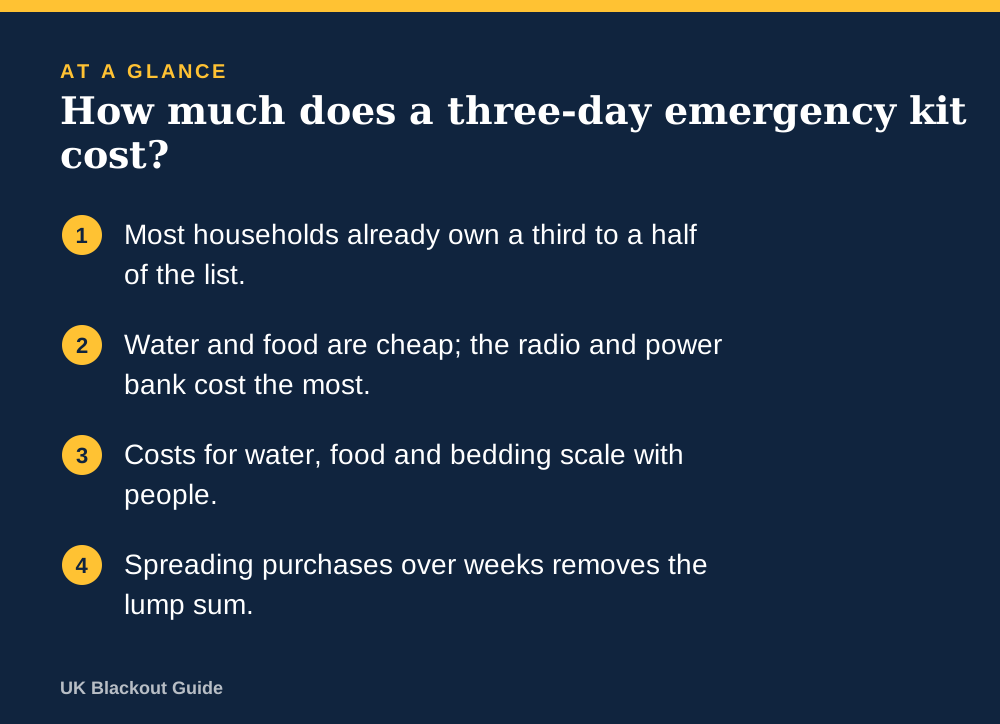
- Most households already own a third to a half of the list.
- Water and food are cheap; the radio and power bank cost the most.
- Costs for water, food and bedding scale with people.
- Spreading purchases over weeks removes the lump sum.
Where the money goes
The official Be Ready list splits neatly into cheap items and less cheap ones. We do not quote exact prices because they move, but the rough bands below hold reasonably well across UK supermarkets and online shops.
| Item | Rough cost band | Scales with people |
|---|---|---|
| Bottled water, 9 litres per person | A few pounds | Yes |
| Three days of tinned and dry food | Around ten to twenty pounds each | Yes |
| Manual tin opener | A few pounds | No |
| LED torch and spare batteries | Under ten to about twenty pounds | Partly |
| Battery or wind-up FM radio | Roughly fifteen to forty pounds | No |
| Power bank, 10,000 to 20,000 mAh | Roughly fifteen to forty pounds | Partly |
| First aid kit | Roughly ten to twenty-five pounds | No |
| Sanitiser and wet wipes | A few pounds | Slightly |
Cash, documents and a contact list cost nothing beyond the cash itself, which you keep. Blankets and warm clothes are already in most homes.
Why your own figure is probably lower
Few people start from zero. If you have a working torch, a first aid box, a duvet and a kitchen cupboard with tins in it, your shopping list may be only water, a radio, a power bank and batteries. Our blackout shopping list of what to buy first and what can wait helps you spread the cost.
The food is not really an extra cost either, provided you buy things you normally eat and rotate them into meals before their dates. You are bringing forward a few weeks of shopping, not throwing money away. Our guide to building a kit on a budget sets out a buying order that spreads the cost over several weekly shops.
What pushes the cost up
Household size is the main factor, because water, food and bedding multiply. A baby adds ready-to-feed formula and nappies. Pets add food.
Beyond that, cost climbs when you move past the official list: a bigger power bank, a lantern for every room, a camping stove, a power station. Some of these are worth having for particular needs, but none is required to meet the three-day advice. Preparing for longer is optional and goes beyond anything the government has asked of households, though preparing for longer outages without overspending is possible if you choose to.
Ready-made kits compared with building your own
Pre-packed kits range from modest one-person bags to large family sets, and prices vary widely. You are paying for assembly as well as contents, so the same items bought separately usually cost less. We weigh that up in whether ready-made emergency kits are worth it.
Remember that a bought kit is never the whole bill. Water for your household, three days of food, medication and cash all come on top. If convenience matters more than the saving, the ready-made kits we think are fair value are the place to start. Check whichever box you choose against the item-by-item kit list before you order, so that you know what is still missing.
Common questions
What is the cheapest useful first purchase?
Bottled water. It costs a few pounds for one person's three-day supply and covers the need that arrives soonest.
Is it cheaper to build a kit all at once?
Not really. Multi-buy offers can help on water and tins, but spreading purchases over several weeks costs about the same in total and is easier to manage.
Are there ongoing costs?
Small ones. Batteries need replacing from time to time, and food and water are eaten and replaced as part of normal shopping.
Reviewed against these sources on 18 November 2026. If official advice has changed since, follow the official advice.
General information only. This page is not professional, safety, medical, legal or financial advice, and it is not official guidance. No national blackout has been forecast or announced, and nothing here suggests one is expected. We are independent and have no connection to the government or any energy company. Always check the official sources linked on this page. Full disclaimer
Keep reading
 Guide
72-hour emergency kit UK: the Be Ready list, item by item
72 hour kit UK: the government's Be Ready three-day list explained item by item, with quantities per person, what each item is for and how to store it.
Read: 72-hour emergency kit UK: the Be Ready list, Buying guide
Best emergency kits for UK homes
No ready-made emergency kit on Amazon UK matches the official Be Ready list. These seven listings cover the parts a UK home can buy ready-made.
Read: Best emergency kits for UK homes Guide
UK emergency kit list: the official items and what we would add
The full UK emergency kit list for managing three days at home, based on the government's Be Ready advice, with quantities for water, food, light and power.
Read: UK emergency kit list: the official items and Guide
Ready-made or DIY emergency kit?
Ready-made emergency kit or build your own? A side-by-side comparison of cost, quality, effort and what every pre-packed kit still leaves you to add.
Read: Ready-made or DIY emergency kit?