On this page
Stay well away and assume the line is live, even if it is silent and not sparking. Keep other people and animals back, and do not touch anything the cable is touching. Call 105 to report it (03457 643643 in Northern Ireland). If someone is injured or in immediate danger, call 999.
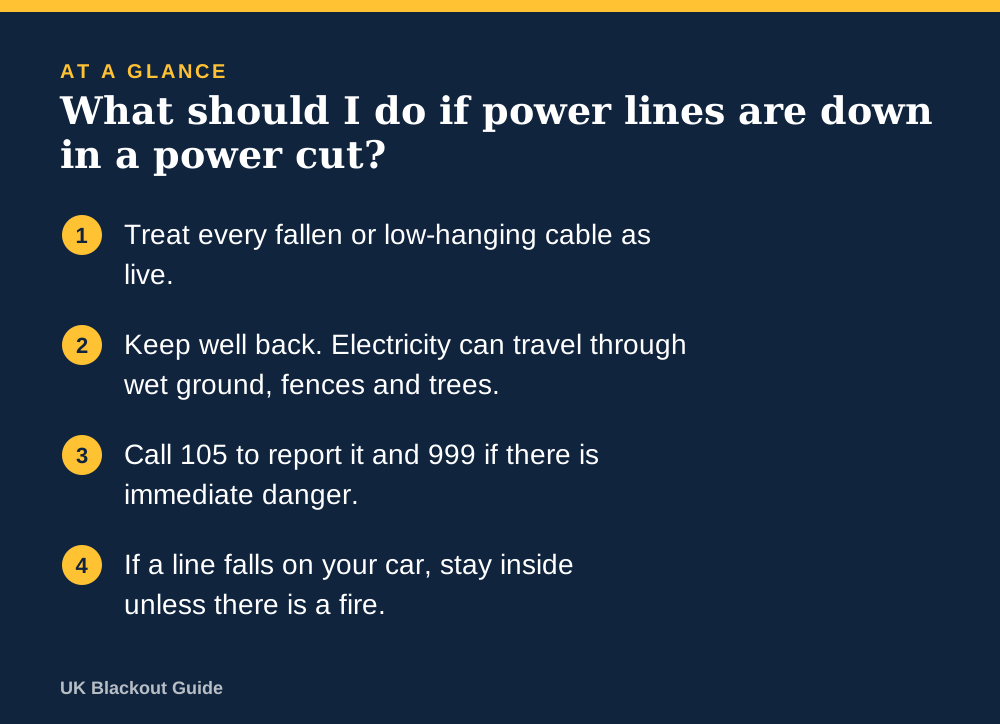
- Treat every fallen or low-hanging cable as live.
- Keep well back. Electricity can travel through wet ground, fences and trees.
- Call 105 to report it and 999 if there is immediate danger.
- If a line falls on your car, stay inside unless there is a fire.
The first minute
- Stop and move back. Keep as far away as you reasonably can, well beyond the reach of the cable if it were to shift. Do not walk under sagging lines.
- Warn others. Keep children, dogs and passers-by away. If the line is across a road or path, warn people from a safe distance.
- Call 105. It is free and puts you through to the local network operator in England, Scotland and Wales. In Northern Ireland call 03457 643643. Give the location as precisely as you can: road name, nearest house number or the number on the pole.
- Call 999 if anyone is hurt, a fire has started, or the line is blocking a road and endangering traffic.
Keeping away from power lines is the first item in the government's Be Ready advice for power cuts. Our guide on how to report a power cut lists what the operator will ask you.
Why you cannot tell whether a line is dead
A live cable on the ground does not necessarily spark, hum or move. It can look exactly like a dead one. Lines can also be re-energised without warning, either automatically by network equipment trying to restore supply or by a generator wrongly connected to a house further along.
The danger is not limited to the wire. Electricity can pass into anything it touches, such as a metal fence, a tree, a parked car or a puddle, and can spread through wet ground around the point of contact. This is why distance matters and why you should never try to move a cable with a branch or a pole.
If a line falls on your vehicle
Stay in the vehicle. Inside it you are well protected. The risk comes from stepping out and touching the car and the ground at the same time. Call 999, sound the horn to attract attention and tell people to stay back.
Only leave if you must, for example because the vehicle is on fire. Open the door without touching the bodywork more than necessary, jump clear so that both feet land together and no part of you touches the car and the ground at once, then move away with small shuffling steps, keeping your feet close together.
If you come across a cable across the road while driving, stop well short and do not drive over it. There is more in our guide to driving in a power cut.
If someone has been hurt
Do not touch a person who is in contact with a power line, or anything they are touching. You could be electrocuted too. Call 999 immediately, say that electricity is involved, and keep others away until the emergency services or the network operator confirm the power is off.
If mobile coverage is poor, a 999 call can connect through any available network. See how to call 999 in a power cut.
After a storm
Fallen lines are most common after high winds, heavy snow and falling trees. Storm Arwen in November 2021 cut power to about a million customers, and damage to overhead lines in rural areas took more than a week to repair in some places.
After a storm, check your garden and lane in daylight before letting children or pets out. Do not start clearing a tree that has a cable anywhere near it. Report it and wait for the operator to make it safe. At night, light the way with a torch and stick to routes you know are clear. Our round-up of torches for power cuts covers models with a long beam.
For more on what bad weather does to the network and how to get ready for it, see storms and power cuts.
Common questions
Can I move a fallen cable off my drive?
No. Do not touch it or try to move it with any object. Call 105 and wait for the network operator.
How do I report a damaged pole or low-hanging wire?
Call 105. Operators treat damaged equipment as a safety report, even when the power is still on.
Is the cable from the pole to my house dangerous?
Yes. The service cable to your home is live and belongs to the network operator. If it is damaged or pulled down, keep away and call 105.
Reviewed against these sources on 18 November 2026. If official advice has changed since, follow the official advice.
General information only. This page is not professional, safety, medical, legal or financial advice, and it is not official guidance. No national blackout has been forecast or announced, and nothing here suggests one is expected. We are independent and have no connection to the government or any energy company. Always check the official sources linked on this page. Full disclaimer
Keep reading
 Buying guide
Best power cut essentials: the blackout kit worth buying
The blackout kit worth buying for a UK power cut: a battery torch, a lantern, a power bank, a wind-up radio, an automatic light and a flask, with picks.
Read: Best power cut essentials: the blackout kit Buying guide
Best surge protectors for power cuts
Surge protectors for power cuts: extension leads that guard a TV, computer or router from the spike when the mains returns, chosen from Amazon UK listings.
Read: Best surge protectors for power cuts Guide
Driving during a wide power cut
Driving in a power cut: what to do when traffic lights are out, why fuel pumps and card machines stop, and how to use your car safely for power and news.
Read: Driving during a wide power cut Guide
The first 24 hours without power
An hour-by-hour plan for the first 24 hours without electricity at home: what to do first, when food becomes a risk and how to ration phone battery.
Read: The first 24 hours without power