On this page
- Be clear about what a 90-day plan is
- The stock: what three months adds up to
- Rotation: the part that makes it affordable
- Routine: the daily jobs that keep a household well
- Power across more than one season
- What no household stockpile can cover
- Do the first three days properly before anything else
- Common questions
The government has not asked households to prepare for 90 days and has not suggested an outage of that length is expected. Official guidance is three days, so this is optional planning beyond it. If you choose to plan that far, think of it as a deep, rotating larder plus daily routines: water you collect and treat, food you already eat and a clear point at which you would leave.
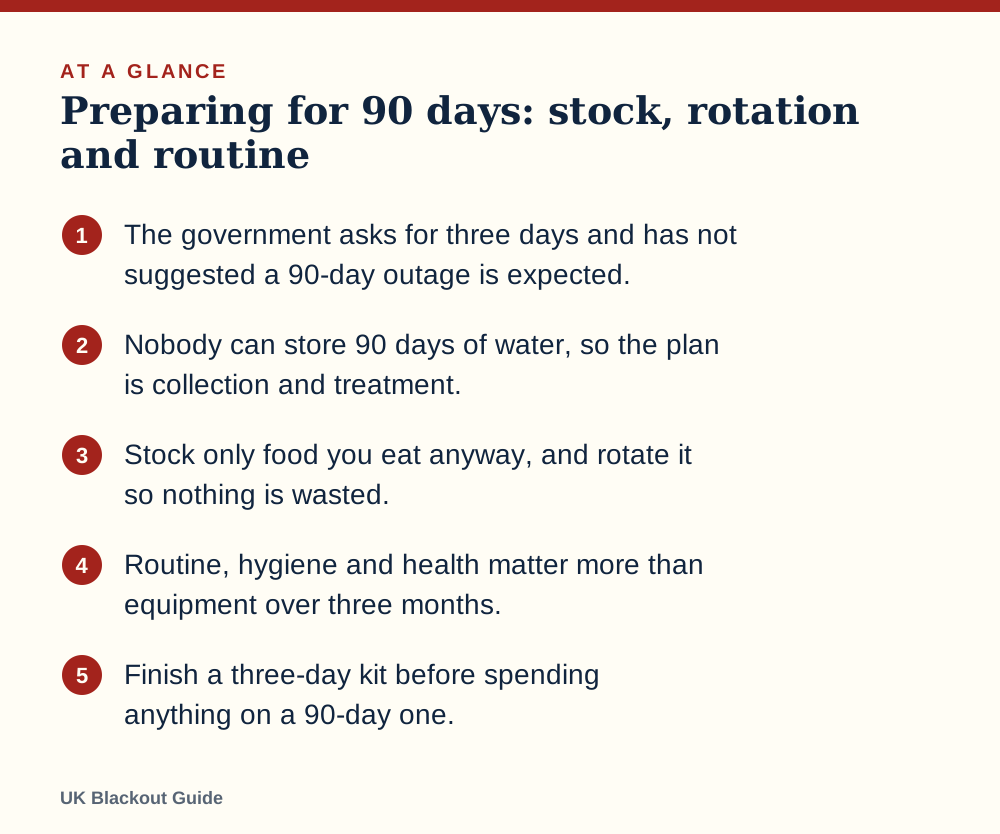
- The government asks for three days and has not suggested a 90-day outage is expected.
- Nobody can store 90 days of water, so the plan is collection and treatment.
- Stock only food you eat anyway, and rotate it so nothing is wasted.
- Routine, hygiene and health matter more than equipment over three months.
- Finish a three-day kit before spending anything on a 90-day one.
Be clear about what a 90-day plan is
A 90-day plan is a personal choice. The government has not asked households to prepare for that long, and no official body has suggested an outage of that length is expected. The Be Ready campaign asks for three days. NESO's restoration standard is 100% of Great Britain's demand within five days. The National Risk Register says restoring the transmission system could take up to about 7 days, and rates a national outage as low likelihood but very high impact.
We know of no UK event that left a region without electricity for anything close to three months. If the question behind your interest is how worried to be, our piece on what officials have said about a UK blackout is the place to start.
There are still reasonable motives for a deep larder. It protects against job loss, illness, snow and supply hiccups as much as against power cuts, and it lets you help relatives and neighbours. Those everyday benefits are the best justification for it.
The stock: what three months adds up to
The arithmetic shows quickly where storage stops being practical.
| Item | Per person, 90 days | Practical approach |
|---|---|---|
| Drinking water at 3 litres a day | 270 litres | Store one to two weeks, collect and treat the rest |
| Food at about 2,000 kcal a day | About 180,000 kcal | Deep cupboard of staples, rotated |
| Toilet roll, soap, bin bags | Three months of normal use | Buy in bulk when on offer |
| Batteries | Depends on your lights and radio | Rechargeables plus a solar charger |
Food is achievable in a spare cupboard or under beds. Water is not, which is why a water plan built on treatment as well as storage is the backbone of any plan this long.
Rotation: the part that makes it affordable
A three-month store that sits untouched will expire and cost you the whole amount again, however carefully you chose which foods to stockpile. A store you eat from costs almost nothing extra over time, because you were going to buy the food anyway.
The method is simple. Buy staples you already cook with, put new stock at the back, eat from the front and replace what you use, which is all that a simple food storage and rotation system amounts to.
Specialist long-life rations have a narrow role: a compact reserve that needs no attention for years.
Routine: the daily jobs that keep a household well
Over 90 days, problems come from small things left undone. A workable day has fixed jobs: fetch and treat water in the morning, put the solar panel out, cook the main meal in daylight, wash hands and dishes properly, deal with waste, and listen to a radio bulletin at a set time.
Hygiene deserves particular care, because stomach bugs spread fast where washing is difficult, so settle your methods for washing and toilets when water is short early.
People need structure too. Keep bedtimes, give children tasks, and build in things to look forward to. A stock of the batteries worth keeping at home and a few books do more for a long stretch than another gadget.
Power across more than one season
Three months spans a change of season, and UK solar output changes with it. A 100 W portable panel, a common size among the best portable solar panels for UK conditions, typically gives roughly 300 to 400 Wh on a clear summer day and often 30 to 80 Wh on a dull winter day. A setup that feels generous in June may only cover phones, a radio and two LED lamps in December.
Plan your winter around the low figure, and treat anything above it as a bonus. Heat should come from clothing, bedding and one small room, and never from a barbecue or camping stove indoors.
Any flame or engine can produce carbon monoxide. Keep generators outdoors, never use outdoor heaters inside, and fit an audible alarm marked EN 50291.
What no household stockpile can cover
Honesty about limits is part of a good plan. No cupboard replaces hospitals, pharmacies, income, schools or the water and sewage networks for three months. Prescription medicines are supplied in limited quantities, and you should follow your clinician's advice on what reserve is appropriate.
That is why official planning, in NESO's restoration standard, is built around restoring power within days, and why your own plan should include other people. Households that know their neighbours cope better, which we explore in how streets share the load.
Do the first three days properly before anything else
If you have read this far and do not yet have a torch, a radio, a power bank and three days of water, stop here and sort those, starting from the emergency kit list. They are what the Be Ready campaign asks every household to have.
After that, deepen the food cupboard a week at a time. There is no need to reach 90 days, and you can stop at any point.
Common questions
Is anyone officially advising a 90-day supply in the UK?
No. The government's Be Ready campaign asks for three days. Ninety days is a personal choice far beyond official guidance, and the government has not suggested an outage of that length is expected.
How much space does 90 days of food take?
It depends on what you eat, but dried staples and tins for one adult will usually fit in a tall cupboard or under a bed. Water is the item that takes real space.
Is it worth buying a generator for a 90-day plan?
Rarely. HSE rules allow up to 30 litres of petrol at home without notification, which is days of running, not months. Solar and a battery suit long periods better.
Is building a 90-day store the same as panic buying?
No, if you build it slowly from normal shopping. Buying a little extra each week takes nothing away from other shoppers.
- Be Ready campaign, UK government
- NESO, National Energy System Operator
- National Risk Register, Cabinet Office
- Health and Safety Executive
Reviewed against these sources on 18 November 2026. If official advice has changed since, follow the official advice.
General information only. This page is not professional, safety, medical, legal or financial advice, and it is not official guidance. No national blackout has been forecast or announced, and nothing here suggests one is expected. We are independent and have no connection to the government or any energy company. Always check the official sources linked on this page. Full disclaimer
Keep reading
 Guide
How to manage 30 days without mains power
Optional planning for 30 days without mains power, far beyond the three days UK guidance asks for: what water, food, energy and health would need.
Read: How to manage 30 days without mains power Question
Can portable solar keep a household going in a long power cut?
What portable solar panels can and cannot power in a UK home during a long outage, with realistic summer and winter output and example daily loads.
Read: Can portable solar keep a household going in Question
How much emergency food does one person need for 30 days?
How much food one adult needs for 30 days, worked out from daily calories, with an example list of tins and dry staples and the water needed to cook it.
Read: How much emergency food does one person need Guide
Food storage and rotation: a simple system
A simple system for keeping a reserve of food at home: what to store, where to keep it, how first in, first out works, and a twice-yearly check.
Read: Food storage and rotation: a simple system