On this page
The simplest system is to store more of what you already eat and use it in date order. Put new stock at the back, eat from the front, and replace each item as you use it. Check the whole store every six months. Done this way a food reserve costs little and nothing goes out of date.
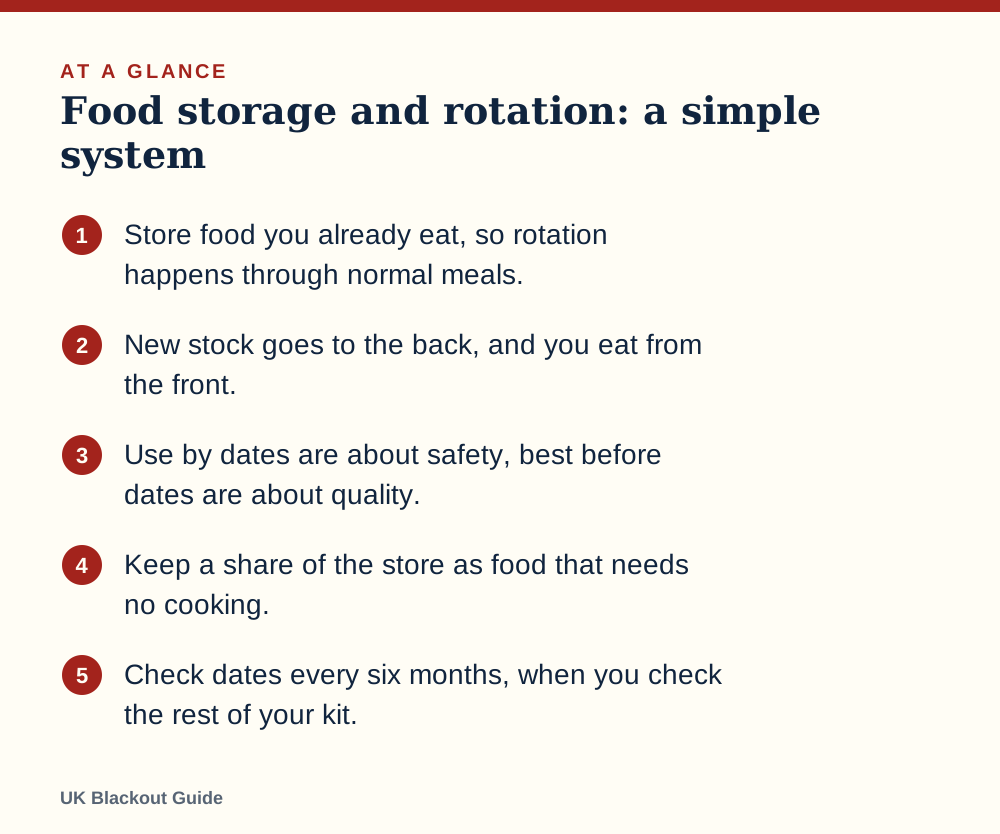
- Store food you already eat, so rotation happens through normal meals.
- New stock goes to the back, and you eat from the front.
- Use by dates are about safety, best before dates are about quality.
- Keep a share of the store as food that needs no cooking.
- Check dates every six months, when you check the rest of your kit.
Store what you eat, and eat what you store
A food reserve works when it is part of your kitchen, not a box in the loft. If the store is made of the tins, pasta, rice, cereal and long-life milk you buy anyway, you will use it up naturally and replace it on the next shop.
The official Be Ready advice is three days of non-perishable food that needs no cooking and no fridge. Start there, using our guide to putting together a three-day food supply, then deepen it if you want a longer margin. Anything beyond three days is your own choice, not something the government has asked for. The far end of that choice is described in preparing for 90 days of stock and rotation.
First in, first out, in three habits
- Back and front. When you unpack shopping, slide older items forward and put new ones behind them.
- One out, one on the list. When you take an item from the reserve, add it to the shopping list straight away.
- Date on top. Write the month and year on the lid or front of each tin with a marker, so you can read it without lifting anything.
That is the whole method. Shops rotate stock the same way. It takes seconds per shop and removes the need for spreadsheets or apps, although a paper list taped inside the cupboard door helps if several people cook.
What the dates on food mean
The Food Standards Agency draws a firm line between two labels. A use by date is about safety, and food should not be eaten after it. A best before date is about quality, and food past it may be less good but is generally safe if it has been stored properly and looks and smells normal.
Most long-life food carries a best before date, which is one reason tins and dried goods suit a reserve. Throw away any tin that is bulging, leaking, badly dented on a seam or rusty. The FSA publishes the detail, and the rule when unsure is the usual one: if in doubt, throw it out.
What to put in the store
Split the store into two layers. The first is food you can eat cold from the packet or tin, because in the first days of a power cut you may have no way to cook: tinned fish, beans, fruit and rice pudding, oatcakes, nut butter, cereal bars, long-life milk. Our list of meals that need no cooking turns these into something you would choose to eat.
The second layer is dry staples that need water and heat: rice, pasta, oats, lentils, flour, stock cubes. They are cheap and compact, but only useful if you have water to spare and a safe way to cook. If that means a camping stove, it must be used outdoors, and the best camping stoves for emergencies are covered separately.
Add the things that make plain food bearable: salt, sugar, tea, coffee, spices, squash. Include a manual tin opener, and consider a spare. The best manual tin openers cost little and are easy to forget.
Freeze-dried pouches and ration packs are an optional third layer for people who want a reserve they can ignore for years.
Where and how to keep it
Food keeps best somewhere cool, dry and dark. A kitchen cupboard away from the oven, an under-stairs shelf or a box under a bed all work. Garages and lofts swing between hot and cold, which shortens the life of most foods, and sheds invite mice.
Decant opened dry goods into sealed tubs. Keep the reserve off the floor in case of a leak or flood. Store water separately from anything scented, such as cleaning products, and see our guide to how long bottled water keeps.
Do not count the freezer as part of the reserve for power cuts. A full freezer typically stays frozen for about 48 hours unopened and a half-full one about 24. It is worth knowing how to get the most out of a freezer in a long cut, but treat its contents as a bonus.
Special diets, babies and pets
A reserve has to work for the people who will eat it. If someone in the house is coeliac, diabetic, has allergies or needs soft food, stock for them first, because those items are the hardest to find in a hurry.
For babies, the official advice prefers ready-to-feed formula, which needs no water or heating. Our guide to feeding a baby in a power cut has more. Pets need their normal food too, and it rotates in exactly the same way.
The six-month check
Twice a year, take everything out. Move anything within a few months of its date into the kitchen to be eaten, wipe the shelf, and restock. Tying it to the clock changes makes it easy to remember, and you can do the rest of your kit at the same time using our routine for a six-monthly kit check.
If you find you are regularly throwing food away, the store is too big or too unlike your normal diet. Shrink it or change it. On the wider question of sizing, see how much food one person needs for a month.
Checklist
Food storage and rotation: a simple system
- Three days of no-cook food per person
- Dry staples you already cook with
- Manual tin opener in the same cupboard
- Month and year written on each item
- New stock at the back, oldest at the front
- Items for special diets, babies and pets
- Date check in the diary every six months
Common questions
Can I eat tinned food after its best before date?
Best before dates are about quality, and the Food Standards Agency says such food is generally safe after the date if stored correctly. Never eat from a bulging, leaking or badly damaged tin.
How much does a food reserve cost?
Very little if you build it from normal shopping, because you eat it and replace it. The only real cost is buying a few weeks' food earlier than you otherwise would.
Should I buy freeze-dried emergency food?
Only as a top-up. Ordinary tins and dry goods are cheaper and familiar. Freeze-dried packs suit a compact reserve you want to leave alone for years.
Is it safe to store food in a garage?
Tins survive, but heat, cold, damp and rodents shorten the life of most food. A cool indoor cupboard is better.
Reviewed against these sources on 18 November 2026. If official advice has changed since, follow the official advice.
General information only. This page is not professional, safety, medical, legal or financial advice, and it is not official guidance. No national blackout has been forecast or announced, and nothing here suggests one is expected. We are independent and have no connection to the government or any energy company. Always check the official sources linked on this page. Full disclaimer
Keep reading
 Question
How much emergency food does one person need for 30 days?
How much food one adult needs for 30 days, worked out from daily calories, with an example list of tins and dry staples and the water needed to cook it.
Read: How much emergency food does one person need Guide
Preparing for 90 days: stock, rotation and routine
An honest look at preparing for 90 days: why it is far beyond official UK planning, what stock and rotation would involve, and where its limits are.
Read: Preparing for 90 days: stock, rotation and Question
Can portable solar keep a household going in a long power cut?
What portable solar panels can and cannot power in a UK home during a long outage, with realistic summer and winter output and example daily loads.
Read: Can portable solar keep a household going in Question
How do I wash clothes without power?
How to wash and dry clothes by hand in a long power cut using two buckets, a little detergent and as little water as possible, and what to wash first.
Read: How do I wash clothes without power?