On this page
By 31 December 2026 the National Energy System Operator (NESO) must have the capability to restore 60% of electricity demand in each region within 24 hours, and 100% of Great Britain's demand within five days, after a total shutdown. The deadline comes from a standard set by government in 2021. It is a readiness target, not the date of an expected blackout.
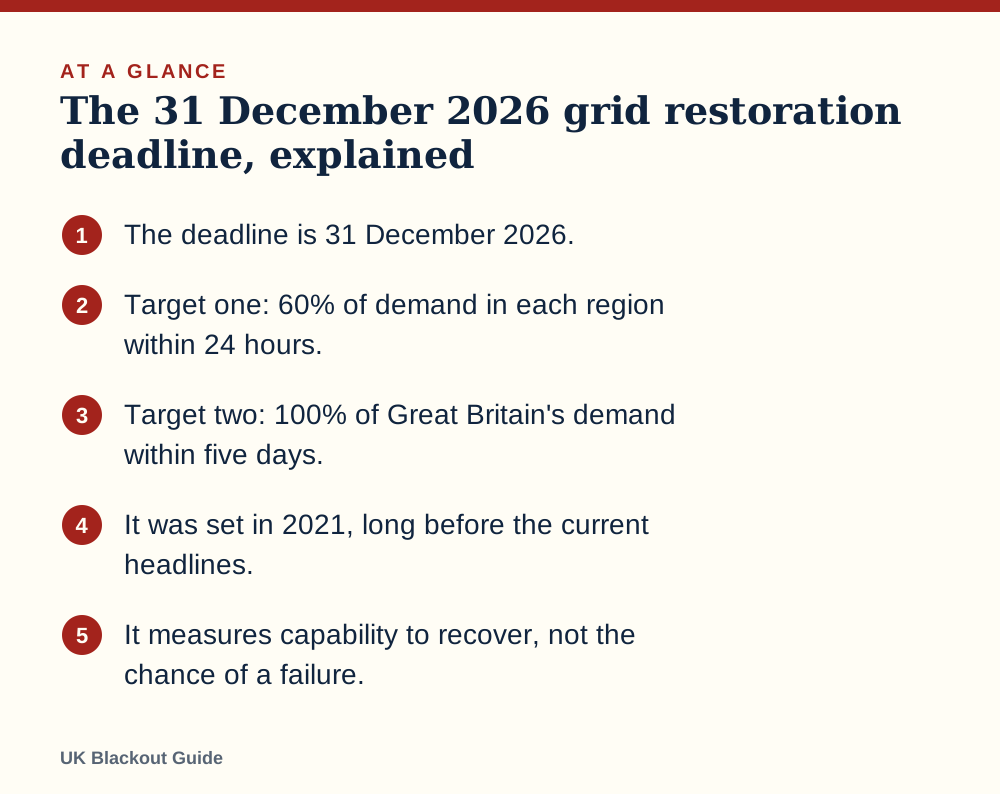
- The deadline is 31 December 2026.
- Target one: 60% of demand in each region within 24 hours.
- Target two: 100% of Great Britain's demand within five days.
- It was set in 2021, long before the current headlines.
- It measures capability to recover, not the chance of a failure.
The two numbers in the standard
The Electricity System Restoration Standard was set by the government in 2021. It applies to NESO, the body that runs Great Britain's electricity grid, and it contains two targets.
| What must be restored | Within |
|---|---|
| 60% of demand in each region | 24 hours |
| 100% of Great Britain's demand | 5 days |
NESO must have the capability to meet both by 31 December 2026. The wording matters. The standard does not promise that every home would be back on within five days in every possible event. It requires that the plans, contracts and equipment exist to make that pace achievable.
'Demand' here means the electricity that homes and businesses would normally be using. So 60% of demand restored is roughly 60% of normal consumption reconnected, not 60% of power stations running.
Why 'in each region' is in there
The first target is regional on purpose. A recovery that brought one part of the country back quickly while another waited most of a week would meet a national average and still leave millions of people in the dark. Writing the 60% figure region by region means restoration capability has to be spread around Great Britain.
Restarting a dead grid is a slow, staged job. Power stations need electricity to start, so engineers begin with sources that can start unaided, energise a small section of network, and add generation and demand piece by piece, the process known as a black start.
What the deadline does not tell you
A date attached to the word 'blackout' is easy to misread. The 31 December 2026 deadline has been fixed since 2021. It is the completion date for a piece of resilience work, and it says nothing about when, or if, a shutdown might happen.
On likelihood, the reference point is the National Risk Register entry on power outages, which describes a national power outage as low likelihood but very high impact. Great Britain has never needed a full national restart. The fact that the standard exists shows that planners take the impact seriously.
The standard also covers Great Britain only. Northern Ireland's electricity system is run separately.
How five days sits beside the seven-day figure
You may see two different durations quoted. The restoration standard speaks of 100% of demand within five days. The National Risk Register says restoration of the transmission system could take up to about seven days.
They come from different documents with different purposes. One is a target capability that NESO must build. The other is the Risk Register's description of how long restoring the transmission system could take in a national outage. Neither is a prediction of how long a national blackout could last on your street, and in any real event some areas would return much sooner than others.
The government has also rehearsed the scenario, in Exercise Mighty Oak, its national power outage exercise in 2023.
What the targets mean for planning at home
The standard is written for one scenario, a total shutdown, which the National Risk Register rates as low likelihood. Within that scenario the targets allow for up to 40% of demand in a region still being off after the first day, and for full restoration taking until day five.
The government's household guidance is separate. The Be Ready campaign asks every household to be able to manage for three days, and it is presented as general preparedness, not a forecast. That means water at 3 litres per person per day, food that needs no cooking, light, a radio and cash, the basis of any plan for getting through three days without power.
The government has not asked households to prepare for longer than three days, and has not suggested a longer outage is expected. Keeping more is optional planning beyond official guidance, and a week without power is the next step up if you choose to take it.
Common questions
Does the 31 December 2026 deadline mean a blackout is expected then?
No. It is the date by which NESO must have restoration capability in place, set in 2021. It is not linked to any predicted event.
Who is NESO?
The National Energy System Operator runs Great Britain's electricity system, balancing supply and demand and planning how the grid would be restarted after a shutdown.
Would my home be back on within 24 hours?
Not necessarily. The 24-hour target is 60% of demand in each region, so some homes would wait longer, up to the five-day target for full restoration.
Reviewed against these sources on 18 November 2026. If official advice has changed since, follow the official advice.
General information only. This page is not professional, safety, medical, legal or financial advice, and it is not official guidance. No national blackout has been forecast or announced, and nothing here suggests one is expected. We are independent and have no connection to the government or any energy company. Always check the official sources linked on this page. Full disclaimer
Keep reading
 News
Amazon Web Services outage, May 2026: what happened and why
The Amazon Web Services outage of 7 May 2026 began when a US data centre overheated. What AWS said, who was affected, and what it means for UK households.
Read: Amazon Web Services outage, May 2026: what News
Amazon Web Services outage, October 2025: what happened and why
The Amazon Web Services outage of 20 October 2025 disrupted Lloyds, HMRC, Snapchat and many more. AWS blamed a DNS fault in its DynamoDB database service.
Read: Amazon Web Services outage, October 2025: News
British Library cyber attack, 2023: what happened and why recovery has taken years
The British Library was hit by ransomware in October 2023 and is still rebuilding. What was lost, what came back and when, and what its own review found.
Read: British Library cyber attack, 2023: what Question
Can you get compensation for a power cut?
You may be owed a payment after a long unplanned power cut under Ofgem's Guaranteed Standards. Who pays, what counts, and how to make a claim that succeeds.
Read: Can you get compensation for a power cut?