On this page

The Amazon Web Services outage began at 5.25pm Pacific time on Thursday 7 May 2026, which was 1.25am on Friday in the UK. AWS said a thermal event, overheating in one data centre in its US-EAST-1 region in northern Virginia, cut power to the affected hardware. The crypto exchange Coinbase halted trading for several hours. AWS has not explained why the cooling failed.
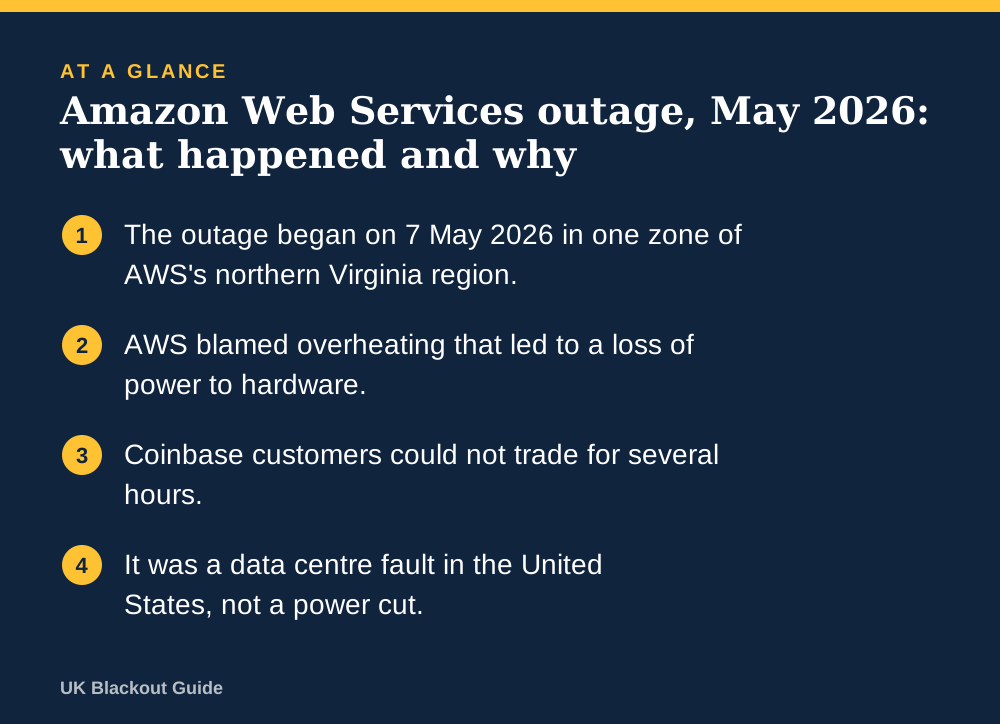
- The outage began on 7 May 2026 in one zone of AWS's northern Virginia region.
- AWS blamed overheating that led to a loss of power to hardware.
- Coinbase customers could not trade for several hours.
- It was a data centre fault in the United States, not a power cut.
What happened at Amazon Web Services
Amazon Web Services (AWS) rents computing power to thousands of companies. On Thursday 7 May 2026, one of the data centres in its largest region, known as US-EAST-1 in northern Virginia, overheated. AWS described it as a thermal event that caused a loss of power to the affected hardware, The Stack reported.
Servers in that building shut down, and the services running on them went offline.
When it started and how long it lasted
AWS first reported the incident at 5.25pm Pacific time, which was 1.25am on Friday 8 May in the UK. By 8.06pm Pacific time it said it had moved traffic away from the affected zone for most services, though some customers were still seeing errors and delays.
AWS said some virtual servers and storage volumes would stay impaired until the hardware was fully recovered. The reports we read do not give a final all-clear time. InfoQ reported that for Coinbase, full recovery took much of the following day.
Who and what was affected
Only one of the region's availability zones was affected. An availability zone is a separate group of data centres, and AWS told customers to use the others. Systems that could not move to another zone on their own stayed down until engineers stepped in. The same single-zone pattern appeared in the Google Cloud outage of October 2026, when a power event took down one of the three zones in Google's London region.
The best documented case is Coinbase, the cryptocurrency exchange. InfoQ reported that customers could not buy, sell, deposit or withdraw for several hours. Coinbase's own review found that a key trading system ran inside a single zone and had no automatic way to move. The reports we read do not describe UK banks or public services being affected.
The cause, as stated by AWS
AWS attributed the outage to overheating at a single data centre, ITPro and The Stack reported, and said it was bringing extra cooling capacity online as part of the recovery. Coinbase's review, as summarised by InfoQ, said several cooling units failed at the same time in one data hall, which forced racks of servers to shut down to protect themselves.
AWS has not said publicly why the cooling failed. Nothing in the reports suggests a cyber attack. The Stack noted it was the fourth incident AWS had recognised for that region in 2026, the earlier three being limited in scope. Another cloud firm had a regional failure of its own that summer, the Microsoft Azure outage of July 2026, which Microsoft traced to a bug in automated maintenance at its West US region.
What customers were told
AWS posted updates on its health dashboard and advised customers to shift work to unaffected zones. Coinbase reopened trading in stages once its systems were rebuilt.
For most people in the UK the outage passed unnoticed, partly because of the hour. That was not true of the AWS outage of October 2025, which began in the same region at 7.48am UK time and disrupted Lloyds, Bank of Scotland and HMRC.
What this does and does not tell us about power cuts
This was a cooling failure inside one American data centre. It was not a power cut on the public grid, it did not cause a power cut in the UK, and no official body has said a cyber attack on the UK electricity grid is expected.
It shows that services people use for money can stop for hours because of a fault in a building thousands of miles away. A household cannot fix that, but it can avoid depending on one app, and it helps to know which everyday services stop working in a blackout, because many of them share the same weak points.
The practical steps are small. A little money in notes and coins, kept as described in how to keep cash for emergencies, covers a day when a payment app will not load.
Common questions
What caused the AWS outage in May 2026?
AWS said overheating at one data centre in northern Virginia led to a loss of power to hardware. It has not said why the cooling failed.
Was the UK affected by the May 2026 AWS outage?
The reports we read describe disruption to companies using one US zone, most notably Coinbase. They do not describe UK banks or public services being hit.
Was the AWS outage a cyber attack?
Nothing in the reports suggests that. AWS described a thermal event.
- The Stack: AWS outage halts Coinbase trades
- ITPro: AWS outage blamed on data center overheating, Coinbase among affected customers
- InfoQ: Coinbase Postmortem Attributes Multi-Hour Trading Outage to Localized AWS Cooling Failure
Reviewed against these sources on 18 November 2026. If official advice has changed since, follow the official advice.
General information only. This page is not professional, safety, medical, legal or financial advice, and it is not official guidance. No national blackout has been forecast or announced, and nothing here suggests one is expected. We are independent and have no connection to the government or any energy company. Always check the official sources linked on this page. Full disclaimer
Keep reading
 News
Google Cloud outage hits UK banks, October 2026: what happened and why
The Google Cloud outage of 20 October 2026 hit UK banks including Revolut, Lloyds and HSBC for about eight hours. Google blamed a power event in a London zone.
Read: Google Cloud outage hits UK banks, October News
Microsoft Azure outage, July 2026: what happened and why
The Microsoft Azure outage of 23 July 2026 disrupted Microsoft 365, Teams and Azure for about five hours. Microsoft blamed a bug in automated network maintenance.
Read: Microsoft Azure outage, July 2026: what News
Amazon Web Services outage, October 2025: what happened and why
The Amazon Web Services outage of 20 October 2025 disrupted Lloyds, HMRC, Snapchat and many more. AWS blamed a DNS fault in its DynamoDB database service.
Read: Amazon Web Services outage, October 2025: News
NCSC Annual Review 2026: what the cyber agency said about AI, ransomware and critical infrastructure
What the National Cyber Security Centre's Annual Review of 3 November 2026 said about AI, ransomware and critical infrastructure, and what it did not say.
Read: NCSC Annual Review 2026: what the cyber