On this page
The Energy Sector Cyber Security Strategy was published on 28 May 2026 by the energy department, Ofgem, the National Cyber Security Centre and the National Energy System Operator. It is a four-year plan to 2030 to raise cyber security across energy companies, including a cross-industry exercise by the end of 2026. It does not forecast an attack or a power cut.
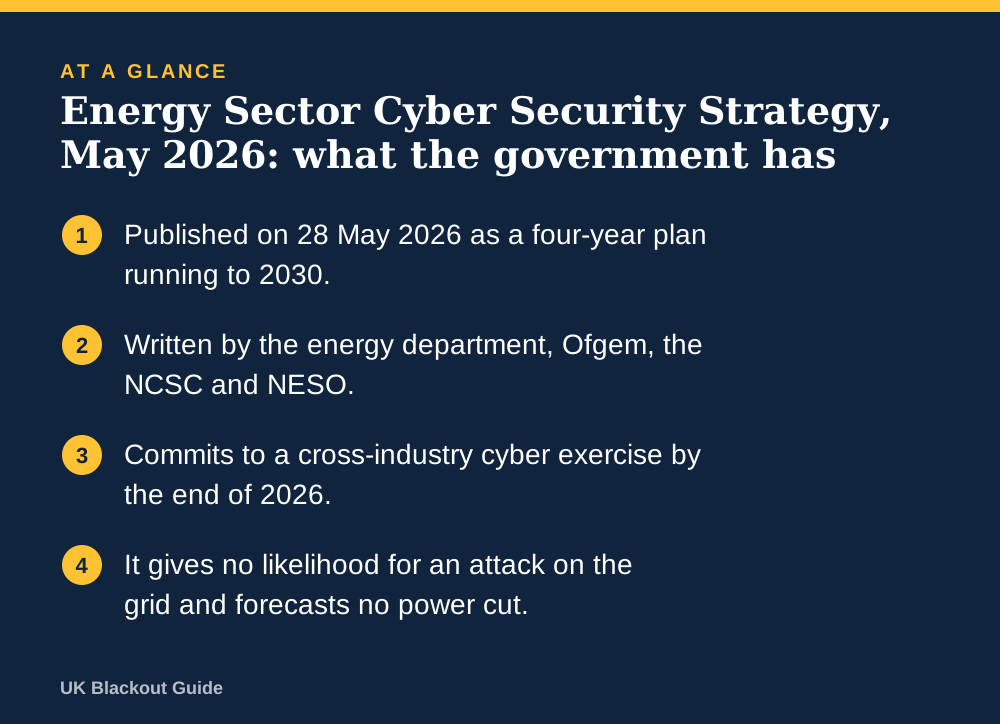
- Published on 28 May 2026 as a four-year plan running to 2030.
- Written by the energy department, Ofgem, the NCSC and NESO.
- Commits to a cross-industry cyber exercise by the end of 2026.
- It gives no likelihood for an attack on the grid and forecasts no power cut.
What was published
On 28 May 2026 the government published the Energy Sector Cyber Security Strategy on GOV.UK. This is a policy document, not an incident. It sets out how the organisations responsible for Great Britain's energy system intend to strengthen its protection against cyber attacks between 2026 and 2030.
It was written jointly by four bodies, which the document calls the "Quad partners": the Department for Energy Security and Net Zero, the regulator Ofgem, the National Cyber Security Centre (NCSC) and the National Energy System Operator (NESO). The foreword is by the energy minister, Michael Shanks.
When it was published and the period it covers
The strategy runs for four years, to the end of 2030, with commitments staged along the way. By the end of 2026 the partners say they will have run a cross-industry and government exercise testing the response to a sophisticated cyber attack on Great Britain's energy system, and drawn up preliminary security principles for the energy supply chain.
By the end of 2027 they plan to assess which companies should fall under the cyber regulations and to pilot a new capability for detecting intruders. By the end of 2028 that detection capability is due in full, along with a tabletop exercise for chief executives. By the end of 2030 the aim is a baseline level of cyber resilience across the whole downstream gas and electricity system.
Who it applies to and who it touches
The strategy is aimed at energy companies and their suppliers, not at households. Network operators, generators, gas companies and the firms that supply their technology are the ones who will see new requirements. One proposal is a basic standard for every company that holds an Ofgem licence, with the government's existing Cyber Essentials scheme as the suggested starting point. Ransomware has already reached an energy company's office systems elsewhere in Europe: the attack on Romania's Oltenia Energy Complex in December 2025 knocked out email and business software without, the company said, endangering the national energy system.
Smaller operators are part of the picture. The strategy commits to reviewing the thresholds that decide who is regulated. That question came up again after the cyber incident at a small UK generator in July 2026.
Why it was written and what it says about attackers
Because this is a plan and not an attack, there is no culprit. The strategy does explain why it was written. It cites the NCSC's assessment of a stark increase in the cyber risk to critical national infrastructure, says ransomware is the most immediate and disruptive risk to that infrastructure, and describes the energy sector as "a particularly attractive target for attacks of increasing sophistication". The NCSC returned to the subject in its Annual Review of November 2026, which judged it highly likely that AI-powered malware will have been used in a ransomware attack on UK critical national infrastructure by 2028.
It also cites real incidents abroad, including the December 2025 attack on Polish energy sites. The strategy does not put a number or a probability on an attack against the energy system in Great Britain.
What the government and regulators will do
Under the strategy, the energy department leads, Ofgem monitors compliance as the regulator, the NCSC provides technical support and NESO provides whole-system coordination and analysis, according to techUK's summary. Regulated operators are expected to comply fully with the existing Network and Information Systems rules and to meet ministerial targets for their most critical systems.
A separate piece of legislation, the Cyber Security and Resilience Bill, is intended to widen and strengthen those rules. Reports in August and November 2026 described it as still on its way through Parliament. We have not been able to confirm its current stage, so we are not stating one.
What this does and does not tell us about power cuts
The strategy did not follow a UK power cut and does not predict one. It says plainly that the sector is an attractive target and that defences need to improve, and it stops there. It gives no likelihood for an attack on the grid, and no official body has said that a cyber attack on the UK grid is expected.
That fits with the other official statements. The National Risk Register describes a national power outage as low likelihood but very high impact. NESO is required to be able to restore 60% of demand in each region within 24 hours and all of Great Britain's demand within five days by 31 December 2026. Our page on the grid restoration standard explains that requirement.
Nothing in the strategy asks households to do anything. The household guidance is the separate Be Ready campaign, which asks people to be able to manage for three days as general preparedness, as the Be Ready campaign explained sets out.
Common questions
Does the energy cyber strategy say the grid will be attacked?
No. It says the energy sector is an attractive target and sets out plans to improve defences. It does not give a likelihood or forecast an attack.
Does the strategy ask households to do anything?
No. It is aimed at energy companies, their suppliers and regulators. Household guidance comes from the separate Be Ready campaign.
Who wrote the Energy Sector Cyber Security Strategy?
The Department for Energy Security and Net Zero, Ofgem, the National Cyber Security Centre and the National Energy System Operator.
- GOV.UK: Energy sector cyber security strategy
- techUK: Government sets out ambitions for security and resilience in the new Energy Sector Cyber Security Strategy
- Help Net Security: Suspected Iran-linked attack knocked UK power plant offline for days
- The Record: British businesses caught in Europe-wide supermarket fridge attacks
Reviewed against these sources on 18 November 2026. If official advice has changed since, follow the official advice.
General information only. This page is not professional, safety, medical, legal or financial advice, and it is not official guidance. No national blackout has been forecast or announced, and nothing here suggests one is expected. We are independent and have no connection to the government or any energy company. Always check the official sources linked on this page. Full disclaimer
Keep reading
 News
Oltenia Energy Complex ransomware attack, December 2025: what happened in Romania
Romania's largest coal power producer was hit by ransomware on 26 December 2025. What was affected, who was named, and why the national grid kept running.
Read: Oltenia Energy Complex ransomware attack, News
UK small generator cyber incident, July 2026: what the government has confirmed
A small UK electricity generator was reportedly offline for four days in July 2026 after a cyber incident. What ministers confirmed, and what remains unknown.
Read: UK small generator cyber incident, July 2026: News
NCSC Annual Review 2026: what the cyber agency said about AI, ransomware and critical infrastructure
What the National Cyber Security Centre's Annual Review of 3 November 2026 said about AI, ransomware and critical infrastructure, and what it did not say.
Read: NCSC Annual Review 2026: what the cyber News
Poland energy sector cyber attack, December 2025: what happened and who was blamed
On 29 December 2025 hackers hit over 30 Polish wind and solar farms and a heat and power plant. What happened, and who the UK and EU later blamed.
Read: Poland energy sector cyber attack, December