On this page
The government has confirmed that a cyber incident affected a small-scale energy generator in the UK in July 2026. Press reports say it was offline for four days. The energy minister said there was no risk to the wider grid and nobody lost power. The site has not been named and the government has not said who was responsible.
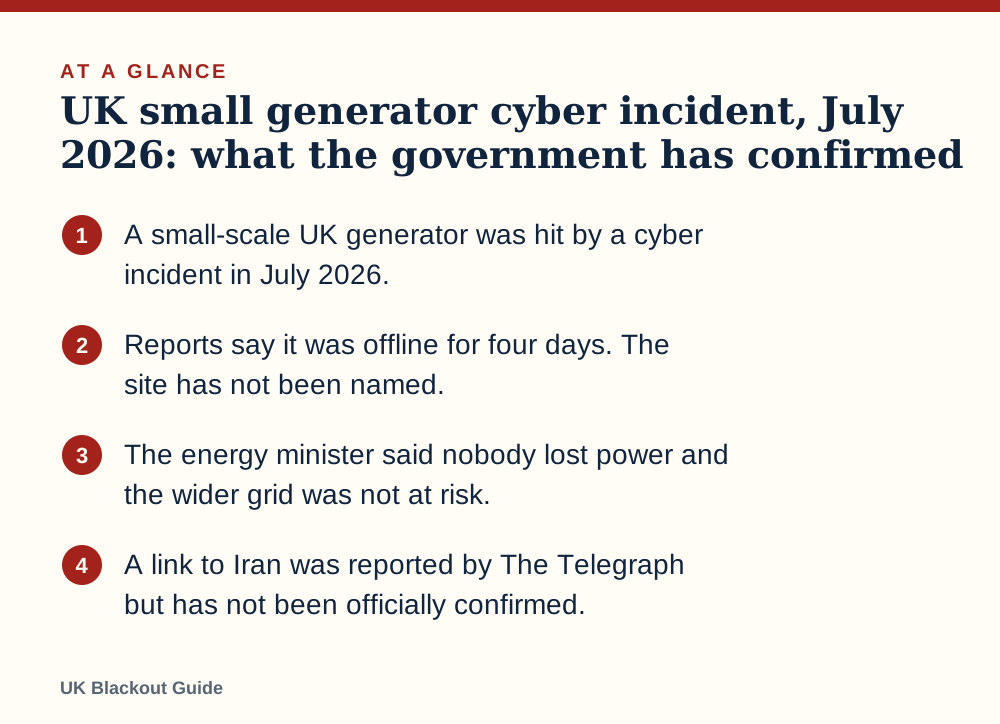
- A small-scale UK generator was hit by a cyber incident in July 2026.
- Reports say it was offline for four days. The site has not been named.
- The energy minister said nobody lost power and the wider grid was not at risk.
- A link to Iran was reported by The Telegraph but has not been officially confirmed.
What happened
In July 2026 a cyber incident took a small electricity generator in the UK out of service. The story became public on about 22 August 2026, when The Telegraph reported it, citing unnamed sources. The government then confirmed that an incident had taken place.
Energy minister Michael Shanks described the site as a "small-scale energy generator". In comments reported by Envirotec, he said it was "tiny" compared with what most people would think of as a power station, and added: "To be clear: there was no threat to the wider grid and nobody lost power."
When it happened and how long it lasted
The generator was offline for four days in July, according to Help Net Security and Cybersecurity Dive, both following The Telegraph's account. The exact dates have not been published.
There was roughly a month between the incident and the first press report. One security consultant quoted by Help Net Security said a four-day recovery could be seen as quick, depending on the scale of the attack.
What was affected and who it touched
One generating site was affected. Its name, location and owner have not been disclosed. The sources we read do not confirm its size or fuel type, so we are not giving one.
A government spokesperson, quoted by Cybersecurity Dive, said that at no point was there a risk to the wider energy system. Great Britain's electricity system draws on a very large number of generators, and a small one dropping out is the kind of event the system is run to absorb. Homes and businesses were not disconnected. In a comparable case abroad, the ransomware attack on Romania's Oltenia Energy Complex in December 2025 hit office systems, and the company said the national energy system was not endangered.
What is known about the cause and who was responsible
The cause is not publicly known in any detail. The Telegraph reported that the attack was linked to hackers connected to Iran. The UK government and the National Cyber Security Centre (NCSC) have not formally attributed it to Iran or to any named group, and Mr Shanks's statement names nobody. Formal attribution, when it comes, is announced publicly: on 13 July 2026 the UK and EU attributed the December 2025 attack on Polish energy sites to Russia's FSB.
Cybersecurity Dive reported that a group calling itself APT Iran denied, in a Telegram post seen by researchers at Check Point, that Iran had been involved in targeting the UK. Officials have not said how the attackers got in or whether the plant's control equipment was tampered with directly. All of that should be treated as unknown.
What the organisation and officials did
The incident was reported to the NCSC. Mr Shanks said that afterwards "we briefed energy CEOs and shared further advice with companies" on staying secure, and that the government works with industry, regulators and the NCSC through the Energy Resilience and Security Taskforce, which he chairs. The NCSC's Annual Review, published on 3 November 2026, said the agency received 1,831 reports of cyber attacks in the year to 31 August 2026.
There is a policy backdrop. The government's energy sector cyber security strategy, published in May 2026, already commits to reviewing which operators fall under the cyber regulations, and Envirotec reports that the energy department and Ofgem plan baseline cyber requirements for all Ofgem licensees.
What this does and does not tell us about power cuts
This incident did not cause a power cut. The minister responsible said so directly: nobody lost power, and the wider grid was not at risk. It is an example of one small site being taken out of service, not of the electricity system failing.
No official body has said that a cyber attack on the UK grid is expected. The National Risk Register describes a national power outage as low likelihood but very high impact, and the Be Ready campaign's request that households can manage for three days is general preparedness, not a forecast. Our explainer on whether a cyber attack could cause a UK blackout goes through how the system is built and who looks after it.
If you want a practical step, the short one is to read the Be Ready campaign's list of things to keep at home and to know what to do in the first hour of an ordinary power cut. Local faults from weather are far more common than anything described here.
Common questions
Which power station was affected?
It has not been named. The government has described it only as a small-scale energy generator.
Did anyone lose electricity because of the July 2026 incident?
No. Energy minister Michael Shanks said there was no risk to the wider grid and nobody lost power.
Has the UK blamed Iran for the generator incident?
No. A link to Iran was reported by The Telegraph, but neither the government nor the NCSC has formally attributed the incident to anyone.
- Help Net Security: Suspected Iran-linked attack knocked UK power plant offline for days
- Cybersecurity Dive: report on the cyber attack that disabled a small UK power facility, 24 August 2026
- Envirotec: Iran-linked cyber attack reportedly shuts UK energy generator for four days
Reviewed against these sources on 18 November 2026. If official advice has changed since, follow the official advice.
General information only. This page is not professional, safety, medical, legal or financial advice, and it is not official guidance. No national blackout has been forecast or announced, and nothing here suggests one is expected. We are independent and have no connection to the government or any energy company. Always check the official sources linked on this page. Full disclaimer
Keep reading
 News
Oltenia Energy Complex ransomware attack, December 2025: what happened in Romania
Romania's largest coal power producer was hit by ransomware on 26 December 2025. What was affected, who was named, and why the national grid kept running.
Read: Oltenia Energy Complex ransomware attack, News
Poland energy sector cyber attack, December 2025: what happened and who was blamed
On 29 December 2025 hackers hit over 30 Polish wind and solar farms and a heat and power plant. What happened, and who the UK and EU later blamed.
Read: Poland energy sector cyber attack, December News
NCSC Annual Review 2026: what the cyber agency said about AI, ransomware and critical infrastructure
What the National Cyber Security Centre's Annual Review of 3 November 2026 said about AI, ransomware and critical infrastructure, and what it did not say.
Read: NCSC Annual Review 2026: what the cyber News
Energy Sector Cyber Security Strategy, May 2026: what the government has committed to
The UK's Energy Sector Cyber Security Strategy was published on 28 May 2026. What it commits energy companies and regulators to do by 2030, in plain English.
Read: Energy Sector Cyber Security Strategy, May