On this page
In the early hours of 2 November 2026, hackers took control of refrigeration controllers at supermarkets in several European countries and switched units to defrost, spoiling stock. A few UK meat suppliers and one produce wholesaler were caught up but reported no lost food. Nobody has been identified as responsible. It was not a power cut.
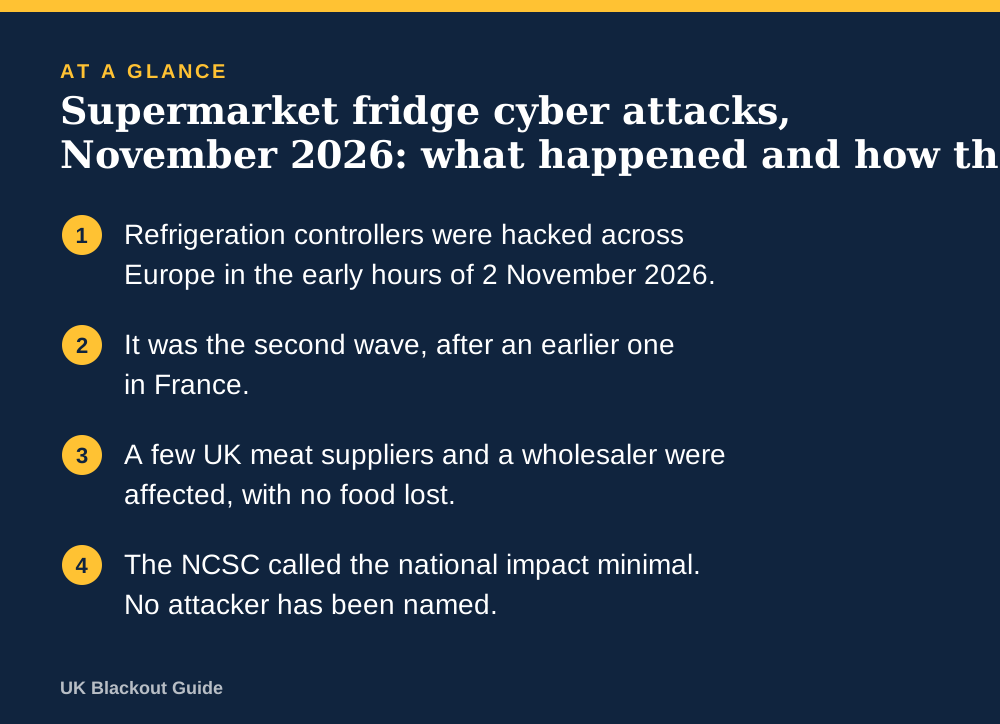
- Refrigeration controllers were hacked across Europe in the early hours of 2 November 2026.
- It was the second wave, after an earlier one in France.
- A few UK meat suppliers and a wholesaler were affected, with no food lost.
- The NCSC called the national impact minimal. No attacker has been named.
What happened
In the early hours of Monday 2 November 2026, refrigeration control systems at supermarkets and grocery shops across Europe were accessed over the internet and switched into defrost mode. Stock spoiled as cabinets warmed up. The Record, a specialist cyber security news site, reported that this was the second wave in recent weeks, after an earlier one that hit shops in France.
British businesses were caught up too, though on a small scale. The Press Association, in a report carried by LBC, said no major UK supermarket chain had been directly affected. UK food retail had been hit in a different way in 2025, when the cyber attack on the Co-op left some shops with empty or half-stocked shelves.
When it happened and how long it lasted
The attack happened overnight. The UK firms that noticed it acted within hours: one wholesaler told The Record he unplugged a fridge from the internet after seeing it had been set to defrost.
There is no single recovery time to report. The sources we read do not say how long the affected European shops took to restock, and Richard Horne, chief executive of the National Cyber Security Centre (NCSC), said on 3 November that the full impact in the UK was not yet known.
What was affected and who it touched
Outlets differ on how many countries were hit, so we are not giving a figure. Total food losses across Europe have not been published in the reports we read. For a sense of what a retail cyber attack can cost, Marks & Spencer put the 2025 attack on its own systems at about £300 million in lost operating profit.
In the UK, the Association of Independent Meat Suppliers (AIMS) said a few of its roughly 300 members were affected. The Record puts the number at three. Their fridges heated up overnight, but the units were empty at the time and no meat was lost. AIMS described its members as collateral, hit because they used the same software as the European shops. Langridge Organic, a fruit and vegetable wholesaler, was also attacked and reported no spoiled stock. Shared software had the same effect in the Collins Aerospace check-in attack of September 2025, when one supplier's product failed at Heathrow, Brussels, Berlin and Dublin together.
What is known about the cause and who was responsible
Nobody has claimed responsibility and British authorities have not attributed the attacks. Asked who was behind them, Mr Horne said: "It's too early for us to say at the moment and give a definitive answer." A Belgian cyber security agency spokesperson told The Record it may never be possible to identify those responsible.
How it was done is clearer. The Record reports that the attackers exploited vulnerable Copeland XWEB supervisory controllers. Older firmware had flaws that let someone take control without a password. An update had been available since August, but the affected businesses had not installed it. Copeland confirmed that certain XWEB products were affected and re-issued its patching guidance. Of the earlier French wave, Mr Horne said the equipment was outdated, connected directly to the internet and still using default passwords.
What the organisation and officials did
The NCSC said its staff worked overnight to contact organisations with exposed systems. Paul Chichester, its director of operations, said the national impact was "minimal". Mr Horne said the NCSC had alerted "handfuls" of UK organisations and knew of "a couple of impacts".
The British Retail Consortium said retailers were working with the NCSC to secure their fridges and freezers. Retailers were urged to monitor their systems, keep software up to date and have plans to move food if needed. AIMS has asked for the food sector to have a stronger place in the UK's list of critical infrastructure. The attacks came the day before the NCSC published its Annual Review for 2026.
What this does and does not tell us about power cuts
This incident did not cause a power cut in the UK or anywhere else, according to the reports we read. The fridges had electricity throughout. Their control settings were changed remotely. No official body has said that a cyber attack on the UK electricity grid is expected, and nothing said about this incident changes that.
What it does show is narrower: equipment that is connected to the internet and left unpatched can be interfered with. That is a matter for the businesses that run it. Our explainer on cyber attacks and the power grid describes how the electricity system is run and protected in general terms.
For a household, the sensible response is modest. The Be Ready campaign already suggests keeping three days of food that needs no fridge or cooking, as general preparedness. Our guide to putting together a three-day food supply shows how to do it from a normal weekly shop.
Common questions
Were UK supermarkets hit by the fridge attacks?
The Press Association reported that no major UK supermarket chain was directly affected. A few meat suppliers and one produce wholesaler were, and they reported no lost food.
Who carried out the fridge attacks?
It is unknown. No group has claimed responsibility and the NCSC said on 3 November 2026 that it was too early to say.
Did the fridges lose power?
No. According to The Record, the attackers changed settings on internet-connected refrigeration controllers. The electricity supply was not affected.
- The Record: British businesses caught in Europe-wide supermarket fridge attacks
- Press Association (via LBC): UK meat processing firms hit amid fridge and freezer cyber attacks
- Associated Press (via ClickOrlando): UK cyber chief says the UK will face AI cyberattacks on critical infrastructure by 2028
Reviewed against these sources on 18 November 2026. If official advice has changed since, follow the official advice.
General information only. This page is not professional, safety, medical, legal or financial advice, and it is not official guidance. No national blackout has been forecast or announced, and nothing here suggests one is expected. We are independent and have no connection to the government or any energy company. Always check the official sources linked on this page. Full disclaimer
Keep reading
 News
Co-op cyber attack, 2025: empty shelves and 6.5 million members' data
The Co-op was hit by a cyber attack in April 2025. Shelves ran low and the data of all 6.5 million members was copied. What happened and what is known.
Read: Co-op cyber attack, 2025: empty shelves and News
Marks & Spencer cyber attack, 2025: the 46 days without online orders
Marks & Spencer disclosed a cyber incident on 22 April 2025 and stopped online orders for 46 days. What was disrupted, what it cost and who was arrested.
Read: Marks & Spencer cyber attack, 2025: the 46 News
Heathrow check-in cyber attack, September 2025: the Collins Aerospace ransomware incident
Ransomware hit Collins Aerospace check-in software on 19 September 2025, disrupting Heathrow and other European airports. What happened and what is known.
Read: Heathrow check-in cyber attack, September News
NCSC Annual Review 2026: what the cyber agency said about AI, ransomware and critical infrastructure
What the National Cyber Security Centre's Annual Review of 3 November 2026 said about AI, ransomware and critical infrastructure, and what it did not say.
Read: NCSC Annual Review 2026: what the cyber