On this page
On 24 November 2025 a cyber attack hit the shared IT systems of Kensington and Chelsea, Westminster and Hammersmith & Fulham councils. Kensington and Chelsea says some data was copied and removed. Its council tax and benefits systems were unavailable until early June 2026, more than six months later. Nobody has been publicly identified as responsible.
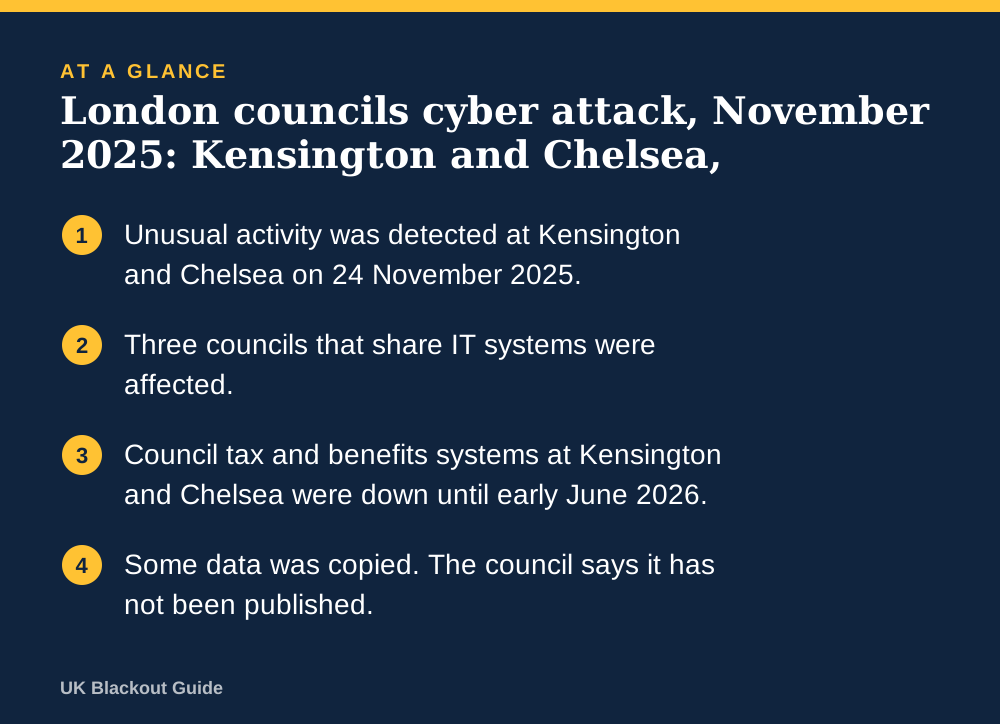
- Unusual activity was detected at Kensington and Chelsea on 24 November 2025.
- Three councils that share IT systems were affected.
- Council tax and benefits systems at Kensington and Chelsea were down until early June 2026.
- Some data was copied. The council says it has not been published.
What happened
On the morning of 24 November 2025 the Royal Borough of Kensington and Chelsea detected unusual activity on its network and began isolating systems. The council shares IT systems and services with Westminster City Council and Hammersmith & Fulham Council, so all three were affected.
Kensington and Chelsea has said the attack was criminal and that it has evidence some data was copied and removed. Its data was not encrypted or locked by the attacker, and the council still has access to its own records.
When it happened and how long it lasted
The attack was found on 24 November 2025. Recovery has been measured in months. Two months on, The Register reported that Hammersmith & Fulham had online and telephone payments working again on 22 January 2026, while Westminster's direct debits were not due to resume until after January at the earliest.
At Kensington and Chelsea, the council's own information page says its revenues and benefits systems were unavailable from November 2025 to early June 2026. Payments have restarted, but as of the page's update on 3 July 2026 the council was still working through a large backlog of correspondence and described itself as having moved from emergency response to recovery. The British Library, hit by ransomware in October 2023, has had a slower recovery still, with some digital services yet to return.
What was affected and who it touched
Residents felt it mainly through money and paperwork. Kensington and Chelsea could not run council tax and business rates normally, 2026/27 council tax bills were delayed, and disabled badge applications and information requests were held up. In January 2026 The Register reported that Westminster residents could not order birth, death or marriage certificates, and that school applications, library cards and free school meal applications were unavailable.
Not everything stopped. Kensington and Chelsea says bin collections, street cleaning and parking permits continued as normal. The council also says it believes the attack affected only its own systems, not residents' banks or utilities.
On data, the full extent of personal information involved was still being assessed. The council says its current understanding is that the copied data has not been published, and that it will contact people directly if sensitive data about them is confirmed as taken. Another public body, the Legal Aid Agency, found in May 2025 that the attack on its online services had taken a large amount of applicants' personal data.
What is known about the cause and who was responsible
Nobody has been publicly identified. Kensington and Chelsea says it has not attributed the attack to anyone while investigations continue, and the sources we read do not describe how the attackers got in.
Hammersmith & Fulham has said there was "no evidence" its own systems were compromised and that it was affected through shared legacy systems linked to a neighbouring council's network. The Register describes Westminster as the worst disrupted of the three. The shared arrangement is the common factor in all the accounts. A shared system was also the target in the C2k attack of April 2026, which cut off the network used by almost all schools in Northern Ireland for about two weeks.
What the organisation and officials did
Kensington and Chelsea set up an emergency response with its own IT staff and the security firm NCC Group. It is working with the Metropolitan Police, the National Cyber Security Centre and the Information Commissioner's Office, which it notified of the data breach. It has said it will review how the incident happened once recovery is complete.
Its advice to residents is to be alert to unexpected calls, emails or texts, to use strong and unique passwords with multi-factor authentication, to report suspicious texts to 7726, and to report identity theft to the police.
What this does and does not tell us about power cuts
This incident did not cause a power cut. The councils' offices had electricity, and essential street services carried on. It was an attack on council computer systems. No official body has said a cyber attack on the UK grid is expected.
What it does show is how long an organisation can take to recover its IT, and how that reaches residents as late bills and slow paperwork. The government's household guidance is separate and unchanged: our Be Ready explainer sets out what it asks for.
One practical point follows. Keep your own copies of bills, reference numbers and identity documents so you are not relying on a council or company portal, as our guide to important documents to copy describes.
Common questions
Which London councils were affected?
Kensington and Chelsea, Westminster and Hammersmith & Fulham, which share IT systems and services.
Was residents' data stolen in the London councils attack?
Kensington and Chelsea says some data was copied and removed and is being assessed. It says its understanding is that the data has not been published.
Were bin collections affected?
Kensington and Chelsea says bin collections and street cleaning continued as normal. The disruption was to digital services such as council tax.
- Royal Borough of Kensington and Chelsea: Cyber security attack FAQs
- The Register: London boroughs limping back online months after cyberattack
Reviewed against these sources on 18 November 2026. If official advice has changed since, follow the official advice.
General information only. This page is not professional, safety, medical, legal or financial advice, and it is not official guidance. No national blackout has been forecast or announced, and nothing here suggests one is expected. We are independent and have no connection to the government or any energy company. Always check the official sources linked on this page. Full disclaimer
Keep reading
 News
British Library cyber attack, 2023: what happened and why recovery has taken years
The British Library was hit by ransomware in October 2023 and is still rebuilding. What was lost, what came back and when, and what its own review found.
Read: British Library cyber attack, 2023: what News
Legal Aid Agency data theft: what happened and what was taken
The Legal Aid Agency found a cyber attack on 23 April 2025. What data was taken, how far back it goes, and what applicants should do.
Read: Legal Aid Agency data theft: what happened News
C2k cyber attack, April 2026: what happened to Northern Ireland's school network
The C2k network used by almost all Northern Ireland schools was hit by a cyber attack in April 2026. What was affected, how long it lasted, and the arrest.
Read: C2k cyber attack, April 2026: what happened News
NCSC Annual Review 2026: what the cyber agency said about AI, ransomware and critical infrastructure
What the National Cyber Security Centre's Annual Review of 3 November 2026 said about AI, ransomware and critical infrastructure, and what it did not say.
Read: NCSC Annual Review 2026: what the cyber