On this page
The Legal Aid Agency became aware of a cyber attack on its online services on 23 April 2025. On 16 May 2025 it found the attackers had taken a large amount of legal aid applicants' personal data, and took the service offline. Most records date from 2007 to May 2025. An October 2026 update said about 250,000 are older, the earliest from 1978.
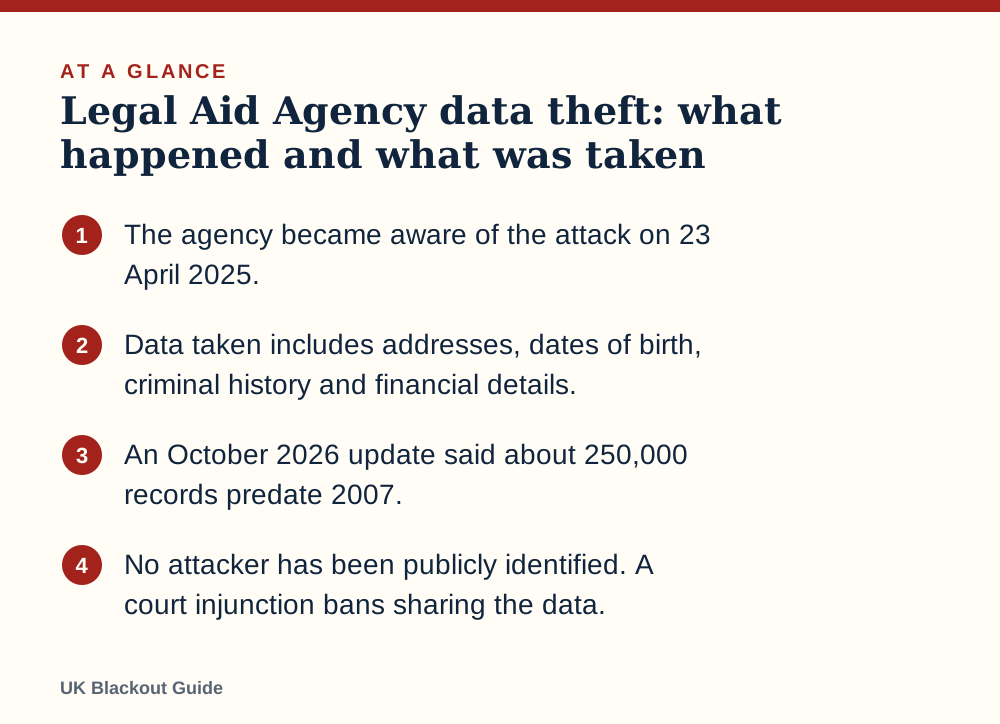
- The agency became aware of the attack on 23 April 2025.
- Data taken includes addresses, dates of birth, criminal history and financial details.
- An October 2026 update said about 250,000 records predate 2007.
- No attacker has been publicly identified. A court injunction bans sharing the data.
What happened
The Legal Aid Agency (LAA) is the part of the Ministry of Justice that pays for legal aid in England and Wales. On 23 April 2025 it became aware of a cyber attack on its online digital services, the systems that legal aid providers use to log their work and get paid. That was the day after Marks & Spencer disclosed the cyber incident that stopped its online orders for 46 days.
At first the agency believed the damage was limited to providers' details. On 16 May 2025 it found the attack was more extensive: the group behind it had accessed a large amount of information about people who had applied for legal aid. The agency took the digital service offline the same day and published a notice on GOV.UK on 19 May 2025.
When it happened and how long it lasted
The key dates are spread over eighteen months. The attack came to light on 23 April 2025, the wider theft on 16 May 2025, and the public notice on 19 May. On 31 July 2025 the agency extended the affected period back from 2010 to 2007 and said partners of some applicants were included.
In October 2026, BleepingComputer reported a further update. The agency said most of the data relates to applications, claims or payments between January 2007 and 16 May 2025, but that "approximately 250,000 records predate 2007". Most of those are from the 1990s and 2000s, and the earliest verified record dates from 1978. The sources we read do not give a date on which the online service was fully restored. Establishing what was taken has been slow elsewhere too: after the Synnovis attack of June 2024, the forensic review took 18 months.
What was affected and who it touched
The people affected are legal aid applicants, in some cases their partners, and the law firms and other providers that do legal aid work. According to the GOV.UK notice, the data may include contact details and addresses, dates of birth, national ID numbers, criminal history, employment status and financial data such as contribution amounts, debts and payments.
The agency has said that the existence of older records does not mean everyone who had dealings with legal aid before 2007 was affected. A Ministry of Justice spokesperson, quoted by BleepingComputer, said: "There is currently no evidence that any personal data believed to have been exfiltrated has been published." In a separate case that summer, the Co-op confirmed on 16 July 2025 that the attack on its systems had copied data on all 6.5 million members.
What is known about the cause and who was responsible
Who carried out the attack is not publicly known. The GOV.UK notice refers only to "the group" behind it, and the reports we read do not link it to any named organisation. How the attackers got in has not been published either. The same is true of the attack on three London councils in November 2025, where data was also copied and nobody has been publicly identified.
Because the information is so sensitive, the fact of the theft matters more to those affected than the identity of the thief. Details like these can be used to make a scam call or message sound convincing.
What the organisation and officials did
The agency worked with the National Crime Agency and the National Cyber Security Centre and informed the Information Commissioner. On 4 June 2025 it added to its notice that a court injunction prohibits sharing the data, and that anyone who does so could be sent to prison. The Ministry of Justice says it is investing more than £200 million in digital modernisation and cyber security.
Its advice to applicants is to watch for suspicious messages or calls, change any passwords that may have been exposed, and independently check the identity of anyone who contacts you before giving information.
What this does and does not tell us about power cuts
This incident did not cause a power cut and has no connection to the electricity system. It was a theft of personal data from a government agency. No official body has said a cyber attack on the UK grid is expected.
The practical lesson is about your own records, not the lights. If an organisation that holds your details is breached, you want to be able to prove who you are and spot a fraudster quickly. Keeping paper copies of key papers helps with the first, and our guide to the documents worth copying and storing safely lists them.
For what official bodies have actually said about outages, the place to start is what the Be Ready campaign asks households to do.
Common questions
Who is affected by the Legal Aid Agency breach?
Mainly people who applied for legal aid through the digital service between 2007 and 16 May 2025, some of their partners, and legal aid providers. About 250,000 records are older.
Has the stolen legal aid data been published?
A Ministry of Justice spokesperson said in 2026 there was no evidence that the data had been published. A court injunction bans sharing it.
What should I do if I applied for legal aid?
The agency advises being alert to suspicious calls and messages, changing exposed passwords and verifying anyone who contacts you before sharing information.
- GOV.UK, Legal Aid Agency and Ministry of Justice: Legal Aid Agency data breach
- BleepingComputer: UK Legal Aid Agency hackers stole records dating back to 1978
Reviewed against these sources on 18 November 2026. If official advice has changed since, follow the official advice.
General information only. This page is not professional, safety, medical, legal or financial advice, and it is not official guidance. No national blackout has been forecast or announced, and nothing here suggests one is expected. We are independent and have no connection to the government or any energy company. Always check the official sources linked on this page. Full disclaimer
Keep reading
 News
Marks & Spencer cyber attack, 2025: the 46 days without online orders
Marks & Spencer disclosed a cyber incident on 22 April 2025 and stopped online orders for 46 days. What was disrupted, what it cost and who was arrested.
Read: Marks & Spencer cyber attack, 2025: the 46 News
Synnovis cyber attack, 2024: how a ransomware attack disrupted London blood tests
Ransomware hit NHS pathology provider Synnovis on 3 June 2024, delaying over 11,000 appointments in south-east London. What happened and how long it lasted.
Read: Synnovis cyber attack, 2024: how a ransomware News
Co-op cyber attack, 2025: empty shelves and 6.5 million members' data
The Co-op was hit by a cyber attack in April 2025. Shelves ran low and the data of all 6.5 million members was copied. What happened and what is known.
Read: Co-op cyber attack, 2025: empty shelves and News
London councils cyber attack, November 2025: Kensington and Chelsea, Westminster and Hammersmith & Fulham
Three London councils sharing IT systems were hit by a cyber attack on 24 November 2025. What stopped working, what data was copied and how long it lasted.
Read: London councils cyber attack, November 2025: