On this page
Synnovis, which runs blood and other pathology tests for NHS hospitals and GPs in south-east London, was hit by ransomware on 3 June 2024. NHS England says more than 11,000 outpatient and elective appointments were delayed and services were fully restored by December 2024. A group called Qilin claimed responsibility. It was not a power cut.
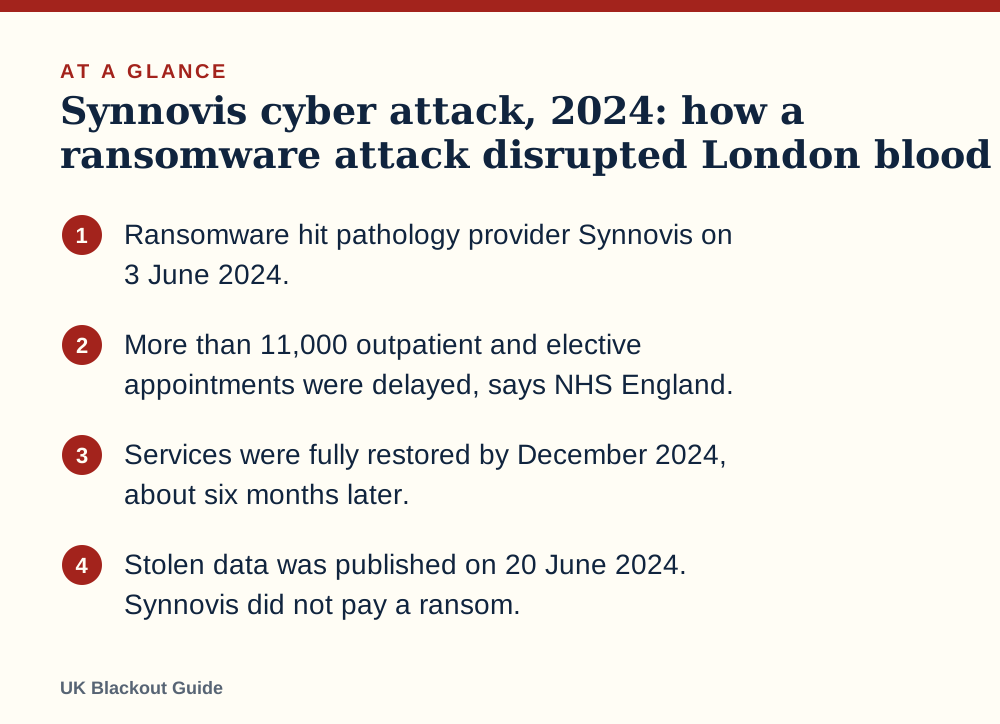
- Ransomware hit pathology provider Synnovis on 3 June 2024.
- More than 11,000 outpatient and elective appointments were delayed, says NHS England.
- Services were fully restored by December 2024, about six months later.
- Stolen data was published on 20 June 2024. Synnovis did not pay a ransom.
What happened
Synnovis provides pathology services, such as blood, urine and specimen testing, to the NHS, mainly in south-east London. It is co-owned by Guy's and St Thomas' NHS Foundation Trust, King's College Hospital NHS Foundation Trust and the company SYNLAB.
On 3 June 2024 it was hit by a ransomware attack. NHS England says this sharply reduced its capacity to process tests. Hospitals and GP surgeries that relied on it could not get results at the normal speed, and non-urgent work had to be postponed. Reliance on one supplier was also the story of the Collins Aerospace ransomware attack of September 2025, which disrupted check-in at Heathrow and three other European airports.
When it happened and how long it lasted
The attack began on 3 June 2024. On 20 June 2024 the attackers published the data they had stolen. NHS England says Synnovis's services were fully restored by December 2024, around six months after the attack. Before then, the CrowdStrike outage of 19 July 2024 separately disrupted the records system used by most GP practices.
The data side took far longer. Working out exactly what had been taken, and whose it was, took more than a year. The Register reported in November 2025 that Synnovis had finished an 18-month forensic review and would complete its notifications to the NHS organisations it serves by 21 November 2025. Those organisations then decide which patients need to be told. The Legal Aid Agency data theft has followed a similar pattern, with the agency still revising the range of affected records in October 2026.
What was affected and who it touched
The disruption to care was concentrated in south-east London. NHS England says delays affected more than 11,000 outpatient and elective procedure appointments at the partner trusts and in local boroughs.
In June 2025, King's College Hospital NHS Foundation Trust confirmed that the disruption had been a contributing factor in the death of a patient, according to The Register.
The stolen data may relate to people across England who used Synnovis services through hospitals, GP practices and clinics. Synnovis has not said how many people are affected. It says the files were taken "in haste from a working drive, in a random and untargeted manner", that its main laboratory database was not accessed, and that some files contained fragments such as names, NHS numbers or dates of birth.
What is known about the cause and who was responsible
A ransomware group called Qilin claimed responsibility, The Register reports. Synnovis did not pay, a decision it says was made jointly with the NHS trusts it serves. The British Library, attacked by the Rhysida ransomware group in October 2023, also saw some of its stolen data released online.
How the attackers first got in is unknown. Synnovis's own investigation could not determine the point of entry, according to The Register. The sources we read do not record any arrest or conviction in connection with the attack.
What the organisation and officials did
Synnovis brought in specialist help, rebuilt its IT infrastructure and has since replaced all of the affected systems. It worked with the National Cyber Security Centre, law enforcement and the NHS, reported the incident to the Information Commissioner's Office and obtained a legal injunction against using or further publishing the stolen data.
NHS England's advice to patients is that Synnovis will not contact them directly. If your data is involved and action is needed, you would hear from the NHS organisation that treated you. Anyone who claims to be calling from Synnovis about the breach should be treated with suspicion.
What this does and does not tell us about power cuts
This incident did not cause a power cut and was not connected to the electricity system. The hospitals had power. What they lost, for a time, was fast access to test results from one supplier. No official body has said a cyber attack on the UK grid is expected.
The Synnovis attack is a serious example of an IT failure affecting health care, and it is right to describe it plainly. It is not a guide to what would happen in a power cut, where the issues for households are different.
If you or someone you live with depends on medicines or powered medical equipment, the practical step is to register for extra help. The Priority Services Register is free, and the Be Ready campaign lists essential medication and a written list of what you take among the things to keep ready. Our guide to storing medicines if the fridge is off deals with one common worry, and the written list can sit with the other papers worth keeping in print. This is general information, so follow your own clinician's advice.
Common questions
How long did the Synnovis disruption last?
The attack was on 3 June 2024 and NHS England says services were fully restored by December 2024.
Will Synnovis contact me about my data?
No. NHS England says Synnovis will not contact patients directly. Affected NHS organisations decide who needs to be told.
Do we know how the Synnovis attackers got in?
No. According to The Register, the company's 18-month investigation could not determine how the attackers first gained entry.
- NHS England: Synnovis cyber incident
- The Register: NHS supplier ends probe into ransomware attack that contributed to patient death
Reviewed against these sources on 18 November 2026. If official advice has changed since, follow the official advice.
General information only. This page is not professional, safety, medical, legal or financial advice, and it is not official guidance. No national blackout has been forecast or announced, and nothing here suggests one is expected. We are independent and have no connection to the government or any energy company. Always check the official sources linked on this page. Full disclaimer
Keep reading
 News
Heathrow check-in cyber attack, September 2025: the Collins Aerospace ransomware incident
Ransomware hit Collins Aerospace check-in software on 19 September 2025, disrupting Heathrow and other European airports. What happened and what is known.
Read: Heathrow check-in cyber attack, September News
CrowdStrike outage, July 2024: what happened and why
The CrowdStrike outage of 19 July 2024 crashed about 8.5 million Windows computers worldwide, hitting GP surgeries and airlines. What happened and why.
Read: CrowdStrike outage, July 2024: what happened News
Legal Aid Agency data theft: what happened and what was taken
The Legal Aid Agency found a cyber attack on 23 April 2025. What data was taken, how far back it goes, and what applicants should do.
Read: Legal Aid Agency data theft: what happened News
British Library cyber attack, 2023: what happened and why recovery has taken years
The British Library was hit by ransomware in October 2023 and is still rebuilding. What was lost, what came back and when, and what its own review found.
Read: British Library cyber attack, 2023: what