On this page
The British Library was hit by a ransomware attack in late October 2023. About 600GB of data was stolen and many servers were destroyed. The online catalogue returned in January 2024, but the Library says a full rebuild of its technology is needed and some digital services remain unavailable. A group called Rhysida claimed responsibility.
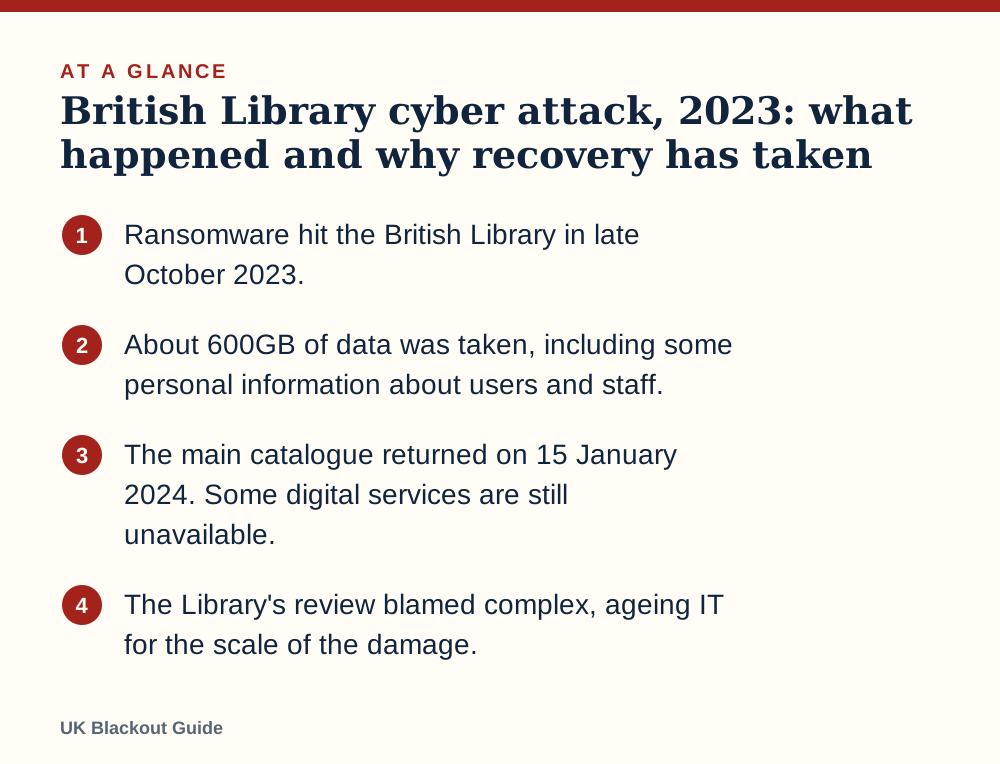
- Ransomware hit the British Library in late October 2023.
- About 600GB of data was taken, including some personal information about users and staff.
- The main catalogue returned on 15 January 2024. Some digital services are still unavailable.
- The Library's review blamed complex, ageing IT for the scale of the damage.
What happened
In late October 2023 the British Library, the UK's national library, suffered what it calls a significant cyber attack. Nearly all of its services were taken offline while the incident was contained, including the online catalogue, on-site wifi and payment terminals, according to The Register's account of the Library's own review. The buildings stayed open.
The attack did two kinds of damage. Data was stolen, and many of the Library's servers were destroyed, which is why recovery has meant rebuilding and not simply switching things back on.
When it happened and how long it lasted
The attack came in late October 2023. In November 2023 the attackers released some of the Library's data on the dark web. On 15 January 2024, about eleven weeks after the attack, the Library began restoring access to its main online catalogue, The Record reported.
Full recovery has taken years and is not finished. The Library's review, published on 8 March 2024, planned for six months of interim restoration followed by 18 months of major IT upgrades. The Library's cyber incident page still says that work to restore full functionality continues, and lists digital collections and electronic resources, reading room PCs and password changes as unavailable. A long recovery was seen again after the cyber attack on three London councils in November 2025, where Kensington and Chelsea's council tax and benefits systems were unavailable for more than six months.
What was affected and who it touched
Researchers were hit hardest. The Library's then chief executive, Sir Roly Keating, called the catalogue "one of the most important datasets for researchers around the world". Five months after the attack, The Register reported that electronic access to research journals was still offline and that material stored at the Library's Boston Spa site in Yorkshire was unavailable.
Authors were affected too, because the Library runs the system that pays them a small sum each time one of their books is borrowed from a public library. Sir Roly said those payments would be made by the statutory deadline at the end of March 2024.
The stolen data, about 600GB, included some personal information about users. The Record reported that the attackers tried to sell staff data. The Library says it may not be able to identify exactly what was compromised. Personal data was also the main loss in the Legal Aid Agency data theft of 2025, where attackers took a large amount of information about legal aid applicants.
What is known about the cause and who was responsible
The Rhysida ransomware group claimed responsibility in November 2023. The sources we read do not record any arrests. Another ransomware group, Qilin, claimed the attack on the NHS pathology supplier Synnovis in June 2024, which delayed more than 11,000 appointments in south-east London.
Exactly how the attackers got in is not certain. The Library's review says the destruction of servers erased many of the digital traces investigators would have used. It points to a "historically complex network topology" and a large number of ageing systems, which gave the attackers wider access than would be usual. Many of those older systems cannot be restored at all because they will not run on new infrastructure or are no longer supported by their makers.
What the organisation and officials did
The Library published a detailed review of the attack and its own shortcomings so that other organisations could learn from it. It is moving more of its systems to cloud services and has brought forward a large part of an IT budget that was meant to be spread over seven years. Outdated systems were still a theme when the NCSC published its Annual Review in November 2026, with its chief executive asking organisations to invest in replacing them.
Its advice to users is specific: if you used your British Library password on any other site, change it there, and follow National Cyber Security Centre guidance on data breaches.
What this does and does not tell us about power cuts
This incident did not cause a power cut and had nothing to do with the electricity system. The Library's reading rooms stayed open with the lights on. What it lost was its computer systems and some of its data. No official body has said a cyber attack on the UK grid is expected.
The length of the recovery is the notable part, and it should not be read across to electricity. The Library's review ties the slow rebuild to old, tangled IT that could not be restored. The electricity system has its own published restoration targets, which we explain in the 31 December 2026 grid restoration standard.
The household lesson is small and practical: do not keep the only copy of anything important in one place. Our guide to copying important documents sets out what to print, and the Be Ready campaign's three-day list includes printed copies of documents and a written list of contacts.
Common questions
Is the British Library back to normal?
Not fully. The Library's cyber incident page says work to restore full functionality continues and lists some digital services as unavailable.
Who attacked the British Library?
The Rhysida ransomware group claimed responsibility in November 2023. The sources we read do not record any arrests.
Was users' personal data taken from the British Library?
Yes. The Library says some personal user information was among the data released on the dark web in November 2023.
- British Library: Cyber incident
- The Register: British Library pushes the cloud button, says legacy IT estate cause of hefty rebuild
- The Record: report on the British Library restoring access after its ransomware attack, 15 January 2024
Reviewed against these sources on 18 November 2026. If official advice has changed since, follow the official advice.
General information only. This page is not professional, safety, medical, legal or financial advice, and it is not official guidance. No national blackout has been forecast or announced, and nothing here suggests one is expected. We are independent and have no connection to the government or any energy company. Always check the official sources linked on this page. Full disclaimer
Keep reading
 News
London councils cyber attack, November 2025: Kensington and Chelsea, Westminster and Hammersmith & Fulham
Three London councils sharing IT systems were hit by a cyber attack on 24 November 2025. What stopped working, what data was copied and how long it lasted.
Read: London councils cyber attack, November 2025: News
Legal Aid Agency data theft: what happened and what was taken
The Legal Aid Agency found a cyber attack on 23 April 2025. What data was taken, how far back it goes, and what applicants should do.
Read: Legal Aid Agency data theft: what happened News
Synnovis cyber attack, 2024: how a ransomware attack disrupted London blood tests
Ransomware hit NHS pathology provider Synnovis on 3 June 2024, delaying over 11,000 appointments in south-east London. What happened and how long it lasted.
Read: Synnovis cyber attack, 2024: how a ransomware News
NCSC Annual Review 2026: what the cyber agency said about AI, ransomware and critical infrastructure
What the National Cyber Security Centre's Annual Review of 3 November 2026 said about AI, ransomware and critical infrastructure, and what it did not say.
Read: NCSC Annual Review 2026: what the cyber