On this page
The National Cyber Security Centre published its Annual Review on 3 November 2026. It judged it highly likely that AI-powered malware will have been used in a ransomware attack on UK critical national infrastructure by 2028. The review is an assessment across many sectors. It did not report a power cut and did not forecast one.
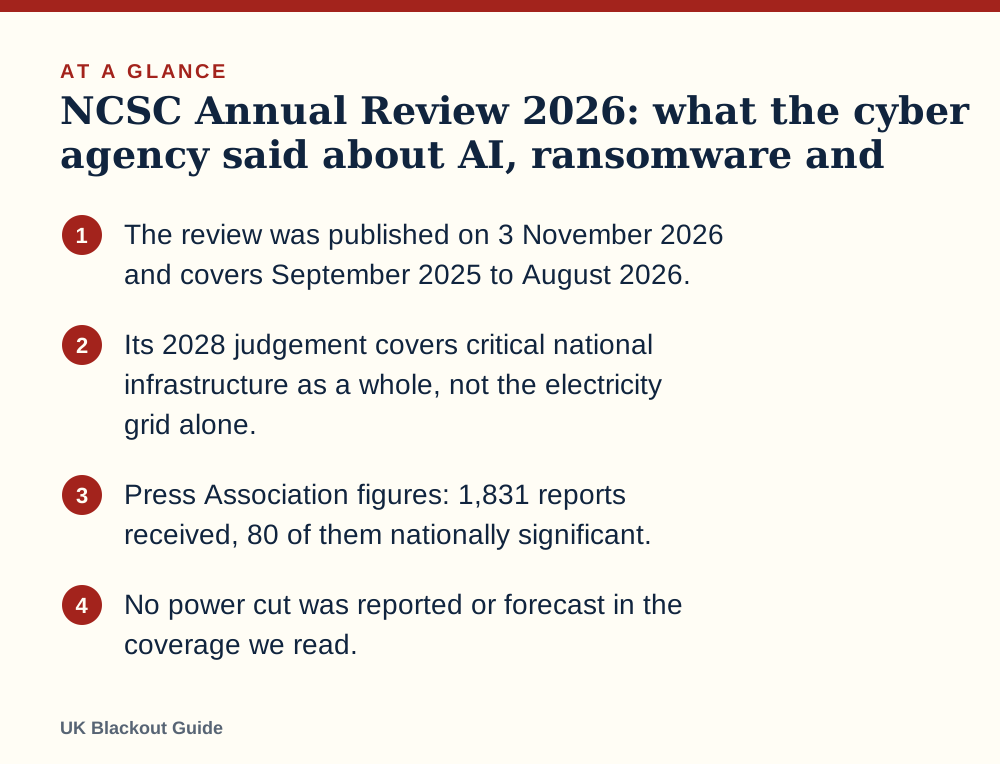
- The review was published on 3 November 2026 and covers September 2025 to August 2026.
- Its 2028 judgement covers critical national infrastructure as a whole, not the electricity grid alone.
- Press Association figures: 1,831 reports received, 80 of them nationally significant.
- No power cut was reported or forecast in the coverage we read.
What happened
On 3 November 2026 the National Cyber Security Centre (NCSC), which is part of GCHQ, published its Annual Review for 2026 under the title "The State of the Cyber Nation". Its chief executive, Richard Horne, launched it with a speech the same day.
The line that made the headlines was an assessment about artificial intelligence. As quoted by The Register, the review says it is "highly likely" that between now and 2028 AI-powered malware will have been used in a ransomware attack on UK critical national infrastructure. This is a judgement about the future, not a report of an incident that has taken place.
When it happened and how long it lasted
The review covers the NCSC's tenth year, from 1 September 2025 to 31 August 2026, according to the NCSC's own page for the document. The 2028 date is the horizon the agency chose for its assessment, roughly two years ahead.
Because this is a published assessment and not an attack, there was no outage and nothing to recover from. The figures in it describe the previous twelve months. Within that period, in July 2026, a cyber incident took a small UK generator offline for four days, and the energy minister said nobody lost power.
What was affected and who it touched
The Press Association, in a report carried by LBC, gave the review's headline numbers: the NCSC received 1,831 reports of cyber attacks in the year, 337 needed its support and 80 were classed as nationally significant. It also notified 8,500 organisations whose systems had been compromised. The period opened with the Jaguar Land Rover cyber attack, which halted the car maker's production for about five weeks from 1 September 2025.
Critical national infrastructure is a broad category. Mr Horne, as reported by the Associated Press, said technology now underpins the automation of physical processes including electricity switching, water sluice gates, dams, and heating and refrigeration controls. He pointed to the supermarket fridge attacks reported the day before as an example of old, internet-connected equipment being misused, and said that case was not an AI attack.
What is known about the cause and who was responsible
The review does not describe one attacker. The Associated Press reports that it calls Chinese cyber activity the "most sophisticated and sustained cyber challenge" facing the UK, describes Russian campaigns that stay below the level of armed conflict, and says Iran is also active against the UK. It refers to the December 2025 attack on Polish energy sites, which the UK and EU have attributed to Russia's FSB.
On AI, the same report says the review judges that states and criminals are "highly likely" to use it to increase the scale and efficiency of their operations, but that it is more likely to improve existing methods than to find wholly new weaknesses.
What the organisation and officials did
Mr Horne's main message was aimed at organisations, not households. He said that for decades "we have collectively got away with doing tech on the cheap" and asked businesses to invest in replacing outdated systems, according to The Register. The British Library's review of its 2023 ransomware attack had made a similar point about ageing systems that could not be restored.
The Register also lists funding announced alongside the review: £60 million for a "Cyber Shield" defence system, £70 million for a National Exposure and Real-Time Vulnerability Centre to map weaknesses across infrastructure, £40 million for a National Agentic Security Unit and £24 million for public sector defences. The NCSC's basic advice, as reported by the Associated Press, is to keep devices updated, limit administrator access and back up important files.
What this does and does not tell us about power cuts
The Annual Review did not report a UK power cut, and none of the coverage we read says it forecast one. Its 2028 judgement is about ransomware reaching critical national infrastructure in general, a category that takes in many sectors besides energy. No official body has said that a cyber attack on Great Britain's electricity grid is expected.
The official position on outages is unchanged. The National Risk Register describes a national power outage as low likelihood but very high impact, and the government's Be Ready campaign asks households to be able to manage for three days as general preparedness, not as a forecast. Our page on what the Risk Register says about a national outage sets that out.
If the headlines have left you wanting to do something practical, the calm steps are the same as before: read what the Be Ready campaign asks households to do, and follow the NCSC's basic advice to keep devices updated and back up important files.
Common questions
Did the NCSC say the UK power grid will be attacked?
No. Its assessment is that AI-powered malware is highly likely to be used in a ransomware attack on critical national infrastructure by 2028. That category covers many sectors, and the coverage we read does not say the grid is expected to be hit.
Is this the same as the Be Ready campaign?
No. Be Ready is a separate government campaign, launched on 22 October 2026, that asks households to be able to manage for three days. It is general preparedness and not a forecast.
Who is the Annual Review written for?
The NCSC says its intended audience is cyber security professionals and the public sector. Most of its recommendations are for organisations.
- The Register: Britain on notice: AI-powered ransomware attacks to arrive by 2028
- Associated Press (via ClickOrlando): UK cyber chief says the UK will face AI cyberattacks on critical infrastructure by 2028
- Press Association (via LBC): UK meat processing firms hit amid fridge and freezer cyber attacks
- National Cyber Security Centre: NCSC Annual Review 2026
Reviewed against these sources on 18 November 2026. If official advice has changed since, follow the official advice.
General information only. This page is not professional, safety, medical, legal or financial advice, and it is not official guidance. No national blackout has been forecast or announced, and nothing here suggests one is expected. We are independent and have no connection to the government or any energy company. Always check the official sources linked on this page. Full disclaimer
Keep reading
 News
UK small generator cyber incident, July 2026: what the government has confirmed
A small UK electricity generator was reportedly offline for four days in July 2026 after a cyber incident. What ministers confirmed, and what remains unknown.
Read: UK small generator cyber incident, July 2026: News
Jaguar Land Rover cyber attack, 2025: the five-week shutdown and what it cost
Jaguar Land Rover stopped production for five weeks from 1 September 2025 after a cyber attack. What happened, the £1.9bn estimate and the loan guarantee.
Read: Jaguar Land Rover cyber attack, 2025: the News
Supermarket fridge cyber attacks, November 2026: what happened and how the UK was affected
Hackers switched supermarket fridges and freezers to defrost across Europe on 2 November 2026. What happened, which UK firms were caught up and what is known.
Read: Supermarket fridge cyber attacks, November News
Poland energy sector cyber attack, December 2025: what happened and who was blamed
On 29 December 2025 hackers hit over 30 Polish wind and solar farms and a heat and power plant. What happened, and who the UK and EU later blamed.
Read: Poland energy sector cyber attack, December