On this page
Jaguar Land Rover halted production for about five weeks from 1 September 2025 after a cyber attack, restarting in stages from early October. The Cyber Monitoring Centre estimated the cost to the UK at about £1.9 billion, with around 5,000 organisations affected. The government backed a loan guarantee of up to £1.5 billion. It was not a power cut.
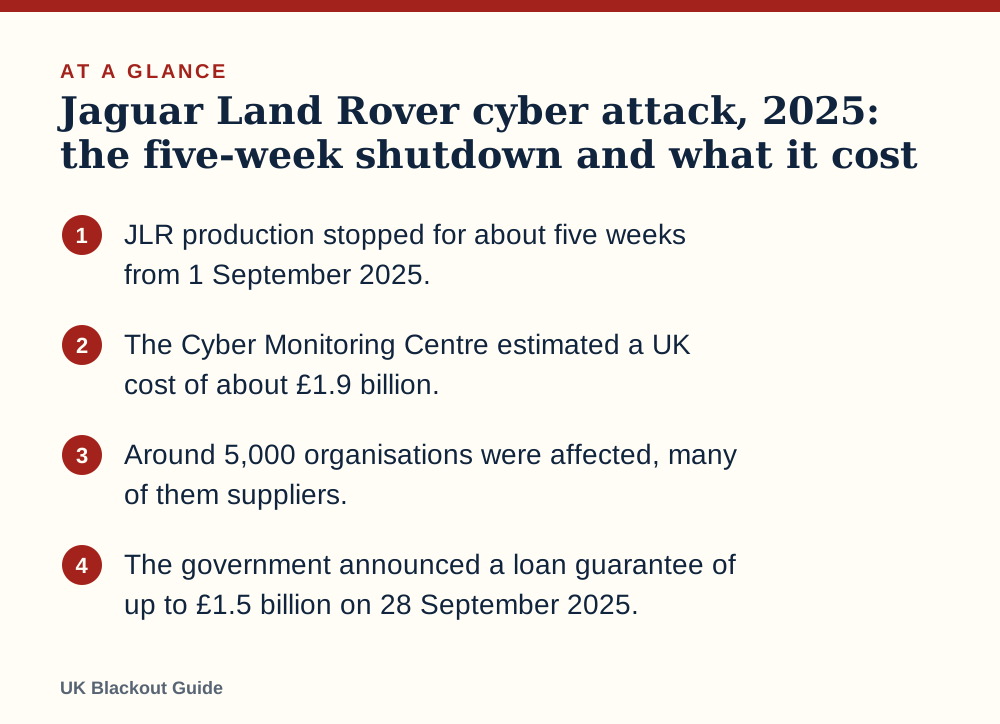
- JLR production stopped for about five weeks from 1 September 2025.
- The Cyber Monitoring Centre estimated a UK cost of about £1.9 billion.
- Around 5,000 organisations were affected, many of them suppliers.
- The government announced a loan guarantee of up to £1.5 billion on 28 September 2025.
What happened
Jaguar Land Rover (JLR), the car maker, shut down its systems after a cyber attack at the end of the summer of 2025. Production stopped at its factories and did not restart for about five weeks. It followed a spring of attacks on retailers, including the Marks & Spencer cyber attack, which stopped online clothing and home orders for 46 days.
Ciaran Martin, who chairs the Cyber Monitoring Centre and formerly led the National Cyber Security Centre, called it "by some distance, the single most financially damaging cyber event ever to hit the UK", in comments reported by City AM.
When it happened and how long it lasted
City AM reports that JLR stopped production for five weeks starting on 1 September 2025 and only partially restarted UK operations in early October. Cybersecurity Dive describes the disruption as running from late August to early October 2025. During the shutdown, on 19 September, a separate ransomware attack on airport check-in software disrupted Heathrow and three other European airports.
Recovery took longer than the shutdown. When the Cyber Monitoring Centre published its estimate on 22 October 2025, JLR was not expected to be back to normal production until January 2026. The British Library, attacked in October 2023, was still restoring services years later.
What was affected and who it touched
JLR employs 34,000 people directly in the UK, at sites including Solihull, Wolverhampton and Halewood, according to the government. Its UK supply chain, much of it made up of smaller firms, employs around 120,000 more.
That is where a lot of the harm fell. The Cyber Monitoring Centre, a non-profit body that assesses major cyber events, estimated the cost to the UK economy at around £1.9 billion and found that around 5,000 organisations were affected. Analysts expected more than half of the cost to fall on JLR itself through lost production, lower sales and recovery spending. The rest fell on suppliers and others who depended on the factories running.
What is known about the cause and who was responsible
JLR has not, in the sources we read, set out how the attackers got in or named who was responsible. We are not repeating unconfirmed claims of responsibility here. The cause should be treated as not publicly established.
What is clear from the reporting is the mechanism of the damage: with its IT systems switched off, a modern car plant cannot order parts, schedule work or ship vehicles, so production stops even though nothing physical is broken. The Co-op made a similar choice during the cyber attack on its systems in April 2025, shutting down some IT and running short of stock in some shops as a result.
What the organisation and officials did
On 28 September 2025 the government announced a loan guarantee expected to unlock up to £1.5 billion for JLR, to give certainty to its supply chain. A commercial bank provides the loan, backed by an Export Development Guarantee from UK Export Finance, to be repaid over five years. Ministers said they had been in daily contact with the company and with cyber experts.
Business and Trade Secretary Peter Kyle described the attack as an assault on "an iconic British brand" and on the wider car industry. JLR restarted its plants in stages from early October 2025.
What this does and does not tell us about power cuts
This incident did not cause a power cut. JLR's factories had electricity throughout. What stopped was the company's own computer systems. No official body has said a cyber attack on the UK grid is expected, and the JLR case is not evidence about the grid either way.
It is, though, a clear picture of how a business can be halted by an IT failure while the lights stay on. For households, similar knock-on effects are more likely to show up as a shop that cannot take cards or an app that will not load than as a dark house. Our page on whether card payments and cash machines keep working covers the practical side.
How the electricity system itself is run and protected is a separate subject, set out in our explainer on cyber attacks and the UK power grid.
Common questions
How long was JLR production stopped?
About five weeks, from 1 September 2025, with a staged restart from early October 2025 according to City AM.
Who was behind the JLR cyber attack?
JLR has not named anyone in the sources we read, and how the attackers got in has not been publicly established.
Did taxpayers pay for the JLR shutdown?
The government provided a guarantee on a commercial bank loan of up to £1.5 billion, not a direct payment. The loan is to be repaid over five years.
- City AM: £1.9bn price tag makes JLR Britain's most expensive cyber attack
- GOV.UK: Government backs Jaguar Land Rover with £1.5 billion loan guarantee
- Cybersecurity Dive: report on the cyber attack that disabled a small UK power facility, 24 August 2026
Reviewed against these sources on 18 November 2026. If official advice has changed since, follow the official advice.
General information only. This page is not professional, safety, medical, legal or financial advice, and it is not official guidance. No national blackout has been forecast or announced, and nothing here suggests one is expected. We are independent and have no connection to the government or any energy company. Always check the official sources linked on this page. Full disclaimer
Keep reading
 News
Marks & Spencer cyber attack, 2025: the 46 days without online orders
Marks & Spencer disclosed a cyber incident on 22 April 2025 and stopped online orders for 46 days. What was disrupted, what it cost and who was arrested.
Read: Marks & Spencer cyber attack, 2025: the 46 News
Heathrow check-in cyber attack, September 2025: the Collins Aerospace ransomware incident
Ransomware hit Collins Aerospace check-in software on 19 September 2025, disrupting Heathrow and other European airports. What happened and what is known.
Read: Heathrow check-in cyber attack, September News
British Library cyber attack, 2023: what happened and why recovery has taken years
The British Library was hit by ransomware in October 2023 and is still rebuilding. What was lost, what came back and when, and what its own review found.
Read: British Library cyber attack, 2023: what News
Co-op cyber attack, 2025: empty shelves and 6.5 million members' data
The Co-op was hit by a cyber attack in April 2025. Shelves ran low and the data of all 6.5 million members was copied. What happened and what is known.
Read: Co-op cyber attack, 2025: empty shelves and