On this page
On 19 September 2025 a ransomware attack on check-in software supplied by Collins Aerospace disrupted Heathrow, Brussels, Berlin and Dublin airports. Airlines checked passengers in by hand, with long queues and hundreds of delays and cancellations. The National Crime Agency arrested a man in West Sussex, who was bailed. Nobody has been publicly named.
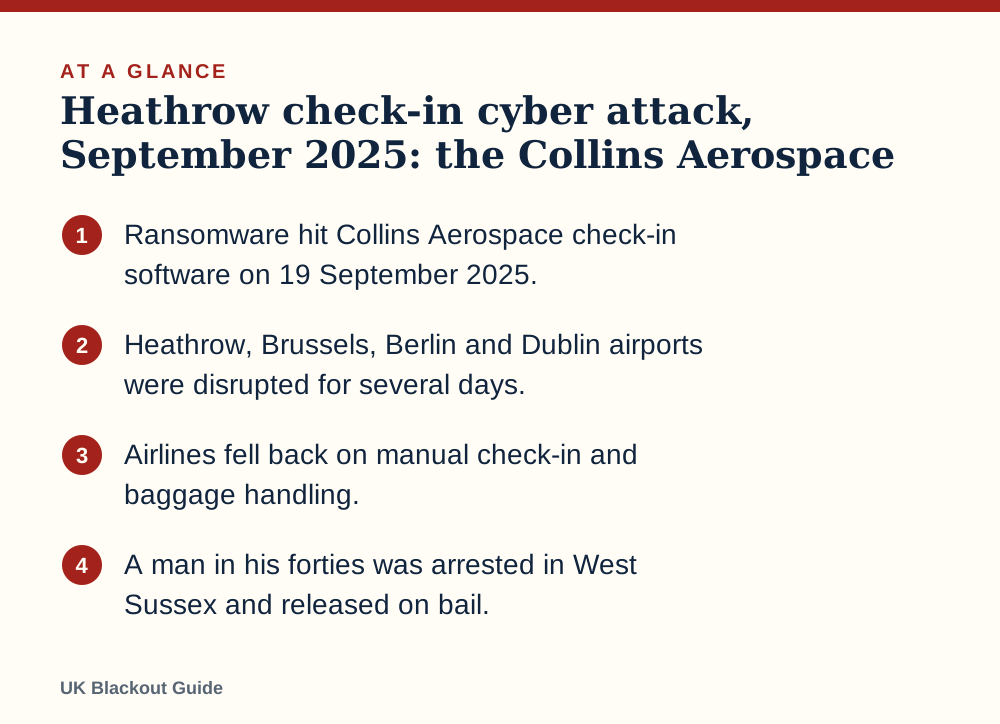
- Ransomware hit Collins Aerospace check-in software on 19 September 2025.
- Heathrow, Brussels, Berlin and Dublin airports were disrupted for several days.
- Airlines fell back on manual check-in and baggage handling.
- A man in his forties was arrested in West Sussex and released on bail.
What happened
On 19 September 2025 a ransomware attack hit passenger processing software supplied by Collins Aerospace, a subsidiary of the American company RTX. The software, part of a product family known as MUSE, lets different airlines share the same check-in desks and boarding gates at an airport.
When it failed, check-in and baggage systems stopped working at several European airports at once, including London Heathrow, Brussels, Berlin and Dublin. Airlines switched to checking passengers in manually. The Record reported long queues and hundreds of flight delays and cancellations. Airlines had also been caught up in the CrowdStrike outage of July 2024, which was caused by a faulty software update and not by an attack.
When it happened and how long it lasted
RTX told the US Securities and Exchange Commission that it became aware of the incident on 19 September 2025, a Friday. Disruption ran through the weekend and into the following week. It came while Jaguar Land Rover's factories were still shut by the cyber attack that halted its production from 1 September 2025.
By 24 September the picture varied by airport. The Record reported that Heathrow had most flights operating normally, Dublin had some airlines still using manual workarounds, Brussels reported limited disruption, and Berlin said its check-in and baggage systems had not yet been restored. Collins said on 22 September that it was in the "final stages" of restoring its systems. The sources we read do not give a final date on which every airport was back to normal.
What was affected and who it touched
Passengers were the people affected, through queues, delays and cancelled flights. The sources we read do not give a total number of flights or passengers.
The systems affected were for check-in, boarding and baggage drop. RTX said they run outside its main company network, on networks specific to each customer. None of the reports we read say that air traffic control or aircraft safety systems were involved. This was a problem on the ground, in the terminal. A single supplier was also the weak point in the Synnovis ransomware attack of June 2024, which slowed blood test results for hospitals and GPs in south-east London.
What is known about the cause and who was responsible
RTX confirmed that the incident was ransomware. No group has been officially named. ENISA, the EU's cyber security agency, said on 22 September that it had identified the type of ransomware but did not give details. An independent security researcher, Kevin Beaumont, said he believed it was a variant of a strain called HardBit, according to ITPro. That has not been officially confirmed.
There was early speculation about a hostile state. One industry figure quoted by ITPro said the arrest of a man in the UK might call that into question. Who was responsible, and how they got in, has not been publicly established.
What the organisation and officials did
On 24 September 2025 the National Crime Agency said it had arrested a man in his forties in West Sussex on suspicion of Computer Misuse Act offences. He was released on conditional bail. Paul Foster, head of the agency's National Cyber Crime Unit, said: "Although this arrest is a positive step, the investigation into this incident is in its early stages and remains ongoing." An arrest is not a finding of guilt, and the sources we read do not record a charge. The same agency had arrested four people in July 2025 in its investigation into the attacks on Marks & Spencer, the Co-op and Harrods.
RTX said it was investigating with internal and external experts, had notified law enforcement and was giving technical support to airlines and airports.
What this does and does not tell us about power cuts
This incident did not cause a power cut. The airports had electricity. One supplier's software stopped working, and because many airports had bought the same product, they were all affected together. No official body has said a cyber attack on the UK grid is expected.
The useful point for travellers is that manual methods worked. Airlines checked passengers in by hand, and at Heathrow most flights were operating normally within days. Having your own details on paper helps in that situation, which is the idea behind our guide to copying important documents before you need them.
Transport is also affected in a real power cut, but in different ways and for different reasons, which our page on whether trains and traffic lights work in a power cut sets out.
Common questions
Which airports were affected by the Collins Aerospace attack?
London Heathrow, Brussels, Berlin and Dublin were all reported as disrupted, because they used the same check-in software.
Was the airport cyber attack carried out by a foreign state?
That has not been established. No group has been officially named. The National Crime Agency arrested a man in West Sussex, who was bailed.
Did the airport attack affect flight safety?
None of the reports we read say so. The affected systems were for check-in, boarding and baggage.
- The Record: report on the UK arrest after the cyber attack that disrupted European airports, 24 September 2025
- ITPro: NCA confirms arrest after airport cyber disruption
Reviewed against these sources on 18 November 2026. If official advice has changed since, follow the official advice.
General information only. This page is not professional, safety, medical, legal or financial advice, and it is not official guidance. No national blackout has been forecast or announced, and nothing here suggests one is expected. We are independent and have no connection to the government or any energy company. Always check the official sources linked on this page. Full disclaimer
Keep reading
 News
CrowdStrike outage, July 2024: what happened and why
The CrowdStrike outage of 19 July 2024 crashed about 8.5 million Windows computers worldwide, hitting GP surgeries and airlines. What happened and why.
Read: CrowdStrike outage, July 2024: what happened News
Jaguar Land Rover cyber attack, 2025: the five-week shutdown and what it cost
Jaguar Land Rover stopped production for five weeks from 1 September 2025 after a cyber attack. What happened, the £1.9bn estimate and the loan guarantee.
Read: Jaguar Land Rover cyber attack, 2025: the News
Synnovis cyber attack, 2024: how a ransomware attack disrupted London blood tests
Ransomware hit NHS pathology provider Synnovis on 3 June 2024, delaying over 11,000 appointments in south-east London. What happened and how long it lasted.
Read: Synnovis cyber attack, 2024: how a ransomware News
Marks & Spencer cyber attack, 2025: the 46 days without online orders
Marks & Spencer disclosed a cyber incident on 22 April 2025 and stopped online orders for 46 days. What was disrupted, what it cost and who was arrested.
Read: Marks & Spencer cyber attack, 2025: the 46